
Change, Continuity, and Connectivity
North-Eastern Mediterranean at the turn of the Bronze Age and in the early Iron Age
edited by Lukasz Niesiolowski-Spano and Marek Wecowski

The end of the Bronze Age and beginning of the Iron Age was the period of a historical turning point for the relationship of the Aegean and the Levant. The two regions were closely related to each other and benefited mutually in this period. The transmission of the alphabet from the East to Greece and the appearance of Mycenaean-style pottery in the East illustrate the cultural borrowings in both directions. The volume presents updated studies on both regions and questions of bilateral relationships regarding archaeological, historical and linguistic aspects. These studies shed light on the pivotal periods of both regions: when Greek poleis were formed, with the culture related to it, and when the political and social situation in the Levant took its form, influencing the entire first millennium BCE. In the linguistic part, the volume includes papers showing possible linguistic relations and mutual borrowings in the triangle of Semitic, Greek and Anatolian languages. In the archaeological and historical parts, the studies deal both with case studies from Anatolia, Greece and Palestine and the synthetic issues regarding the ‘big’ questions. The book also presents the possible benefits of the usage of scientific methods in historical reconstruction – analysis of isotopes and ancient DNA samples. These new techniques offer a useful tool, expanding our way of exploring the past.
The end of the Bronze Age and beginning of the Iron Age was the period of a historical turning point for the relationship of the Aegean and the Levant. The two regions were closely related to each other and benefited mutually in this period. The transmission of the alphabet from the East to Greece and the appearance of Mycenaean-style pottery in the East illustrate the cultural borrowings in both directions. The volume presents updated studies on both regions and questions of bilateral relationships regarding archaeological, historical and linguistic aspects. These studies shed light on the pivotal periods of both regions: when Greek poleis were formed, with the culture related to it, and when the political and social situation in the Levant took its form, influencing the entire first millennium BCE. In the linguistic part, the volume includes papers showing possible linguistic relations and mutual borrowings in the triangle of Semitic, Greek and Anatolian languages. In the archaeological and historical parts, the studies deal both with case studies from Anatolia, Greece and Palestine and the synthetic issues regarding the ‘big’ questions. The book also presents the possible benefits of the usage of scientific methods in historical reconstruction – analysis of isotopes and ancient DNA samples. These new techniques offer a useful tool, expanding our way of exploring the past.
- Edited by Lukasz Niesiolowski-Spano
- Edited by Marek Wecowski
Other Titles in this Series
 Pharao und Priester – Sakrale Affirmation von Herrschaft durch Kultvollzug
Das Tagliche Kultbildritual im Neuen Reich und der Dritten Zwischenzeit
Volume 23
 Alexandrinische Mosaikglaseinlagen
Die Typologie, Systematik und Herstellung von Gesichterdarstellungen in der ptolemaischen Glaskunst
Volume 22


 Antike Wirtschaft und ihre kulturelle Pragung / The Cultural Shaping of the Ancient Economy
Volume 98
 Hercules in der Spatantike
Die Rolle des Heros im Spannungsfeld von Heidentum und Christentum
Volume 89


 Was ist ‚La Hoguette‘ – Kultur, Phänomen, Subkultur?
Archäologische Studien und portable, energiedispersive Röntgenfluoreszenzanalysen (p-ED-RFA an Keramik zu einer altbekannten Frage
Volume 183


 Historiographie, Ethnographie, Utopie
Gesammelte Schriften, Teil 4. Studien zur griechischen Historiographie
Volume 18.4

 Papyrus Ebers und die antike Heilkunde
Akten der Tagung vom 15.-16.3.2002 in der Albertina der Universitat Leipzig
Volume 7
 Grossmacht gegen lokale Machthaber
Die Herrschaftspraxis der Seleukiden an den Randern ihres Reiches
Volume 164


 Romische Graber augusteischer und tiberischer Zeit im Westen des Imperiums
Akten der Tagung vom 11. bis 14. November 2010 in Trier
Volume 63
 Antike Lebenswelten: Konstanz – Wandel – Wirkungskraft
Festschrift fur Ingomar Weiler zum 70. Geburtstag
Volume 25


 Ships of the Desert and Ships of the Sea
Palmyra in the World Trade of the First Three Centuries CE
Volume 101
 Livius, Dionysios, Augustus, Machiavelli
Ein diskursanalytischer Vergleich der romischen Fruhgeschichte bei Livius und Dionysios von Halikarnassos und die Rezeption ihrer livianischen Darstellung im Werk des Niccolo Machiavelli
Volume 88

 Interkulturalitat in der Alten Welt
Vorderasien, Hellas, Agypten und die vielfaltigen Ebenen des Kontakts
Volume 34

 Josef Wiesehofer. Iran – Zentralasien – Mittelmeer
Gesammelte Schriften Teil I: Studien zur Geschichte der Achaimeniden
Volume 159


Similar Books





 Caesar’s Visions and Impact on the Roman Empire
Revisiting the Archaeological and Historical Record of the 40s BC
Volume 2


 Connecting the Dots: Counting, Writing, and the Beginnings of Civilization
The Secret Lives of Clay Tokens: A Memoir
 Construction Processes in Historical Western Societies (5th c. BC – 10th c. AD)
Case Studies on Techniques, Models, and Costs
 Contesting Labeled Identities
The Sociology of Gentilics in Biblical and Northwest Semitic Literature

 Curating the Prehistoric Past
Studies on West Asian Archaeology and Beyond in Honour of Yoshihiro Nishiaki
 Drunk the Potion, No Whit Charmed
The Doctrine of Pure and Perfect Souls from Iamblichus to Damascius

 Epigraphic “Shades” from Hellenistic Thrace
Contextualizing Inscriptions in Greek from Thracian Tombs

 Epiphanies of the Divine in the Septuagint and the New Testament
Fifth International Symposium of the Corpus Judaeo-Hellenisticum Novi Testamenti (CJHNT), 14-17 May 2015, Nottingham


 Etruscan and Roman Hellenistic Anatomical ex votos
Reassessing Popular Religious Expressions in Central Italy
Volume 8


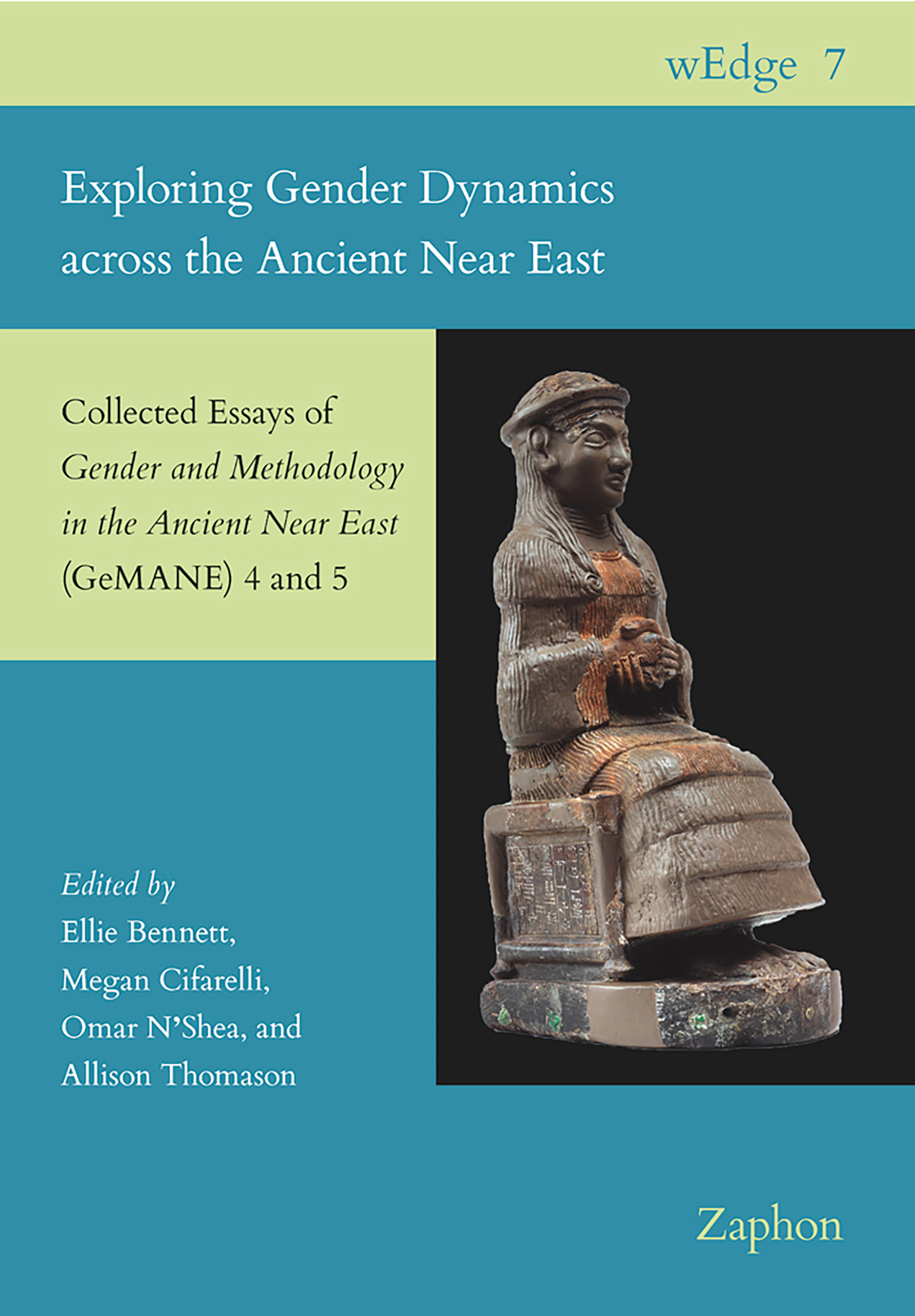 Exploring Gender Dynamics across the Ancient Near East
Collected Essays of Gender and Methodology in the Ancient Near East (GeMANE) 4 and 5
Volume 7


 Gold, Silver and Glass: Power Networks, Cultural Identities, Technology Transfers and Agency across the Old World (7th Century BC – 1st Century AD)
Proceedings of a Conference Held at the British Museum, 16–18 June 2023
 Ḫattušaš utnē išḫameški
Hittite and Other Ancient Near Eastern Studies Presented to Piotr Taracha on the Occasion of His 65th Birthday



 Invisible Labour in Antiquity
Visualizing Obscure Work in the Ancient Mediterannean and West Asia
Volume 1
