
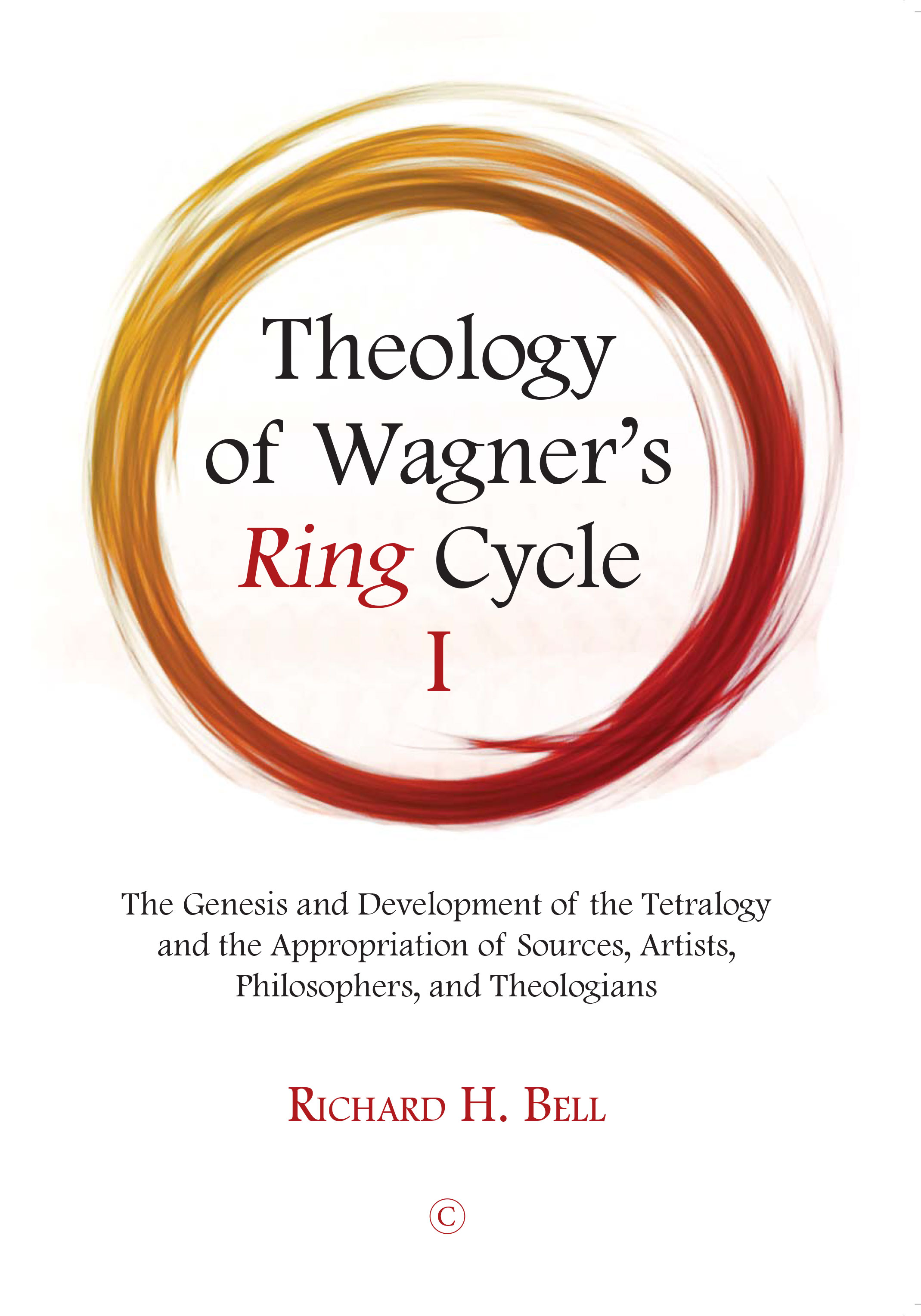
Theology of Wagner’s Ring Cycle I
The Genesis and Development of the Tetralogy and the Appropriation of Sources, Artists, Philosophers, and Theologians
by Richard H. Bell
Paperback (No longer our product)
(July 2021)
ISBN: 9780227177471
Price: $44.00
In stock
The first volume in a two-part analysis of Wagner’s most famous work and its theological message.
Wagner’s Ring is one of the greatest of all artworks of Western civilization, but what is it all about? The power and mystery of Wagner’s creation was such that he himself felt he stood before his work “as though before some puzzle.” A clue to the Ring’s greatness lies in its multiple avenues of self-disclosure and the corresponding plethora of interpretations that over the years has granted ample scope for directors and will no doubt do so well into the distant future. One possible interpretation, which Richard Bell argues should be taken seriously, is the Ring as Christian theology. In this first of two volumes, Bell considers, among other things, how the composer’s Christian interests may be detected in the “forging” of his Ring, looking at how he appropriated his sources (whether they be myths and sagas, writers, poets, or philosophers) and considering works composed around the same time, especially his Jesus of Nazareth.
Richard H. Bell is Professor of Theology at the University of Nottingham, UK. He studied theoretical physics at University College London and theology at Oxford and Tubingen. He is author of Provoked to Jealousy (1994), No one seeks for God (1998), The Irrevocable Call of God (2005), Deliver Us from Evil (2007), and Wagner’s Parsifal (2013).
- By (author) Richard H Bell
"I am not aware of any more meticulous trawl of the voluminous sources for, and influences on, the Ring, through the ancient Greek dramas, Old Norse and Germanic myths, Dante and Shakespeare to Goethe and Schiller. The work of the major German Idealists - Fichte, Kant, Schelling, Hegel, Feuerbach, and Schopenhauer - is subjected to forensic analysis for Wagner's debt to each. Above all, Professor Bell is concerned to demonstrate possible influences on theological and ethical issues in the Ring." Barry Millington, Editor, The Wagner Journal; Chief Music Critic, London Evening Standard "In this erudite and formidably researched study, Richard Bell situates Wagner's Ring cycle within the context of some of the most powerful and influential systems of thought to have shaped the Western mind. Of interest to theologians, philosophers, and historians alike, Bell's challenging ideas will not only inform current and future debates around Wagner, but stimulate and provoke in equal measure." Roger Allen, Emeritus Fellow in Music, University of Oxford "Add this to your list of essential reading! Comprehensive and authoritative, Bell's Theology of Wagner's Ring Cycle I maps the theological territories of Wagner's wide-ranging literary, poetic, philosophical, and musical influences. Never before has the Ring been subject to such a sustained theological argument and approach ... a conceptually transformative book bound to recalibrate our understanding of Wagner and his intellectual world." Bennet Zon, Director, Centre for Nineteenth-Century Studies, Durham University; General Editor, Nineteenth-Century Music Review "Applying a theological lens to familiar ground, Richard Bell argues in these volumes that Wagner's Ring cycle can be seen as a Christian allegory. Through a rich account of the composer's intellectual world, the author unpacks such classic theological concerns as nature and the fall; love, death, and immortality; freedom, necessity, and providence; and redemption - to the great benefit of both Wagnerians and theologians." Stephen McClatchie, Professor of Theology & the Arts, Huron University College, London, Ontario
—
Similar Books
 ‘For You I Study, For You I Work, For You I Live, For You I Am Ready To Even Give My Life’
Essays in Honour of Francis (Frank) J Moloney, SDB

 A Connecting Polemic in the Medieval Mediterranean
The Correspondence of Leo III and ʿUmar II
Volume 6





 Ars Prophetica
Theology in the Poetry of Twentieth-Century Hebrew Poets Avraham Halfi, Shin Shalom, Amir Gilboa, and T. Carmi
 As Messianism Turns to Heresy
The Regenstein Chair Lectures On Lurianic Kabbalah and Shabbatai Tzevi at Hebrew Union College - Cincinnati


 Creating the Woman in Antiquity
Proceedings of the 16th Melammu Workshop, Innsbruck, 2–3 June 2022
Volume 13
 Cultic Kisses
Fruitful Encounters Between Deities and Humans. Festschrift for Angelika Berlejung on the Occasion of Her 65th Birthday
 De/colonizing Theologies
Glocal Histories, Contemporary Challenges, Theoretical Reflections
Volume 4
 Drunk the Potion, No Whit Charmed
The Doctrine of Pure and Perfect Souls from Iamblichus to Damascius




 Extracanonical Traditions and the Holy Land
Texts, Rituals, and Material Culture in Late Antique Palestine
 Fear, Fear of God, God-Fearers
Philological and Historical Perspectives on the World of Ancient Judaism and Christianity


 Gender and Iconography in Antiquity
Femininities, Masculinities, Ambiguities, and Beyond in the Ancient Levant, Near East, and Mediterranean


 Hoghe minne es deen vor dander
Essays on the Christian Mystical Tradition in Honour of Rob Faesen SJ
Volume 122

 International Comparison and Transfer in Religious Education
The Projects “RE at Schools in Europe” and “International Knowledge Transfer” in Dialogue
 Isaiah in the Fourth Gospel
Use of the Citations of Isaiah in John’s Gospel in Comparison to the Synoptics and Other Places in the New Testament