
Personal Reality, Volume 2
The Emergentist Concept of Science, Evolution, and Culture
by Daniel Paksi Paksi
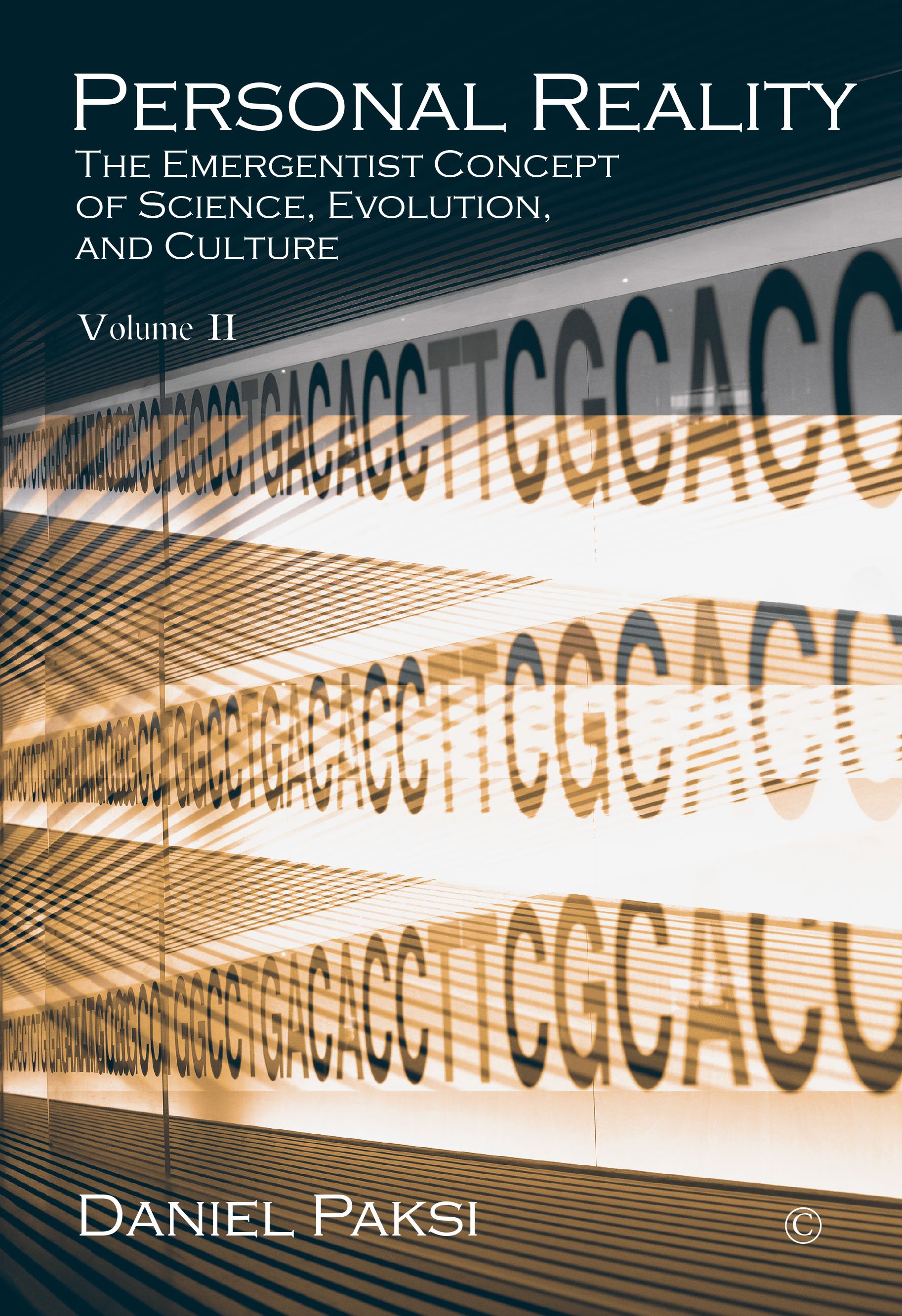
The second of two volumes showing how the principles of emergence and evolution underlie our personal knowledge and understanding of reality.
Western civilization was built on the concept of God. Today modern science, based on the critical method and so-called objective facts, denies even the existence of our soul. There is only matter: atoms, molecules, and DNA sequences. There is no freedom; there are no well-grounded beliefs. The decline of Western civilization is not the simple consequence of decadence, hedonism, and malevolence. Modern critical science has liberated us from the old dogmas but failed to establish our freedoms, values, and beliefs. However, human knowledge is not objective but personal. We are the children of evolution. Everybody sees the world from his own personal point of view anchored into his/her body. We use our billions-of-years-old evolutionary skills and thousands-of-years-old cultural heritage to recognize and acknowledge the personal facts of our reality, freedom, and most important natural beliefs: respect and speak the truth. In reality, even science itself is based on our personal knowledge. Only our false conceptual dichotomies paralyze our thinking. God or matter? – there is a third choice: the emergence of life and human persons. This is the only way to defend our freedoms and the Christian moral dynamism of free Western societies.
Volume II List of Figures and Tables Part Three: Evolution 8. The Logic of Achievement 9. Evolution 10. Cultural Evolution Part Four: Personal Reality 11. Scientific and Cultural Reality 12. Moral and Intellectual Reality 13. The Future of Personal Reality Bibliography
Daniel Paksi is a Postdoctoral Research Fellow of the Hungarian Academy of Sciences at the Budapest University of Technology and Economics where he received his PhD in history and philosophy of science in 2010. His primary goal with Personal Reality to establish a coherent concept of emergence based on Michael Polanyi’s Personal Knowledge and Samuel Alexander’s Space, Time, and Deity.
- By (author) Daniel Paksi
"Addressed to current controversy concerning the origin and explanation of biological life and human culture, Hungarian philosopher Daniel Paksi aims to establish a coherent, scientifically grounded concept of evolutionary emergence as a more viable alternative to both reductionist materialism(s) and ontological dualism(s), providing a sounder conceptual foundation for cultural meaning. Paksi's argument draws on philosopher-scientist Michael Polanyi's Personal Knowledge and Samuel Alexander's Space, Time, and Deity. Developed in dialogue with previous efforts toward this goal, Paksi articulates a hopeful intellectual vision for humankind in the twenty-first century." Dale Cannon, Western Oregon University "This is a thorough examination of Neo-Darwinism's denial of the reality and significance of emergence, using and developing Michael Polanyi's and other philosophies plus more empirical detail, followed by an account of the meaning and reality of the emergence of genuinely new orders of existence and how they can be related by the boundary conditions of a lower level being determined by the next higher. Perhaps how emergence is itself possible is more open than Paski allows." R.T. Allen, author of The Necessity of God
—
Similar Books
 ‘For You I Study, For You I Work, For You I Live, For You I Am Ready To Even Give My Life’
Essays in Honour of Francis (Frank) J Moloney, SDB

 A Connecting Polemic in the Medieval Mediterranean
The Correspondence of Leo III and ʿUmar II
Volume 6





 Ars Prophetica
Theology in the Poetry of Twentieth-Century Hebrew Poets Avraham Halfi, Shin Shalom, Amir Gilboa, and T. Carmi
 As Messianism Turns to Heresy
The Regenstein Chair Lectures On Lurianic Kabbalah and Shabbatai Tzevi at Hebrew Union College - Cincinnati


 Creating the Woman in Antiquity
Proceedings of the 16th Melammu Workshop, Innsbruck, 2–3 June 2022
Volume 13
 Cultic Kisses
Fruitful Encounters Between Deities and Humans. Festschrift for Angelika Berlejung on the Occasion of Her 65th Birthday
 De/colonizing Theologies
Glocal Histories, Contemporary Challenges, Theoretical Reflections
Volume 4
 Drunk the Potion, No Whit Charmed
The Doctrine of Pure and Perfect Souls from Iamblichus to Damascius




 Extracanonical Traditions and the Holy Land
Texts, Rituals, and Material Culture in Late Antique Palestine
 Fear, Fear of God, God-Fearers
Philological and Historical Perspectives on the World of Ancient Judaism and Christianity


 Gender and Iconography in Antiquity
Femininities, Masculinities, Ambiguities, and Beyond in the Ancient Levant, Near East, and Mediterranean


 Hoghe minne es deen vor dander
Essays on the Christian Mystical Tradition in Honour of Rob Faesen SJ
Volume 122

 International Comparison and Transfer in Religious Education
The Projects “RE at Schools in Europe” and “International Knowledge Transfer” in Dialogue
 Isaiah in the Fourth Gospel
Use of the Citations of Isaiah in John’s Gospel in Comparison to the Synoptics and Other Places in the New Testament