
Domitiane – Kaine Latomia (Umm Balad)
Le praesidium et les carrieres
Edited by Jean-Pierre Brun
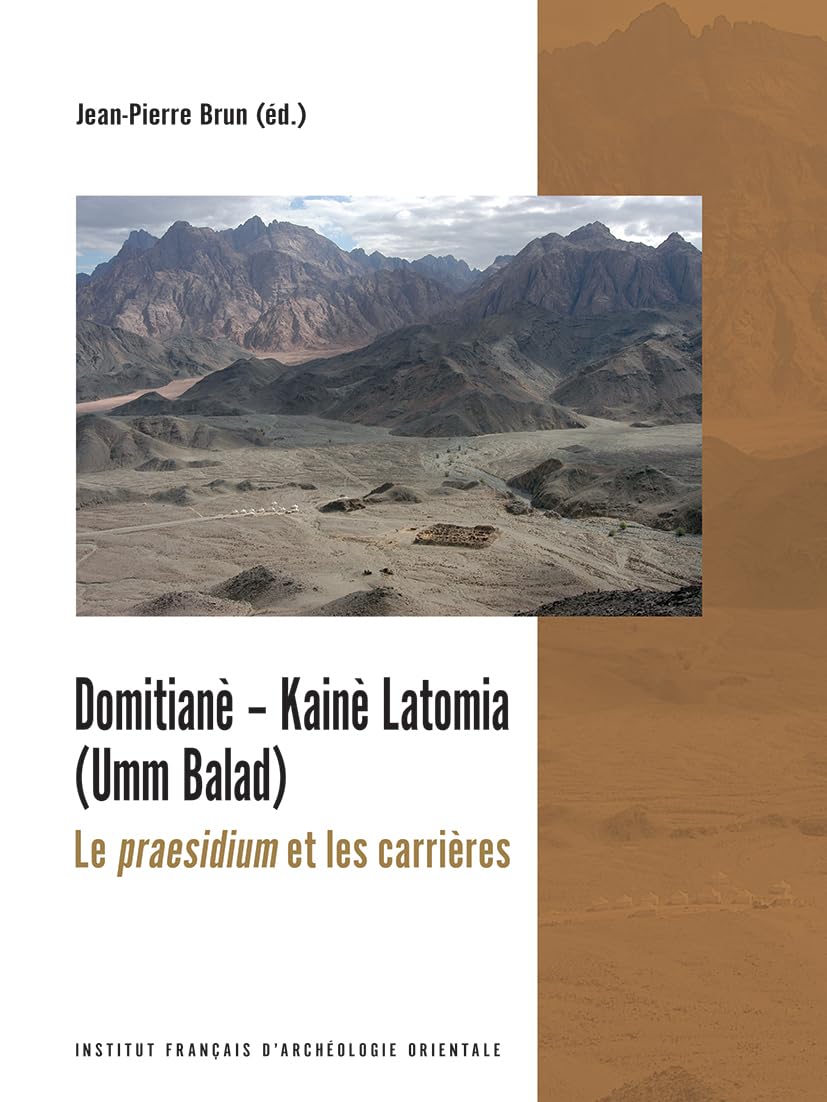
The excavations carried out at Domitiane/Kaine Latomia (Umm Balad) in 2001 2003 by the French Ministry of Foreign Affairs/IFAO have added to our knowledge of the occupation of the Eastern Desert of Egypt in Roman times. This site, located in the Porphyrites massif, has a rock deposit of “granito verde fiorito di bigio” (gray flowered green granite). The attempt to exploit it led to the construction of a small fort by the army under Domitian. It served as a base for the quarry workers. The gate inscription, although very mutilated, indicates a date of construction around 88-92. This early phase does not seem to go beyond the beginning of Trajan’s reign. The praesidium was probably abandoned thereafter, until around 146, when it was reoccupied for only a short period of time, before being abandoned again. The examination of the two quarries provides a lot of information about the organization of the work, but what can be established about their respective histories remains speculative for the most part. The use of Kaine Latomia finally ended in failure, probably due to the poor quality of the stone. However, some blocks were sent to Rome where they were used first of all for the decoration of the Domus Flavia (Flavian Palace) on the Palatine.
The excavations carried out at Domitiane/Kaine Latomia (Umm Balad) in 2001 2003 by the French Ministry of Foreign Affairs/IFAO have added to our knowledge of the occupation of the Eastern Desert of Egypt in Roman times. This site, located in the Porphyrites massif, has a rock deposit of “granito verde fiorito di bigio” (gray flowered green granite). The attempt to exploit it led to the construction of a small fort by the army under Domitian. It served as a base for the quarry workers. The gate inscription, although very mutilated, indicates a date of construction around 88-92. This early phase does not seem to go beyond the beginning of Trajan’s reign. The praesidium was probably abandoned thereafter, until around 146, when it was reoccupied for only a short period of time, before being abandoned again. The examination of the two quarries provides a lot of information about the organization of the work, but what can be established about their respective histories remains speculative for the most part. The use of Kaine Latomia finally ended in failure, probably due to the poor quality of the stone. However, some blocks were sent to Rome where they were used first of all for the decoration of the Domus Flavia (Flavian Palace) on the Palatine.
- Edited by Jean-Pierre Brun
Other Titles in this Series
 Mirgissa V
Les empreintes de sceaux. Apercu sur l'administration de la Basse Nubie au Moyen Empire
Volume 80

 Ostraca de Krokodilo II
La correspondance privee et les reseaux personnels de Philokles, Apollos et Ischyras
Volume 81




 Ports & Fortifications in the Muslim World
Coastal Military Architecture from the Arab Conquest to the Ottoman Period
Volume 85
 Du côté de chez Zeus
Fouilles de la Mission archéologique française du désert Oriental à Abû Qurayya (Dios) et Bi’r Bayza (y inclus O.Dios I 1-67)
Volume 98



Similar Books


 Caesar’s Visions and Impact on the Roman Empire
Revisiting the Archaeological and Historical Record of the 40s BC
Volume 2

 Construction Processes in Historical Western Societies (5th c. BC – 10th c. AD)
Case Studies on Techniques, Models, and Costs



 Etruscan and Roman Hellenistic Anatomical ex votos
Reassessing Popular Religious Expressions in Central Italy
Volume 8






 Invisible Labour in Antiquity
Visualizing Obscure Work in the Ancient Mediterannean and West Asia
Volume 1


 Late Antique villae in the Balkans (3rd–7th c. AD): Current Research Questions and Perspectives
HAEMUS Companion to the Late Antique Balkans 1
Volume 4





 Portraying the Individual in the Roman East
Local–Imperial Entanglements in Sculpture, Mosaics, and Paintings (First–Fourth Centuries AD)
Volume 18


 Roman Copies, Collecting, and Culture in the Bay of Naples and Beyond
Papers in Honor of Eugene J. Dwyer

 Small Worlds and Relational Agencies: Local Societies in Early Medieval Iberia
Pequeños mundos y Agencias relacionales: Sociedades locales altomedievales en la Península Ibérica
 SOMA 2023: Proceedings of the 24th Symposium on Mediterranean Archaeology
Ideas that Travelled by the Sea, Udine, 2-4 February, 2023
