
Bürgertum nach dem bürgerlichen Zeitalter
Leitbilder und Praxis seit 1945
Contributions by Dieter Gosewinkel Contributions by Christine G. Krüger Contributions by Gabriele Lingelbach Contributions by Volker Depkat Contributions by Jens Hacke Contributions by Holger Nehring Contributions by Werner Plumpe M.A. Contributions by Adelheid von Saldern Contributions by Peter Lundgreen Contributions by Sven Oliver Müller Contributions by Marie-Christine Potthoff Contributions by Christian Reuber Contributions by Till Manning Contributions by Lu Seegers Contributions by Daniela Münkel Contributions by Miriam Gebhardt Edited by Gunilla Budde Edited by Eckart Conze Edited by Cornelia Rauh
Hardback (Published)
(August 2010)
ISBN: 9783525368503
6.3 x 9.33 inches
Price: $87.00
In stock
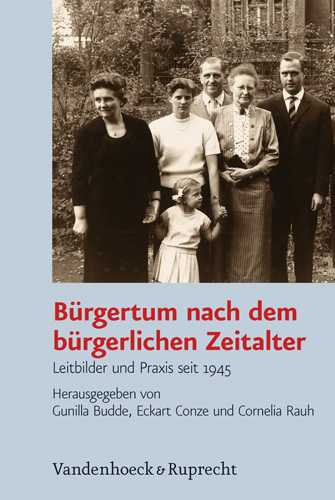
Gibt es in Deutschland nach dem bürgerlichen Zeitalter noch ein Bürgertum?
English summary: Civil values are fairly newly discovered; pleadings for a new commoner have filled the newspapers of every political faction in the last years. But do Germany and Europe still have a social formation that continues the tradition of the bourgeoisie after the civil era? In order to question continuity and the new definition of the commoner, the authors examine fields of expertise that were characterised bourgeois in 19th century research. Five fields are in the center of attention: civil society, everyday culture, education and upbringing, enterprise, as well as policies and state. German text. German description: Der burgerliche Wertehimmel wird gerade neu entdeckt: Beschworungen einer neuen Burgerlichkeit fullen in den letzten Jahren Medien ganz unterschiedlicher politischer Couleur. Doch gibt es in Deutschland und in Europa nach dem burgerlichen Zeitalter noch eine Sozialformation, die in der Tradition des Burgertums steht? Um sich der Frage nach burgerlichen Kontinuitaten, aber auch nach Neubestimmungen von Burgerlichkeit, zu nahern, suchen die Beitrage bestimmte Handlungsfelder auf, welche die Forschung zum 19. Jahrhundert als burgerlich charakterisiert hat. Funf solcher Orte stehen dabei im Fokus: die Zivilgesellschaft, die Alltagskultur, Bildung und Erziehung, Unternehmen sowie Politik und Staat.
- Contributions by Dieter Gosewinkel
- Contributions by Christine G. Krüger
- Contributions by Gabriele Lingelbach
- Contributions by Volker Depkat
- Contributions by Jens Hacke
- Contributions by Holger Nehring
- Contributions by Werner Plumpe M.A.
- Contributions by Adelheid von Saldern
- Contributions by Peter Lundgreen
- Contributions by Sven Oliver Müller
- Contributions by Marie-Christine Potthoff
- Contributions by Christian Reuber
- Contributions by Till Manning
- Contributions by Lu Seegers
- Contributions by Daniela Münkel
- Contributions by Miriam Gebhardt
- Edited by Gunilla Budde
- Edited by Eckart Conze
- Edited by Cornelia Rauh
Similar Books


 As Messianism Turns to Heresy
The Regenstein Chair Lectures On Lurianic Kabbalah and Shabbatai Tzevi at Hebrew Union College - Cincinnati

 Beyond Sovereign Courts
Agents and Practices in Early Modern Spanish and Habsburg Diplomacy
Volume 3





 Dis/United States of Vulnerability
Literary and Cultural Transgressions in U.S. Poetry Since the 1960s
Volume 330


 European Drama and Performance Studies
Dramatisations politiques. Théâtre, politique et idéologie au XIXe siècle (1806-1914)
Volume 27

 Food Security under Armed Conflict
Global Knowledge Landscape and Public Attention to Social, Economic, and Humanitarian Dimensions


 Innovationes Lovanienses: Arts, Law and Theology at the University of Louvain (1425–1797)
Studium Lovaniense: Learning across Borders, 2
Volume 18


 Modernization, Crises, Cultural Revolutions
Yugoslavia’s 1960s and 1970s through the amateur film lens
 Myths and Tales of the Inughuit
Erik Holtved's Polar Eskimo Texts Revised and Re-translated into Danish and English
Volume 475, 12


