
Markiani, Amorgos
An Early Bronze Age Fortified Settlement
by Christos Doumas, Giorgos Gavalas, Lila I. Marangou and Lord Colin Renfrew

Markiani in Amorgos is the first rural settlement of the Early Cycladic period to be excavated systematically and published comprehensively. Most of our knowledge of the Cycladic islands of Greece in the third millennium BC comes from the well-known Cycladic cemeteries, with their fine decorated pottery, marble vessels and striking marble figurines. Early Cycladic remains also underlie the proto-urban trading centres of the Aegean Bronze Age, such as Phylakopi on Melos or Ayia Irini on Kea. Now, for the first time, we glimpse the life of a country farming community with its rural crafts, including spinning and probably weaving and metallurgy. The stratified culture sequence, with its radiocarbon chronology, documents clearly a thousand years of peasant life in this rather isolated island community. The site, overlooking the sea on the south coast of Amorgos, was already fortified towards the beginning of the Bronze Age. The abundant finds contrast strikingly with the elite products recovered from the Cycladic cemeteries. The abundant pottery is local and undecorated. There is a full repertoire of tools and artefacts of stone and bone, and the metal finds include a lead seal, an indication (with the clay sealings) of some organisation in production and exchange already in this modest community. Written by an internationally recognised team of Greek and British scholars, and with its clear documentation and abundant drawings and photographs, this volume establishes a new direction in the study of Cycladic prehistory. It should become an indispensable work of reference for every archaeological library.
- By (author) Christos Doumas
- By (author) Giorgos Gavalas
- By (author) Lila I. Marangou
- By (author) Lord Colin Renfrew
Similar Books


 Caesar’s Visions and Impact on the Roman Empire
Revisiting the Archaeological and Historical Record of the 40s BC
Volume 2


 Etruscan and Roman Hellenistic Anatomical ex votos
Reassessing Popular Religious Expressions in Central Italy
Volume 8



 Invisible Labour in Antiquity
Visualizing Obscure Work in the Ancient Mediterannean and West Asia
Volume 1

 Late Antique villae in the Balkans (3rd–7th c. AD): Current Research Questions and Perspectives
HAEMUS Companion to the Late Antique Balkans 1
Volume 4
 Making and Meaning in the Bronze and Iron Ages
Chronology, Landscapes and Societies across Europe. Proceedings from the METALAGES2024 Colloquium (Florence, 23 October 2024)


 Portraying the Individual in the Roman East
Local–Imperial Entanglements in Sculpture, Mosaics, and Paintings (First–Fourth Centuries AD)
Volume 18


 Small Worlds and Relational Agencies: Local Societies in Early Medieval Iberia
Pequeños mundos y Agencias relacionales: Sociedades locales altomedievales en la Península Ibérica


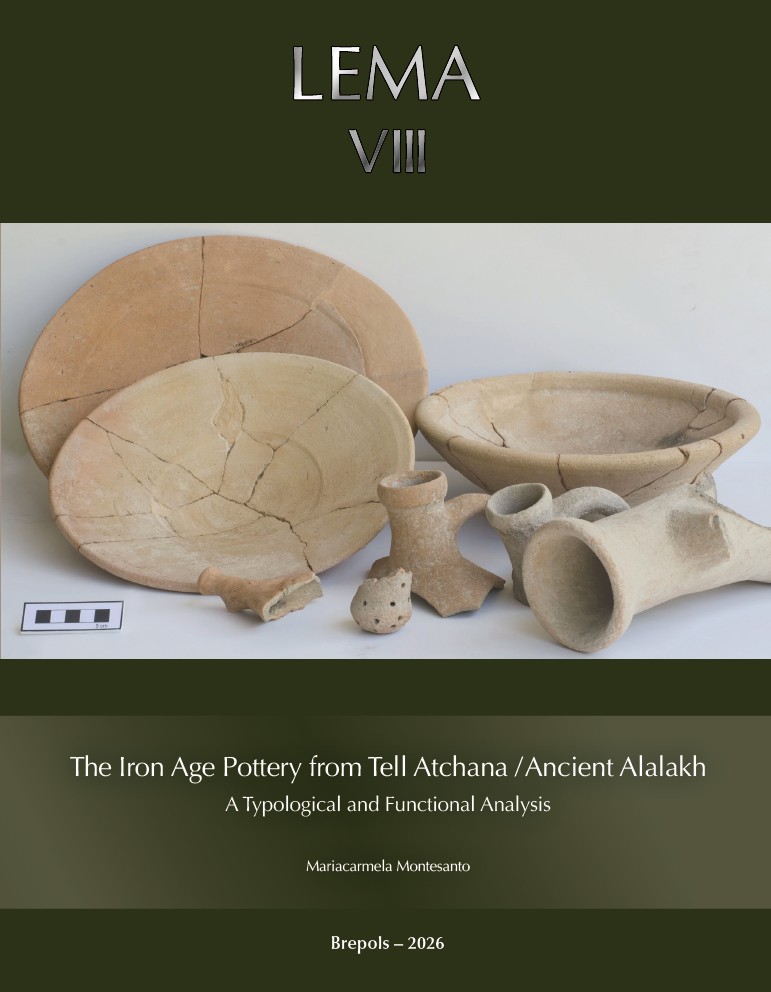 The Iron Age Pottery from Tell Atchana / Ancient Alalakh
A Typological and Functional Analysis
Volume 8

 Writing in the Church of the Nativity in Bethlehem
Inscription and Graffiti in a Multilingual and Multigraphic Perspective
Volume 45

 Roman Copies, Collecting, and Culture in the Bay of Naples and Beyond
Papers in Honor of Eugene J. Dwyer


 Atlante tematico di topografia antica 36-2026
Urbanistica e monumenti, porti, Roma. Ricerche sui monti Aurunci
Volume 36
 Cerámica común romana y ciclo haliéutico
Análisis de los contextos de las cetariae de Iulia Traducta

 Nuove scoperte e progressi nelle metodologie di rilievo e analisi dell’arte rupestre post-paleolitica in Italia
New discoveries and progress in the tracing and analysis methodologies of the post-Paleolithic rock art in Italy


