
Botanical Aspects of Environment and Economy at Gordion, Turkey
By (author) Naomi F Miller

Hardback (Published)
(December 2010)
ISBN: 9781934536155
8.46 x 10.98 inches
Price: $69.95
In stock
The archaeological site of Gordion is most famous as the home of the Phrygian king Midas and as the place where Alexander the Great cut the Gordian knot on his way to conquer Asia. Located in central Anatolia (present-day Turkey) near the confluence of the Porsuk and Sakarya rivers, Gordion also lies on historic trade routes between east and west as well as north to the Black Sea. Favorably situated for long-distance trade, Gordion’s setting is marginal for agricultural cultivation but well suited to pastoral production. It is therefore not surprising that with the exception of a single Chalcolithic site, the earliest settlements in the region are fairly late-they date to the Early Bronze Age (late 3rd millennium B.C.). The earliest known levels of Gordion, too, date to the Early Bronze Age, and occupation of at least some part of the site was nearly continuous through at least Roman times (second half of the 1st century B.C.). This work is a contribution to both the archaeobotany of west Asia and the archaeology of the site of Gordion. The book’s major concern is understanding long-term changes in the environment and in land use. An important finding, with implications for modern land management, is that the most sustainable use of this landscape involves mixed farming of dry-farmed cereals, summer-irrigated garden crops, and animal husbandry. The large number of samples from the 1988-89 seasons analyzed here make this a rich source for understanding other materials from the Gordion excavations and for comparison with other sites in west Asia.
- By (author) Naomi F Miller
Similar Books


 Caesar’s Visions and Impact on the Roman Empire
Revisiting the Archaeological and Historical Record of the 40s BC
Volume 2

 Connecting the Dots: Counting, Writing, and the Beginnings of Civilization
The Secret Lives of Clay Tokens: A Memoir


 Etruscan and Roman Hellenistic Anatomical ex votos
Reassessing Popular Religious Expressions in Central Italy
Volume 8


 Ḫattušaš utnē išḫameški
Hittite and Other Ancient Near Eastern Studies Presented to Piotr Taracha on the Occasion of His 65th Birthday



 Invisible Labour in Antiquity
Visualizing Obscure Work in the Ancient Mediterannean and West Asia
Volume 1
 Late Antique villae in the Balkans (3rd–7th c. AD): Current Research Questions and Perspectives
HAEMUS Companion to the Late Antique Balkans 1
Volume 4

 New Research on Old Collections in Southwest Asian Archaeology
Proceedings of the Workshop Held at the British Museum, London, 31 July – 2 August, 2023
 Old Aramaic Inscriptions and their Contexts
An Epigraphic, Archaeological, and Historical Synthesis
Volume 63


 Portraying the Individual in the Roman East
Local–Imperial Entanglements in Sculpture, Mosaics, and Paintings (First–Fourth Centuries AD)
Volume 18
 Punning in Odd or Elegant Constructions in Jeremiah
The Convergence of Linguistics, Rhetoric, and Textuality in the Hebrew Text of Jeremiah

 Shame in the Worlds of the Hebrew Bible and Akkadian Texts
A Linguistic Study and Its Implications
Volume 33
 Small Worlds and Relational Agencies: Local Societies in Early Medieval Iberia
Pequeños mundos y Agencias relacionales: Sociedades locales altomedievales en la Península Ibérica
 Telling Contexts
Archaeological and Textual Studies in Honor of Elizabeth Bloch-Smith and Mark S. Smith
 The Body
Lived, Cultured, Adorned: Essays on Dress and the Body in the Bible and Ancient Near East in Honor of Nili S. Fox
 The Discourse of Rites
Shaping and Reshaping the (Counter-)Priestly Rituals Conducted Outside the Tabernacle

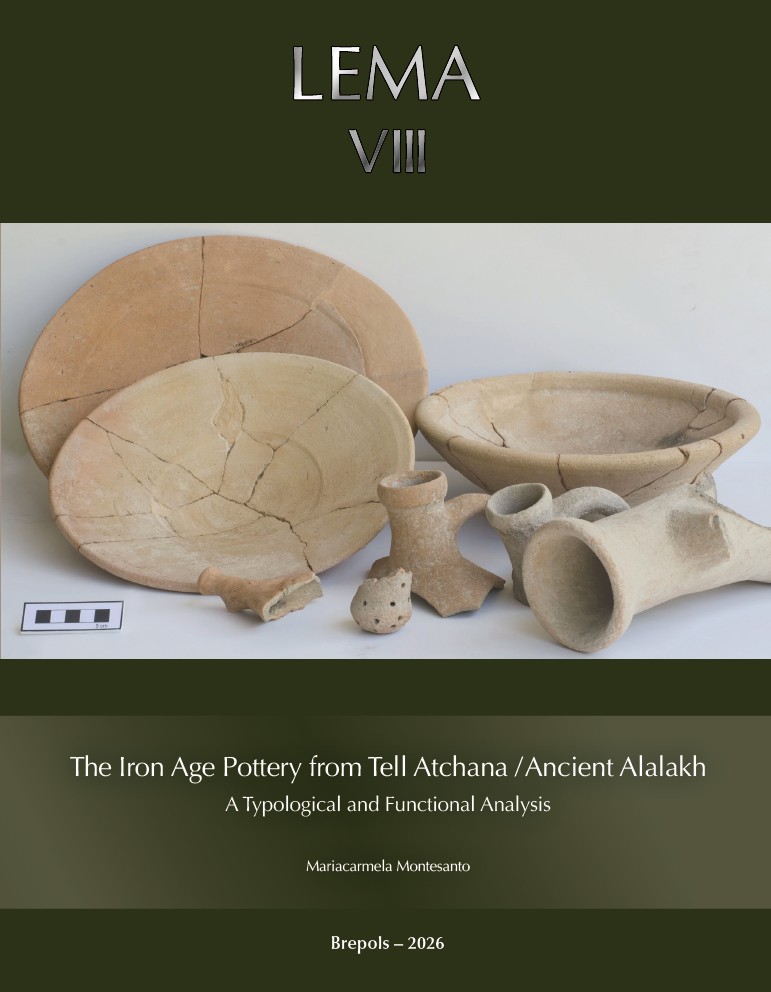 The Iron Age Pottery from Tell Atchana / Ancient Alalakh
A Typological and Functional Analysis
Volume 8



 Writing in the Church of the Nativity in Bethlehem
Inscription and Graffiti in a Multilingual and Multigraphic Perspective
Volume 45