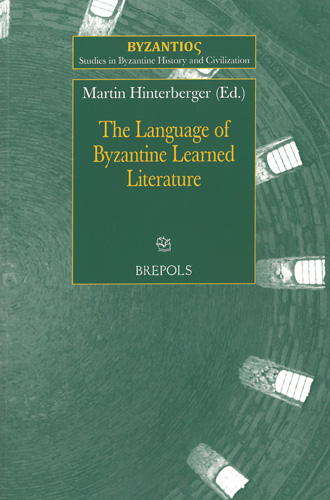
The Language of Byzantine Learned Literature
Edited by Martin Hinterberger
Built on a highly traditional educational system, the language of Byzantine literature was for the most part written in an idiom deeply influenced by ancient Greek texts and grammatical handbooks. The resulting overall archaizing impression of Byzantine Greek is largely why the language of learned literature – as compared with the re
Built on a highly traditional educational system, the language of Byzantine literature was for the most part written in an idiom deeply influenced by ancient Greek texts and grammatical handbooks. The resulting overall archaizing impression of Byzantine Greek is largely why the language of learned literature – as compared with the relatively well researched vernacular literature – has seldom been taken seriously as an object of linguistic study. This volume combines the expertise of linguists and scholars of Byzantine literature to challenge the assumption that learned medieval Greek is merely the weary continuation of ancient Greek or, worse still, a poor imitation of it, while proposing that it needs to be treated as a literary idiom in its own right. The contribution that texts of this kind can offer to sub-fields of Greek historical linguistics is explored using specific examples. Sociolinguistic theory provides a particularly useful framework for a more accurate analysis of the relationship between the vernacular and classicizing varieties of Greek literary language. In addition, the impact of the educational system on the production of texts is examined. In another chapter it is shown that a number of far-reaching assumptions, which originated in the 15th century, about accentuation and the middle voice still tend to colour our understanding of Byzantine, as well as ancient, Greek. Other chapters focusing on particles, the dative and the synthetic perfect reveal that Byzantine authors, while of course influenced by the living spoken language, used their classical linguistic heritage in a creative and innovative way.
- Edited by Martin Hinterberger
Other Titles in this Series

Similar Books

 A Collaborative Tapestry in Honour of Shirley Ann Brown / Une fresque brodée en l’honneur de Shirley Ann Brown
The Bayeux Tapestry Seen by her Colleagues and Friends / La Tapisserie de Bayeux vue par ses collègues et amis

 Behind the Scenes of Medieval Roofs
An Overview of the Roofing Systems of Italian Churches
Volume 90


 Des mots aux actes
Traduction épistémique et littéraire. Nouvelles tendances en histoire et didactique
Volume 15




 Innovation and Medieval Communities
The Circulation of Ideas and Practices in and out of the Town (1200-1500)
Volume 63

 John Dunstaple Reading Boethius
John Dunstaple’s Annotations to Boethius’s “De institutione musica” in the Manuscript Oxford, Corpus Christi College Library, MS 118

 Linguistic and Cultural Dynamics in a Frontier Society
New Perspectives on Northeastern Bavaria and Western Bohemia in the Early Middle Ages
Volume 9


 Medieval Debates on Foreknowledge: Future Contingents, Prophecy, and Divination
Acts of the XXVII Annual Colloquium of the SIEPM, Trento 12-15 September 2023
Volume 31
 Medieval Yeghegis, Armenia
History, Archaeology, Society. Local Multiplicities and Global Connections of a Rural Centre on the Silk Road(s)