
Krisen – Crashs – Depressionen
Indes 2013 Jg. 2 Heft 01
Contributions by Matthias Micus Contributions by Katharina Rahlf Contributions by Michael Makropoulos Contributions by Robert Misik Contributions by Nikolaus Kowall Contributions by Wolfgang Martynkewicz Contributions by Susanne Maasen Contributions by Barbara Sutter Contributions by Markus R. Pawelzik Contributions by Daniela Kallinich Contributions by Laura Fernandez de Mosteyrin Contributions by Eirikur Bergmann Contributions by Lars Geiges Contributions by Torben Lütjen Contributions by Andrea Roedig Contributions by Felix Butzlaff Contributions by Karin Schweinebraten Edited by Franz Walter Editorial board member Daniel Sander
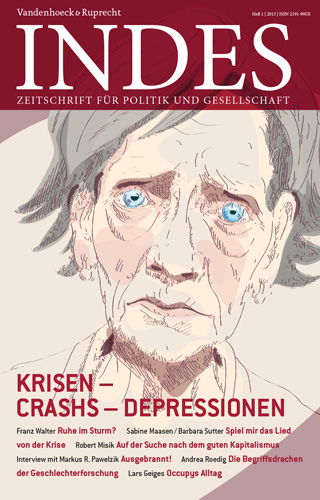
Paperback (Published)
(April 2013)
ISBN: 9783525800027
6.54 x 9.84 inches
Price: $29.00
On back order
English summary: This first issue of INDES in 2013 addresses the cluster of terms ‘crises – inflation – depression’. The term ‘crisis’ has been on everyone’s lips for several years now due to the international financial crisis (and selectively real estate-, banking -, debts crisis etc.). INDES aims to provide additional perspective on the constellation of corresponding problematic issues. Alongside economic analysis it presents biographical studies of ‘crisis politicians’, on-site inspections of countries particularly affected by the crisis, medical accounts of today’s ‘fashionable diseases’ from depression to burn-out as well as a historical account of the concept of ‘crisis’. It also asks if it is possible to learn from a crisis. Under which circumstances can crises be not only threatening and paralyzing, but also provide a breeding ground for productive creativity? German description: Die erste INDES-Ausgabe des Jahres 2013 widmet sich dem Begriffstrio Krisen – Inflation – Depression. Der Krisenbegriff ist seit einigen Jahren durch die internationale Finanzkrise (wahlweise auch Immobilien-, Banken-, Schuldenkrise etc.) in aller Munde. Dass im Zuge der immensen Transferzahlungen zur Stutzung von Banken, Staaten und nicht zuletzt der europaischen Wahrung absehbar die Geldentwertung beschleunigt wird, gilt in Expertenkreisen vielfach als ausgemacht. Und dass Preisanstiege, Zinssenkungen und Wertminderungen bei den Sparguthaben negative Auswirkungen auf die subjektive Beurteilung der personlichen und gesellschaftlichen Zukunft haben, ist durch den grundsatzlichen Gleichlauf von Konjunkturzyklen und demoskopisch erfragten Zufriedenheitswerten auch in diesem Fall wahrscheinlich. So weit, so okonomisch. Doch will INDES auf die hier skizzierte Problemkonstellation einen weiteren Blick werfen – neben wirtschaftswissenschaftlichen Analysen finden sich biographische Studien von Krisenpolitikern, Vor-Ort-Inspektionen krisengebeutelter Staaten, die medizinische Erkundung aktueller Modekrankheiten von Depression bis Burn-Out sowie eine Begriffsgeschichte der Krise, zudem fragen wir: Lasst sich aus Krisen lernen? Wann sind Krisenzeiten nicht nur bedrohlich und lahmend, sondern bieten gar den Nahrboden fur schopferische Kreativitat?
Dr. Matthias Micus ist Akademischer Rat am Göttinger Institut für Demokratieforschung.
- Contributions by Matthias Micus
- Contributions by Katharina Rahlf
- Contributions by Michael Makropoulos
- Contributions by Robert Misik
- Contributions by Nikolaus Kowall
- Contributions by Wolfgang Martynkewicz
- Contributions by Susanne Maasen
- Contributions by Barbara Sutter
- Contributions by Markus R. Pawelzik
- Contributions by Daniela Kallinich
- Contributions by Laura Fernandez de Mosteyrin
- Contributions by Eirikur Bergmann
- Contributions by Lars Geiges
- Contributions by Torben Lütjen
- Contributions by Andrea Roedig
- Contributions by Felix Butzlaff
- Contributions by Karin Schweinebraten
- Edited by Franz Walter
- Editorial board member Daniel Sander
Similar Books


 Balthasar Caymox of Nuremberg
Early Modern German Print Publishers: Popular Prints of the Seventeenth Century
 Constitutional Conflict as Judicial Civil Disobedience and Conscientious Objection
Reconceptualising National Constitutional Court Rulings in the European Union Legal Space



 European Review of Service Economics and Management
De nouveaux horizons pour l’innovation dans les services ? IA, inclusion et responsabilité
Volume 21
 Formulary apportionment in international tax law
An allocation method for the age of globalization and digitalization
Volume 210
 Friedlicher Handel oder umkämpfte Geschäfte?
Handel und Handelsrecht in der Vormoderne zwischen Krieg und Frieden


 Global Gulf
Geo-Economic, Geo-Political, and Geo-Technological Transformation in Saudi Arabia, the United Arab Emirates, and Qatar

 Hofmann oder Vorkämpfer der „philosophes“?
Deutsche Voltaire-Bildnisse und -Imaginationen im Zeitalter der Aufklärung
 Invisible Labour in Antiquity
Visualizing Obscure Work in the Ancient Mediterannean and West Asia
Volume 1


 Legal Unification through Case Law?
Supreme Courts and the Emergence of Uniform Law in the Modern Era
Volume 242



 Socio-économie du travail
La dégradation du travail au XXIe siècle ? Lectures contemporaines de Harry Braverman
Volume 17
 Socio-économie du travail
Le sens du travail, concept scientifique ou instrument du capitalisme ? Volume 1
Volume 18

 The Documentation of Historical Facts in Trial Judgments of the International Criminal Court
A Constitutional Theory of International Criminal Proceedings
Volume 66



 Linguistic and Cultural Dynamics in a Frontier Society
New Perspectives on Northeastern Bavaria and Western Bohemia in the Early Middle Ages
Volume 9
 Obsidian and the Sea
Evidence, Concepts and Social Implications of its Maritime Transportation
Volume 22

 Socio-économie du travail
Le sens du travail, concept scientifique ou instrument du capitalisme ? Volume 2
Volume 19
 The Law of the International Civil Service
Institutional Law and Practice in International Organisations
 The Social Lives of Monuments
Transforming Material Legacies of Colonialism, Fascism, and National Socialism
 “Aktenzeichen XY … ungelöst”, Facebook und Co.
Chancen und Risiken der Einbeziehung der Öffentlichkeit in das strafprozessuale Ermittlungsverfahren
Volume 476
 “Das Grundgesetz ist unsere Leitkultur”
Eine verfassungsrechtliche und -theoretische Annäherung an die Gleichsetzung von Grundgesetz und Leitkultur
Volume 1595