
Ruling the Greek World
Approaches to the Roman Empire in the East
Edited by Juan Manuel Cortes Copete Edited by Elena Muniz Grijalvo Edited by Fernando Lozano Gomez

Paperback (Published)
(December 2015)
ISBN: 9783515111355
6.69 x 9.49 inches
Price: $78.00
In stock
This book analyses the procedures, ideas and realities that allowed the people from the Greek East to become a part of the Roman Empire, while both preserving and redeveloping their cultural identity. The volume assesses this complex process both in the traditional Greek cities of the provinces of Achaea and Asia as well as in other areas that had been deeply hellenised for centuries, as the Near East. A common point of departure of the different essays is the notion that granting the Greeks a privileged position within the Roman Empire as a tribute to their civilisation was as possible an option as that of “barbarisation”, i.e. the substitution of Greek cultural identity by the Roman one. Between the respect and conservation of political and cultural structures, and their total annihilation and substitution by new realities of undeniable Roman stamp, there existed a wide spectrum of political possibilities with strong cultural and religious undertones. In creating those new options, which Rome either opted for, refused, or transformed, the political and cultural activity of the Greeks themselves, and in particular the oligarchs who ruled the cities in the Mediterranean East, played an important role. This volume attempts to analyse all those new possibilities.
This book analyses the procedures, ideas and realities that allowed the people from the Greek East to become a part of the Roman Empire, while both preserving and redeveloping their cultural identity. The volume assesses this complex process both in the traditional Greek cities of the provinces of Achaea and Asia as well as in other areas that had been deeply hellenised for centuries, as the Near East. A common point of departure of the different essays is the notion that granting the Greeks a privileged position within the Roman Empire as a tribute to their civilisation was as possible an option as that of “barbarisation”, i.e. the substitution of Greek cultural identity by the Roman one. Between the respect and conservation of political and cultural structures, and their total annihilation and substitution by new realities of undeniable Roman stamp, there existed a wide spectrum of political possibilities with strong cultural and religious undertones. In creating those new options, which Rome either opted for, refused, or transformed, the political and cultural activity of the Greeks themselves, and in particular the oligarchs who ruled the cities in the Mediterranean East, played an important role. This volume attempts to analyse all those new possibilities.
- Edited by Juan Manuel Cortes Copete
- Edited by Elena Muniz Grijalvo
- Edited by Fernando Lozano Gomez
Other Titles in this Series

 The Christian Mystery
Early Christianity and the Ancient Mystery Cults in the Work of Franz Cumont and in the History of Scholarship


 Zwischen Krise und Alltag / Conflit et normalite
Antike Religionen im Mittelmeerraum / Religions anciennes dans l'espace mediterraneen
Volume 1


 Fasti sacerdotum
Die Mitglieder der Priesterschaften und das sakrale Funktionspersonal römischer, griechischer, orientalischer und jüdisch-christlicher Kulte in der Stadt Rom von 300 v. Chr. bis 499 n. Chr.


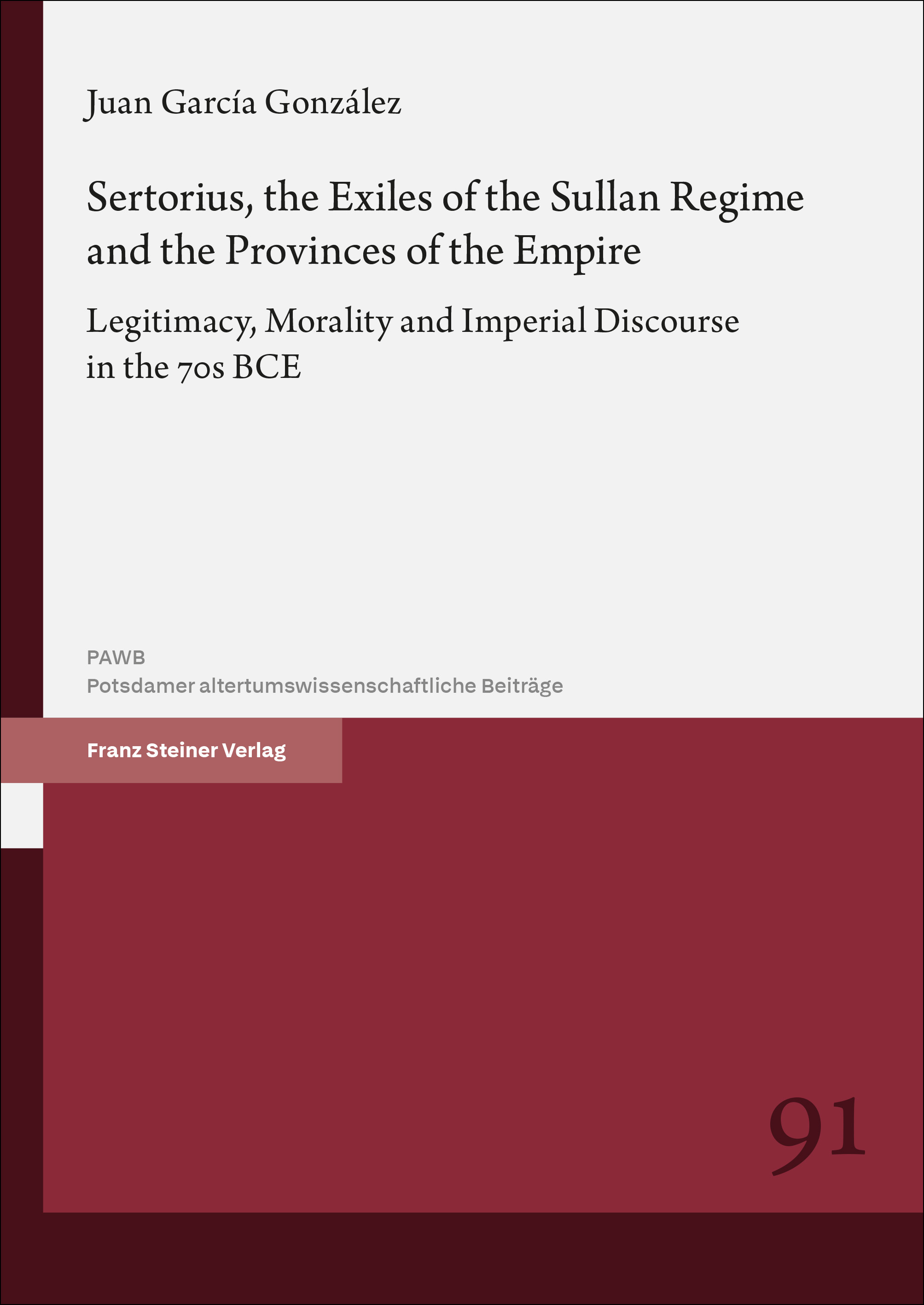 Sertorius, the Exiles of the Sullan Regime and the Provinces of the Empire
Legitimacy, Morality and Imperial Discourse in the 70s BCE
 Der Gemeinsinn der Märtyrer
Die Darstellung gemeinwohlorientierten Handelns in den frühchristlichen Martyriumsberichten
 Religiöses in der politischen Argumentation der späten römischen Republik
Ciceros Erste Catilinarische Rede – eine Fallstudie


 From “Roma quadrata” to “la grande Roma dei Tarquini”
A Study of the Literary Tradition on Rome's Territorial Growth under the Kings


 Vestigia
Miscellanea di studi storico-religiosi in onore di Filippo Coarelli nel suo 80° anniversario


 Tutela urbis
Il significato e la concezione della divinità tutelare cittadina nella religione romana
Similar Books


 Contesting Labeled Identities
The Sociology of Gentilics in Biblical and Northwest Semitic Literature

 Drunk the Potion, No Whit Charmed
The Doctrine of Pure and Perfect Souls from Iamblichus to Damascius

 Epigraphic “Shades” from Hellenistic Thrace
Contextualizing Inscriptions in Greek from Thracian Tombs

 Epiphanies of the Divine in the Septuagint and the New Testament
Fifth International Symposium of the Corpus Judaeo-Hellenisticum Novi Testamenti (CJHNT), 14-17 May 2015, Nottingham


 Gold, Silver and Glass: Power Networks, Cultural Identities, Technology Transfers and Agency across the Old World (7th Century BC – 1st Century AD)
Proceedings of a Conference Held at the British Museum, 16–18 June 2023
 Language and Power in the Roman Empire and Early India
Hierarchy, Ambiguity, and the Art of Reading the Signs in Cosmopolitan Cultures
 Late Antique villae in the Balkans (3rd–7th c. AD): Current Research Questions and Perspectives
HAEMUS Companion to the Late Antique Balkans 1
Volume 4


 Nurturing the Elite
Representations of Drinking, Eating, and Religious Vessels in Palmyrene Funerary Iconography
Volume 13





 Roman Copies, Collecting, and Culture in the Bay of Naples and Beyond
Papers in Honor of Eugene J. Dwyer



 The Compositional History of the Book of Kings
An Analysis of the Evaluative Frameworks in 1 Kings 14–2 Kings 25




 Zooarchaeology of Ancient Greek Sanctuaries in Southwestern Sicily
Faunal Analysis from Selinus and Akragas as Evidence of Differences in the Treatment of Animals for Ritual Purposes


