
Human Development in Sacred Landscapes
Between Ritual Tradition, Creativity and Emotionality
Contributions by Oliver Rackham Contributions by Susan Guettel Cole Contributions by Lukas Thommen Contributions by Sarah Hitch Contributions by Hamish A. Forbes Contributions by Efrosyni Boutsikas Contributions by James Roy Contributions by Mercedes Aguirre Contributions by Richard Buxton Contributions by Bettina Schulz Paulsson Contributions by Michael Teichmann Contributions by Vassiliki Pothou Contributions by Lutz Käppel Contributions by Jeremy McInerney Edited by Lutz Käppel Edited by Vassiliki Pothou
Hardback (Published)
(June 2015)
ISBN: 9783847102526
6.34 x 9.33 inches
Price: $74.00
In stock
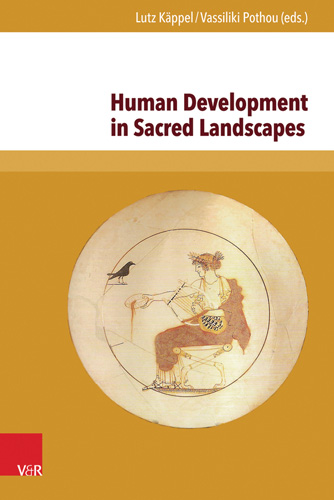
The conference was focused on the identification and interpretation of sacred areas principally – but not exclusively – in the ancient Greek world and in the study of Greek religious ideas or religious practice. What did ancient Greece, from the Mesolithic onwards, look like, if it is possible to identify sacred areas on a landscape scale and if the sacred landscapes were differing from countryside. Another paper offered a new understanding of the role of astronomical observations in the Delphic and Spartan landscapes. Most of the contributions were directly connected with the cult of Apollo and the history and tradition of the famous sanctuary of Delphi.
“Holy Landscape” is a term frequently used to describe a multidimensional phenomenon. What this actually comprises is hard to define. Precisely this question is addressed in this volume. The “holy landscape” depends on people’s Weltanschauung and is influenced by their respective culture and ethos. It is not just a question of religious buildings and rituals, nor is a mere matter of explicating terms such as “pure” and “impure”, magic and myths; it is about an expressive space in which the “ceremony and mood of rites and cults” take place. The contributions also deal with the emergence and continuing development of the term “holy landscape” and the changing expressions of religious mood.
Lutz Kappel is Professor of Greek Literature at the University of Kiel. Dr. Vassiliki Pothou teaches at the University of Kiel (“Human Development in Landscapes”).
- Contributions by Oliver Rackham
- Contributions by Susan Guettel Cole
- Contributions by Lukas Thommen
- Contributions by Sarah Hitch
- Contributions by Hamish A. Forbes
- Contributions by Efrosyni Boutsikas
- Contributions by James Roy
- Contributions by Mercedes Aguirre
- Contributions by Richard Buxton
- Contributions by Bettina Schulz Paulsson
- Contributions by Michael Teichmann
- Contributions by Vassiliki Pothou
- Contributions by Lutz Käppel
- Contributions by Jeremy McInerney
- Edited by Lutz Käppel
- Edited by Vassiliki Pothou
Similar Books

 A Companion to Christianity and Sport in Europe and North America (19th-21st centuries)
Volume 1: Western and Eastern Europe
 A Connecting Polemic in the Medieval Mediterranean
The Correspondence of Leo III and ʿUmar II
Volume 6





 Ars Prophetica
Theology in the Poetry of Twentieth-Century Hebrew Poets Avraham Halfi, Shin Shalom, Amir Gilboa, and T. Carmi
 As Messianism Turns to Heresy
The Regenstein Chair Lectures On Lurianic Kabbalah and Shabbatai Tzevi at Hebrew Union College - Cincinnati



 Contesting Labeled Identities
The Sociology of Gentilics in Biblical and Northwest Semitic Literature

 Creating the Woman in Antiquity
Proceedings of the 16th Melammu Workshop, Innsbruck, 2–3 June 2022
Volume 13
 Cultic Kisses
Fruitful Encounters Between Deities and Humans. Festschrift for Angelika Berlejung on the Occasion of Her 65th Birthday
 De/colonizing Theologies
Glocal Histories, Contemporary Challenges, Theoretical Reflections
Volume 4
 Drunk the Potion, No Whit Charmed
The Doctrine of Pure and Perfect Souls from Iamblichus to Damascius


 Epigraphic “Shades” from Hellenistic Thrace
Contextualizing Inscriptions in Greek from Thracian Tombs

 Epiphanies of the Divine in the Septuagint and the New Testament
Fifth International Symposium of the Corpus Judaeo-Hellenisticum Novi Testamenti (CJHNT), 14-17 May 2015, Nottingham