
Three Theological Mistakes
How to Correct Enlightenment Assumptions about God, Miracles, and Free Will
by Ric S. Machuga
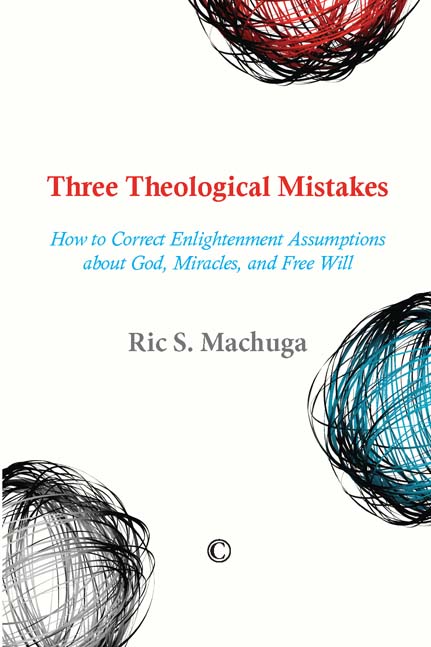
Paperback (No longer our product)
(April 2015)
ISBN: 9780227175286
5.98 x 9.02 inches
Price: $37.00
In stock
A critical study of three major errors that have crept into theological thinking in the wake of the Englightenment, offering an alternative understanding rooted in scripture and the insights of Thomas Aquinas and Karl Barth.
Is the existence of God a matter of faith or knowledge? Does God sometimes act miraculously or are there physical causes for everything? Is morality absolute or relative? Are humans truly free or does God’s sovereignty determine everything? Whenbad things happen, is God the cause or are they the fault of humans? Too frequently Christians answer these questions with a Yes to one side and a No to the other side. Thomas Aquinas and Karl Barth answer Yes to both. Following their model, Machuga defends a third way which transcends the Enlightenment dichotomies of fideism vs. rationalism, supernaturalism vs. naturalism, relativism vs. absolutism, free will vs. predestination, and God’s justice vs. his mercy. Machuga begins by showing how these false dichotomies grew out of the Enlightenment assumptions of mechanism, universal quantification, and mono-causation. He then corrects these demonstrably dubious assumptions by articulating a theory of dual-causation. The result is a thoroughly biblical understanding of God, miracles, and free will that can withstand the contemporary criticisms of both science and philosophy.
Ric S. Machuga has taught Philosophy in the Honour Programme at Butte College for thirty-five years. He is the author of In Defense of the Soul (2002) and Life, the Universe, and Everything (The Lutterworth Press, 2011).
- By (author) Ric S Machuga
"This patient, lucid argument unpacks the false dichotomies that bedevil controversies about God's sovereignty, human freedom, and divine judgment, leading us persuasively to embrace humility, mystery, and confident hope." John Wilson, editor of Books & Culture "... provides a valuable service by exposing the roots, and the questionableness, of many views which are still too often taken for granted. The book is recommended to all those who are interested in questions of theological method, all who are interested in the relationship of theology to science and philosophy, and all who are interested in the effects of the Enlightenment on theology." William J. Brennan III, in Reviews in Religion and Theology, Vol 25, Issue 1
—
Similar Books

 A Companion to Christianity and Sport in Europe and North America (19th-21st centuries)
Volume 1: Western and Eastern Europe
 A Connecting Polemic in the Medieval Mediterranean
The Correspondence of Leo III and ʿUmar II
Volume 6





 Ars Prophetica
Theology in the Poetry of Twentieth-Century Hebrew Poets Avraham Halfi, Shin Shalom, Amir Gilboa, and T. Carmi
 As Messianism Turns to Heresy
The Regenstein Chair Lectures On Lurianic Kabbalah and Shabbatai Tzevi at Hebrew Union College - Cincinnati


 Creating the Woman in Antiquity
Proceedings of the 16th Melammu Workshop, Innsbruck, 2–3 June 2022
Volume 13
 Cultic Kisses
Fruitful Encounters Between Deities and Humans. Festschrift for Angelika Berlejung on the Occasion of Her 65th Birthday
 De/colonizing Theologies
Glocal Histories, Contemporary Challenges, Theoretical Reflections
Volume 4

 Drunk the Potion, No Whit Charmed
The Doctrine of Pure and Perfect Souls from Iamblichus to Damascius



 Éthique, politique, religions
Superstition (XVIIe - XXIe siècles). Sémantique, histoires et cultures