
Visual Typology in Early Modern Europe
Continuity and Expansion
Edited by Dagmar Eichberger Edited by Shelley Perlove
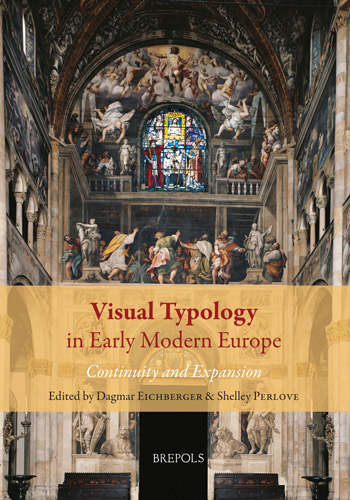
Visual Typology in early Modern Europe: Continuity and Expansion is the first study that examines the varied manifestations of typological thinking in diverse media of the visual arts from the Late Middle Ages through the seventeenth century in Germany, The Netherlands, Italy, and France. This study counteracts the underlying misconception that typology was in decline or even ceased to exist in the sixteenth century. The studies within this volume offer new interpretations that redefine what is meant by typological thinking in the early modern period. Typological thinking informs traditional pre-figurations, as well as more broadly associative interconnections between the Old Testament, classical texts, and even natural history, in relation to the New Testament. Typological thought permeates religious and secular visual culture during the period under consideration and this collection of essays reveals the continuing relevance and expansion of typological patterns for the visual arts, with particular emphasis on innovations in the sixteenth century. In the course of the sixteenth century typology became more complex and flexible, and came under the influence of the writings of Protestant and Catholic reformers, and also derived new secular and political analogies. Each essay offers a different interpretation of typological thinking. The typological manuals that were written in the course of the Late Middle Ages remain the basis for many artistic projects in illuminated manuscripts, stained glass windows, sculpture, and painting. By the sixteenth century, the notion of type and antitype was so well embedded in thought that artists such as Brueghel and Lucas van Leyden implicitly evoked typological relationships. Before the Council of Trent, more allusive interpretations led to unorthodox pairings of images from secular and religious contexts. In the first half of the sixteenth century new relationships were developed by Protestant commentators. After the Council of Trent the Catholic Church returned to more traditional typological forms and established new guidelines for reading devotional images. Nonetheless, artists continued to pursue unorthodox, innovative pairings.
Visual Typology in early Modern Europe: Continuity and Expansion is the first study that examines the varied manifestations of typological thinking in diverse media of the visual arts from the Late Middle Ages through the seventeenth century in Germany, The Netherlands, Italy, and France. This study counteracts the underlying misconception that typology was in decline or even ceased to exist in the sixteenth century. The studies within this volume offer new interpretations that redefine what is meant by typological thinking in the early modern period. Typological thinking informs traditional pre-figurations, as well as more broadly associative interconnections between the Old Testament, classical texts, and even natural history, in relation to the New Testament. Typological thought permeates religious and secular visual culture during the period under consideration and this collection of essays reveals the continuing relevance and expansion of typological patterns for the visual arts, with particular emphasis on innovations in the sixteenth century. In the course of the sixteenth century typology became more complex and flexible, and came under the influence of the writings of Protestant and Catholic reformers, and also derived new secular and political analogies. Each essay offers a different interpretation of typological thinking. The typological manuals that were written in the course of the Late Middle Ages remain the basis for many artistic projects in illuminated manuscripts, stained glass windows, sculpture, and painting. By the sixteenth century, the notion of type and antitype was so well embedded in thought that artists such as Brueghel and Lucas van Leyden implicitly evoked typological relationships. Before the Council of Trent, more allusive interpretations led to unorthodox pairings of images from secular and religious contexts. In the first half of the sixteenth century new relationships were developed by Protestant commentators. After the Council of Trent the Catholic Church returned to more traditional typological forms and established new guidelines for reading devotional images. Nonetheless, artists continued to pursue unorthodox, innovative pairings.
- Edited by Dagmar Eichberger
- Edited by Shelley Perlove
Similar Books
 A Collaborative Tapestry in Honour of Shirley Ann Brown / Une fresque brodée en l’honneur de Shirley Ann Brown
The Bayeux Tapestry Seen by her Colleagues and Friends / La Tapisserie de Bayeux vue par ses collègues et amis





 Balthasar Caymox of Nuremberg
Early Modern German Print Publishers: Popular Prints of the Seventeenth Century


 Beyond Sovereign Courts
Agents and Practices in Early Modern Spanish and Habsburg Diplomacy
Volume 3


 Circulation, Use, Impact
The Consumption of Architectural Books in the Early Modern Eastern Adriatic
Volume 1


 Councils, Conflicts, Correspondence
Urban Diplomacy in Reval (Tallinn) and Lübeck (c. 1470–1570)
Volume 67


 ENTANGLED AFRICA
Intra-African Relations Between Rain Forest and Mediterranean from Around 4,000 BCE to 1,500 CE


 Gold, Silver and Glass: Power Networks, Cultural Identities, Technology Transfers and Agency across the Old World (7th Century BC – 1st Century AD)
Proceedings of a Conference Held at the British Museum, 16–18 June 2023


 Homo-Politicus in the Balkans
Early Modern Southeast European History in Imperial and Regional Context

 Innovationes Lovanienses: Arts, Law and Theology at the University of Louvain (1425–1797)
Studium Lovaniense: Learning across Borders, 2
Volume 18
 Legal Visuality
Exegesis, Ambiguity, and Dissimulation of the Donation of Constantine in the Early Modern Period
 Listening to the Swan Song
More-than-Human Beings and Sounds in Literature and Culture Through the Ages


 Monastic Manuscripts from the Eastern Mediterranean (Sinai, Jerusalem, Antioch)
Production, Use, and Contexts


 Naples as Laboratory / Laboratorium Neapel
Style Options, Artistic Rivalry and Self Fashioning in Neapolitan Baroque Painting / Plurale Stilbildung, Kunstlerkonkurrenz und Self Fashioning in der neapolitanischen Barockmalerei

 Nurturing the Elite
Representations of Drinking, Eating, and Religious Vessels in Palmyrene Funerary Iconography
Volume 13

