To Help or Not to Help – Humanitarianism in the 20th Century
Contributions by Doina Anca Cretu Contributions by Julia Schulte-Werning Edited by Sarah Knoll Edited by Katharina Seibert
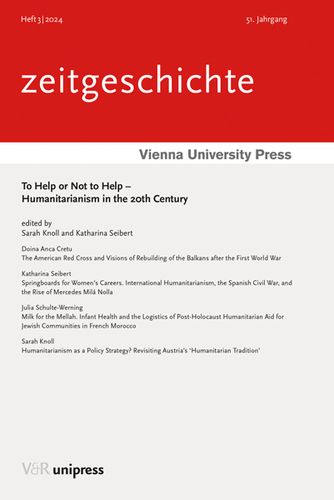
Paperback (Published)
(November 2024)
ISBN: 9783847117414
6.1 x 9.13 inches
Price: $35.00
In stock
This special issue approaches humanitarianism and humanitarian aid from the perspective of such ‘benevolent saviors’ and their agendas and covers different moments in history and geographical regions in the 20th century. The papers analyze humanitarianism as a reconstruction mission according to civilizing desires, as an enabling factor for individual professionalization, as a power struggle, and as a tool for domestic and international policymaking.
Today, humanitarianism, as a moral imperative to help, is prevalent, especially in the so-called Western world. The public react to natural disasters, war, or medical emergencies with a desire to alleviate suffering. But in recent decades historians have begun to critically assess this moral perspective and examine humanitarian organizations, politics, and the motives of humanitarian actors. They highlight how helping people relieve their suffering is just one side to every humanitarian story. Humanitarian actors themselves have their own reasons for helping. Humanitarian aid evolves in a tense dialectic between people in need and the individual agendas of the ‘benevolent saviors.’ The third issue approaches humanitarianism and humanitarian aid from the perspective of such ‘benevolent saviors’ and their agendas and covers different moments in history and geographical regions in the 20th century. The papers analyze humanitarianism as a reconstruction mission according to civilizing desires, as an enabling factor for individual professionalization, as a power struggle, and as a tool for domestic and international policymaking.
- Contributions by Doina Anca Cretu
- Contributions by Julia Schulte-Werning
- Edited by Sarah Knoll
- Edited by Katharina Seibert
Similar Books

 As Messianism Turns to Heresy
The Regenstein Chair Lectures On Lurianic Kabbalah and Shabbatai Tzevi at Hebrew Union College - Cincinnati

 Beyond Sovereign Courts
Agents and Practices in Early Modern Spanish and Habsburg Diplomacy
Volume 3





 Food Security under Armed Conflict
Global Knowledge Landscape and Public Attention to Social, Economic, and Humanitarian Dimensions

 Innovationes Lovanienses: Arts, Law and Theology at the University of Louvain (1425–1797)
Studium Lovaniense: Learning across Borders, 2
Volume 18


 Myths and Tales of the Inughuit
Erik Holtved's Polar Eskimo Texts Revised and Re-translated into Danish and English
Volume 475, 12


 Students, Scholars and Their Books at the University of Louvain (1425-1797)
Studium Lovaniense: Learning across Borders, 1
Volume 17


 The Exeter Companion to Fairies, Nereids, Trolls and other Social Supernatural Beings
European Traditions


 The Phantom Hitchhiker
Italian Literature, Japanese Lore, and the Transnational Afterlives of a Global Ghost Story