
Thinking about Political Things
An Aristotelian Approach to Pacific Life
by Andrew Murray
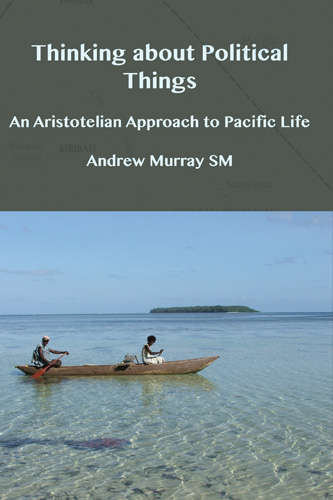
Paperback (Published)
(May 2016)
ISBN: 9781925232981
5.94 x 9.09 inches
Price: $21.95
In stock
Hardback (Published)
(May 2016)
ISBN: 9781925232998
5.94 x 9.09 inches
Price: $29.95
In stock
“Andrew Murray offers us an ingenious and humane reading of Aristotle’s Politics. He presents the Politics as its author intended it to be received, as a work that clarifies how we must think about political matters and order our civic communities if we are to bring out the best in our humanity. He does this by blending classical political philosophy with the concerns of contemporary political societies of the Pacific islands: the chapters of the book move back and forth between Aristotle and life in Melanesia, Polynesia, and Micronesia. Murray acknowledges the sharp difference between the classical city and the modern state, and shows what we who live in modern states are in danger of losing if we abandon Aristotle for Hobbes.’ Robert Sokolowski, Elizabeth Breckenridge Caldwell Professor of Philosophy, The Catholic University of America ‘Andrew Murray offers extensive research, reflection, and deep thought on the political life of Pacific island states and applies Aristotelian political philosophy to Pacific experiences. The book is successful in its aim to explain the political philosophy of Aristotle in a way that is simple yet clear so as to enable Pacific islanders to apply Aristotle’s thought to their own issues. Concerns of the three main races of the Pacific namely the Polynesians, Melanesians and Micronesians are well represented in excursions from the main text. While the situations in Fiji and Tonga remain difficult and will need further research, it is worth noting that the thought of democracy in Tonga was initiated by Professor Futa Helu of ‘Atenisi, who followed the Greek thinkers. The attempt to understand the political life of the Pacific islands under the light of Aristotle’s thought is a huge task. This book is a great contribution to political thinking in the Pacific islands.” Soane Patita P Cardinal Mafi, Bishop of Tonga & Niue
“Andrew Murray offers us an ingenious and humane reading of Aristotle’s Politics. He presents the Politics as its author intended it to be received, as a work that clarifies how we must think about political matters and order our civic communities if we are to bring out the best in our humanity. He does this by blending classical political philosophy with the concerns of contemporary political societies of the Pacific islands: the chapters of the book move back and forth between Aristotle and life in Melanesia, Polynesia, and Micronesia. Murray acknowledges the sharp difference between the classical city and the modern state, and shows what we who live in modern states are in danger of losing if we abandon Aristotle for Hobbes.’ Robert Sokolowski, Elizabeth Breckenridge Caldwell Professor of Philosophy, The Catholic University of America ‘Andrew Murray offers extensive research, reflection, and deep thought on the political life of Pacific island states and applies Aristotelian political philosophy to Pacific experiences. The book is successful in its aim to explain the political philosophy of Aristotle in a way that is simple yet clear so as to enable Pacific islanders to apply Aristotle’s thought to their own issues. Concerns of the three main races of the Pacific namely the Polynesians, Melanesians and Micronesians are well represented in excursions from the main text. While the situations in Fiji and Tonga remain difficult and will need further research, it is worth noting that the thought of democracy in Tonga was initiated by Professor Futa Helu of ‘Atenisi, who followed the Greek thinkers. The attempt to understand the political life of the Pacific islands under the light of Aristotle’s thought is a huge task. This book is a great contribution to political thinking in the Pacific islands.” Soane Patita P Cardinal Mafi, Bishop of Tonga & Niue
- By (author) Andrew Murray
Other Titles in this Series
Similar Books


 As Messianism Turns to Heresy
The Regenstein Chair Lectures On Lurianic Kabbalah and Shabbatai Tzevi at Hebrew Union College - Cincinnati

 Beyond Sovereign Courts
Agents and Practices in Early Modern Spanish and Habsburg Diplomacy
Volume 3



 Contesting Labeled Identities
The Sociology of Gentilics in Biblical and Northwest Semitic Literature



 Drunk the Potion, No Whit Charmed
The Doctrine of Pure and Perfect Souls from Iamblichus to Damascius


 Epigraphic “Shades” from Hellenistic Thrace
Contextualizing Inscriptions in Greek from Thracian Tombs

 Epiphanies of the Divine in the Septuagint and the New Testament
Fifth International Symposium of the Corpus Judaeo-Hellenisticum Novi Testamenti (CJHNT), 14-17 May 2015, Nottingham


 Éthique, politique, religions
Superstition (XVIIe - XXIe siècles). Sémantique, histoires et cultures


 Food Security under Armed Conflict
Global Knowledge Landscape and Public Attention to Social, Economic, and Humanitarian Dimensions


 Gold, Silver and Glass: Power Networks, Cultural Identities, Technology Transfers and Agency across the Old World (7th Century BC – 1st Century AD)
Proceedings of a Conference Held at the British Museum, 16–18 June 2023

 Innovationes Lovanienses: Arts, Law and Theology at the University of Louvain (1425–1797)
Studium Lovaniense: Learning across Borders, 2
Volume 18
 La Lettre clandestine
La littérature philosophique clandestine, ses éditeurs et ses éditions
Volume 34

 Language and Power in the Roman Empire and Early India
Hierarchy, Ambiguity, and the Art of Reading the Signs in Cosmopolitan Cultures