
Theologie als Erzahlung im Markusevangelium
Eine narratologisch-rezeptionsasthetische Studie zu Mk 1,1-15
by Christian Rose

English summary: Christian Rose examines the image of God in Mark. Whereas in the past the relationship between Christology and theology has often been determined by theology, the narrator in Mark develops an image of God from the opposite perspective by talking of Jesus Christ. Thus the oldest Gospel depicts a certain form of narrative theology: theology as a narrative, and for this reason the author uses questions pertaining to narrative criticism and reader response criticism for his analysis of the text. Since the beginning of a narrative forms the basis for the entire text, the author also studies Mark 1:21-28; 2:1-12; 9:2-13 and 15:33-41 in addition to Mark 1:1-15 in order to show the references within the whole narrative. In doing so, he demonstrates that due to the deliberately polyvalent wording of Mark 1:1 not only Mark but Jesus Christ himself has to be regarded as a narrator of God’s Gospel (Mark 1:14ff.). German description: Das Verhaltnis von Christologie und Theologie ist in der Vergangenheit haufig aus der Perspektive der Theologie bestimmt worden. Der alteste Evangelist aber schlagt den entgegengesetzten Weg ein: Er geht von Jesus Christus aus und erzahlt von dessen Auftreten und Wirken. So wahrgenommen, erscheint das Markusevangelium als eine bestimmte Form narrativer Theologie; es ist eine Theologie als Erzahlung. Fur die Analyse des altesten Evangeliums wendet Christian Rose deshalb narratologische und rezeptionsasthetische Fragestellungen an; einen Schwerpunkt bildet Gerard Genettes Die Erzahlung, einen anderen zwei neuere rezeptionsorientiert arbeitende exegetische Entwurfe von Moises Mayordomo-Marin und Detlef Dieckmann. Die Literaturwissenschaft weist dem Anfang eines Textes besondere Bedeutung zu; der Anfang einer Erzahlung hat Basisfunktion fur die ganze Erzahlung. Dieser Anfang liegt im Markusevangelium in Mk 1,1-15. Hier erarbeitet der Erzahler die Grundlagen fur das, was er im folgenden Text berichten wird. Neben einer genauen Analyse dieser Verse werden als weitere exemplarische Textabschnitte Mk 1,21-28; 2,1-12; 9,2-13 und 15,33-41 untersucht, um die Bezuge zum Anfang aufzuzeigen. Dabei wird deutlich, dass nicht nur Markus der Erzahler des Evangeliums ist, sondern dass durch die bewusst polyvalente Formulierung von Mk 1,1 auch Jesus Christus selbst als Erzahler des Evangeliums Gottes (Mk 1,14f.) gelten muss.
- By (author) Christian Rose
Other Titles in this Series
 Jesaja 53 als theologische Mitte der Apostelgeschichte
Studien zu ihrer Christologie und Ekklesiologie im Anschluss an Apg 8,26-40
Volume 398

 Luke-Acts and Jewish Historiography
A Study on the Theology, Literature, and Ideology of Luke-Acts
Volume 366


 Jesus’ Transfiguration and the Believers’ Transformation
A Study of the Transfiguration and Its Development in Early Christian Writings
Volume 265
 Jesus, the Tribulation, and the End of the Exile
Restoration Eschatology and the Origin of the Atonement
Volume 204

 Die Wunder an den Widersachern
Wunderhermeneutik am Beispiel der Strafwunder im lukanischen Doppelwerk
Volume 612


 The Temple Keys of Isaiah 22:22, Revelation 3:7, and Matthew 16:19
The Isaianic Temple Background and Its Spatial Significance for the Mission of Early Christ Followers
Volume 559


 Peter – Apocalyptic Seer
The Influence of the Apocalypse Genre on Matthew's Portrayal of Peter
Volume 348

 Spirits and the Proclamation of Christ
1 Peter 3:18-22 in Light of Sin and Punishment Traditions in Early Jewish and Christian Literature
Volume 305


 Jesus as the Eschatological Davidic Shepherd
Studies in the Old Testament, Second Temple Judaism, and in the Gospel of Matthew
Volume 216

 Schopfungspoetik im Johannesevangelium
Sprachanalytische Untersuchungen zum Lebensmotiv. Kontexte und Normen neutestamentlicher Ethik / Contexts and Norms of New Testament Ethics. Band XVI
Volume 621

 Desire in Paul’s Undisputed Epistles
Semantic Observations on the Use of epithymeo, ho epithymetes, and epithymia in Roman Imperial Texts
Volume 539


Similar Books


 Athanasius of Alexandria, Epistula ad episcopos Aegypti et Libyae
Old Slavonic Version and English Translation
Volume 261


 Cyril of Alexandria’s Christological Exegesis
Explorations of Partitive Exegesis in the Dialogues on the Trinity
Volume 70


 Epiphanies of the Divine in the Septuagint and the New Testament
Fifth International Symposium of the Corpus Judaeo-Hellenisticum Novi Testamenti (CJHNT), 14-17 May 2015, Nottingham

 Extracanonical Traditions and the Holy Land
Texts, Rituals, and Material Culture in Late Antique Palestine
 From Joseph to Jesus
The Joseph Narrative as a Compositional Template from Old Greek Esther to the Gospel of Luke
Volume 125


 Paradise Lost in Transmission
The Return to Eden in the Apocalypse of Peter within Its Ethiopic and Early Christian Contexts



 Punning in Odd or Elegant Constructions in Jeremiah
The Convergence of Linguistics, Rhetoric, and Textuality in the Hebrew Text of Jeremiah

 Shame in the Worlds of the Hebrew Bible and Akkadian Texts
A Linguistic Study and Its Implications
Volume 33

 Tabernacle, Table, Ark, and Text
Richard of Saint Victor on the Interpretation of Scripture
Volume 67
 The Anglo-Norman Bible’s Books of Kings, a Critical Edition
(BL Royal 1 C III, fols 234r-274v)
Volume 37
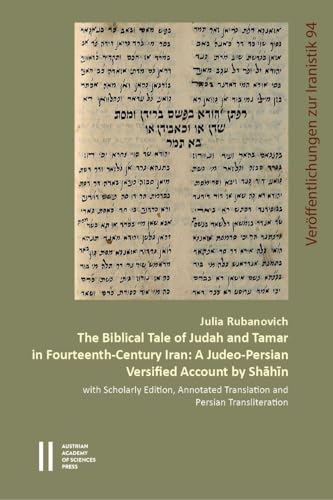 The Biblical Tale of Judah and Tamar in Fourteenth-Century Iran
A Judeo-Persian Versified Account by Shāhīn with Scholarly Edition, Annotated Translation and Persian Transliteration
Volume 94, 951
 The Body
Lived, Cultured, Adorned: Essays on Dress and the Body in the Bible and Ancient Near East in Honor of Nili S. Fox

 The Compositional History of the Book of Kings
An Analysis of the Evaluative Frameworks in 1 Kings 14–2 Kings 25
 The Discourse of Rites
Shaping and Reshaping the (Counter-)Priestly Rituals Conducted Outside the Tabernacle


