
The Hagia Photia Cemetery I
The Tomb Groups and Architecture
by Costis Davaras and Philip P. Betancourt

This volume presents the tomb groups and the architecture of the Hagia Photia Cemetery, which takes its name from the nearby village on the northeast coast of Crete, 5 km east of modern Siteia. This large Early Minoan burial ground with over fifteen hundred Cycladic imports was discovered in 1971.
The Hagia Photia Cemetery takes its name from the nearby village on the northeast coast of Crete, 5 km east of modern Siteia. This large Early Minoan burial ground with over fifteen hundred Cycladic imports was discovered in 1971. A total of 263 tombs were excavated as a rescue excavation in 1971 and 1984. Among the 1800 artefacts are some of the earliest known Cretan discoveries of several types: the grave goods come mostly from the Kampos Group, an assemblage of artefacts known mainly from the Cyclades. Similarly, the tombs represent an architectural style and a series of burial customs that are foreign to Crete but familiar from elsewhere within the Aegean. In fact, the cemetery has such close parallels from the Cyclades that it has often been regarded as a Cycladic colony. The burial contents are an extremely interesting body of evidence for the study of the formative phases of Minoan Crete.
- By (author) Philip P. Betancourt
- By (author) Costis Davaras
Other Titles in this Series
 An Archaeological Survey of the Gournia Landscape
A Regional History of the Mirabello Bay, Crete, in Antiquity
Volume 37

 Mochlos IC
Period III. Neopalatial Settlement on the Coast: The Artisans' Quarter and the Farmhouse at Chalinomouri: The Small Finds
Volume 9


 Mochlos IVA
Period III. The House of the Metal Merchant and Other Buildings in the Neopalatial Town
Volume 68



 The Shrine of Eileithyia
Minoan Goddess of Childbirth and Motherhood, at the Inatos Cave in Southern Crete: Volume I: The Egyptian-Type Artifacts
Volume 69




 The Cave of the Cyclops
Mesolithic and Neolithic Networks in the Northern Aegean, Greece. Volume I: Intra-Site Analysis, Local Industries, and Regional Site Distribution
Volume 21
 An Archaeological Palimpsest in Minoan Crete
Tholos Tomb A and Habitation at Apesokari Mesara
Volume 70



Similar Books


 Behind the Scenes of Medieval Roofs
An Overview of the Roofing Systems of Italian Churches
Volume 90

 Caesar’s Visions and Impact on the Roman Empire
Revisiting the Archaeological and Historical Record of the 40s BC
Volume 2

 Circulation, Use, Impact
The Consumption of Architectural Books in the Early Modern Eastern Adriatic
Volume 1


 Etruscan and Roman Hellenistic Anatomical ex votos
Reassessing Popular Religious Expressions in Central Italy
Volume 8




 Invisible Labour in Antiquity
Visualizing Obscure Work in the Ancient Mediterannean and West Asia
Volume 1

 Late Antique villae in the Balkans (3rd–7th c. AD): Current Research Questions and Perspectives
HAEMUS Companion to the Late Antique Balkans 1
Volume 4
 Making and Meaning in the Bronze and Iron Ages
Chronology, Landscapes and Societies across Europe. Proceedings from the METALAGES2024 Colloquium (Florence, 23 October 2024)


 Portraying the Individual in the Roman East
Local–Imperial Entanglements in Sculpture, Mosaics, and Paintings (First–Fourth Centuries AD)
Volume 18


 Small Worlds and Relational Agencies: Local Societies in Early Medieval Iberia
Pequeños mundos y Agencias relacionales: Sociedades locales altomedievales en la Península Ibérica




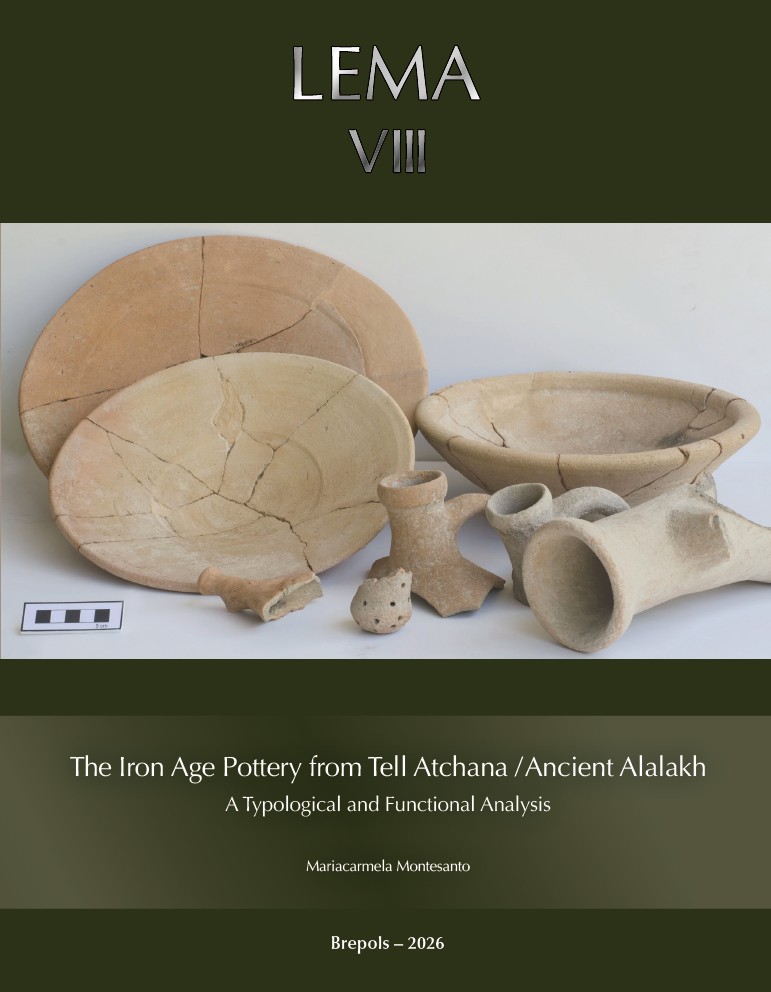 The Iron Age Pottery from Tell Atchana / Ancient Alalakh
A Typological and Functional Analysis
Volume 8


 Visual Memory and Oblivion
Monuments and Conflicts in Urban Spaces in Central and Eastern Europe from the Nineteenth Century to the Present Day

 Writing in the Church of the Nativity in Bethlehem
Inscription and Graffiti in a Multilingual and Multigraphic Perspective
Volume 45