The Death of the Maiden in Classical Athens
By (author) Katia Margariti
Paperback (Published)
(March 2017)
ISBN: 9781784915469
8.07 x 11.46 inches
Price: $160.00
In stock
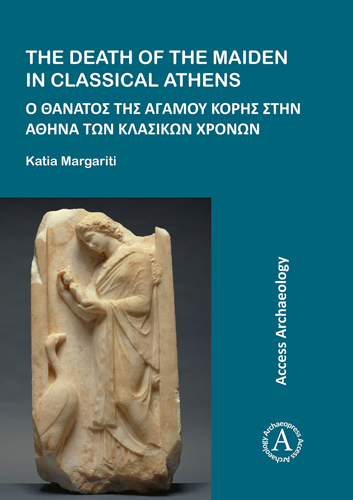
The present study examines the death of maidens in classical Athens, combining the study of Attic funerary iconography with research on classical Attic maiden burials, funerary inscriptions, tragic plays, as well as the relevant Attic myths. The iconography of funerary reliefs focuses on the idealized image of the deceased maiden, as well as the powerful bonds of love and kinship that unite her with the members of her family, whereas the iconography of vases emphasizes the premature death of the maiden, the pain of loss and mourning felt by her family, as well as the observance of the indispensable funerary rites concerning her burial and ‘tomb cult’. Particularly interesting is the fact that the ‘traditional’ theory according to which the loutrophoros marked the graves of the unmarried dead alone has been proven non valid. The study of classical Attic maiden burials indicates that the prematurely dead maidens were buried as children who didn’t live long enough to reach adulthood. The untimely death of maidens in Attic drama and mythology is beneficial to the family or the city. In great contrast to that, the premature death of real – life Athenian maidens was a terrible disaster for the girls’ families, as well as the polis itself. Despite this, the iconography of dead maidens in classical Athens is in accordance with the ‘image’ of the deceased maidens presented by funerary epigrams, tragedy, and mythology. It has to be noted though, that the same is not true in the case of maiden burials. This Access Archaeology publication presents a special edition of Katia Margariti’s doctoral thesis entitled The Death of the Maiden in Classical Athens. The original thesis was submitted to the Department of History, Archaeology, and Social Anthropology (IAKA) of the University of Thessaly in Volos in 2010. Here the original thesis is augmented by an extensive 63 page summary in English accompanied by the original Greek text, catalogue and illustrations. The thesis contains much valuable analysis and catalogue material and this publication has been produced in order that the work should not be overlooked merely for reasons of language.
Katia Margariti has a PhD in Classical Archaeology and is a Research Associate of the Department of Classics of the University of Reading. Having published three books and peer-reviewed articles in leading academic journals, she is currently co-authoring two books and co-editing a conference proceedings volume. She is co-founder and administrator of the online group for the study of animals in Greco-Roman Antiquity (Zoa – Animals in Greco-Roman Antiquity), co-organizer of two major international conferences on animals in the ancient Mediterranean. Her research interests focus on Greek art and iconography with special emphasis on ancient Athens, funerary art (especially funerary sculpture) and animals in antiquity.
- By (author) Katia Margariti
Similar Books


 Contesting Labeled Identities
The Sociology of Gentilics in Biblical and Northwest Semitic Literature

 Drunk the Potion, No Whit Charmed
The Doctrine of Pure and Perfect Souls from Iamblichus to Damascius

 Epigraphic “Shades” from Hellenistic Thrace
Contextualizing Inscriptions in Greek from Thracian Tombs

 Epiphanies of the Divine in the Septuagint and the New Testament
Fifth International Symposium of the Corpus Judaeo-Hellenisticum Novi Testamenti (CJHNT), 14-17 May 2015, Nottingham


 Gold, Silver and Glass: Power Networks, Cultural Identities, Technology Transfers and Agency across the Old World (7th Century BC – 1st Century AD)
Proceedings of a Conference Held at the British Museum, 16–18 June 2023
 Language and Power in the Roman Empire and Early India
Hierarchy, Ambiguity, and the Art of Reading the Signs in Cosmopolitan Cultures
 Late Antique villae in the Balkans (3rd–7th c. AD): Current Research Questions and Perspectives
HAEMUS Companion to the Late Antique Balkans 1
Volume 4


 Nurturing the Elite
Representations of Drinking, Eating, and Religious Vessels in Palmyrene Funerary Iconography
Volume 13





 Roman Copies, Collecting, and Culture in the Bay of Naples and Beyond
Papers in Honor of Eugene J. Dwyer



 The Compositional History of the Book of Kings
An Analysis of the Evaluative Frameworks in 1 Kings 14–2 Kings 25




 Zooarchaeology of Ancient Greek Sanctuaries in Southwestern Sicily
Faunal Analysis from Selinus and Akragas as Evidence of Differences in the Treatment of Animals for Ritual Purposes