
The Church of the Archangel Michael at Kavalariana
Art and Society on Fourteenth-Century Venetian-Dominated Crete
by Angeliki Lymberopoulou
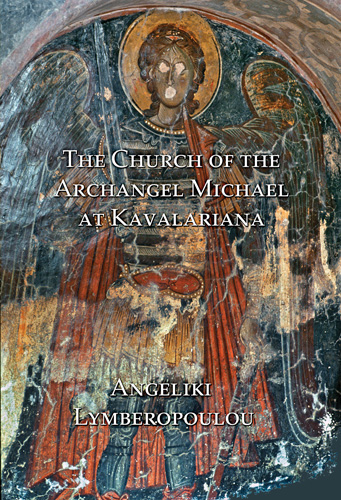
Dr Angeliki Lymberopoulou lectures on Byzantine Studies at the Open University, and is an expert on the art and society of Venetian-dominated Crete (1211-1669). During this period, Crete was perhaps the most important Venetian stronghold in the Mediterranean . The traditional view that there was little cultural interaction between the native Greek Orthodox population and the Venetian colonists has recently been cast in doubt. From the early fourteenth century onwards, the two ethnically and religiously different inhabitants of Crete formed in fact a hybrid society, and Cretan artistic development reflects this progress. The book focuses as a case study on the church of the Archangel Michael at Kavalariana. This is a small church in the village of Kavalariana on the south-western part of the island. It is dated by a dedicatory inscription to the year 1327/28. The conservative iconographic programme of the wall paintings inside the church consists of seventeen religious scenes and thirty-three isolated saintly figures. As the paintings are signed Ioannes, they have been attributed to the prolific fourteenth-century Cretan artist Ioannes Pagomenos. A close examination of the style and comparisons with Pagomenos’ oeuvre suggest, however, that Ioannes of Kavalariana was a separate artist with an identity of his own. A unique feature of the Kavalariana cycle is the pro-Venetian inscription which, in combination with the fourteen portraits of the donors that appear in the church, forms an important witness to Venetian/Cretan cultural interaction.
Preface 1: Introducing the Monument: Introduction The Historical Context: The Venetian period in Crete (1211-1669) 'By the Hand of Ioannes Pagomenos' Architecture 2: The Iconographic Programme: Introduction Sanctuary The Bishops on the North and South Walls Nave, The Feast Cycle
Nave, Figures The Kavalariana Programme 3: Stylistic Analysis: Introduction
Figures: Kavalariana The Pagomenos Group
Scenes: Kavalariana The Pagomenos Group
Iconographic Programmes Decorative Motifs: Kavalariana The Pagomenos Group Inscriptions: Kavalariana
The Pagomenos Group Conclusions The Church of the Archangel Michael and Fourteenth-Century Monumental Painting 4: Signs of their Time: The Inscription and the Donors of the Church of the Archangel Michael at Kavalariana 5: Conclusions Bibliography Index Plates
- By (author) Angeliki Lymberopoulou
Similar Books

 Behind the Scenes of Medieval Roofs
An Overview of the Roofing Systems of Italian Churches
Volume 90
 Circulation, Use, Impact
The Consumption of Architectural Books in the Early Modern Eastern Adriatic
Volume 1


 Late Antique villae in the Balkans (3rd–7th c. AD): Current Research Questions and Perspectives
HAEMUS Companion to the Late Antique Balkans 1
Volume 4


 Visual Memory and Oblivion
Monuments and Conflicts in Urban Spaces in Central and Eastern Europe from the Nineteenth Century to the Present Day


 Die Entwicklung erdbebensicherer Bautechniken in der Frühen und Mittleren Eisenzeit in Ostanatolien
Volume 11
 La chiesa di San Francesco grande e l’ospedale antico di Padova
Archeologia Storia Arte Architettura e Restauri
Volume 8


 Building the Presence of the Prince
The Institutions Responsible for the Construction and Management of the Buildings of European Courts (14th-17th centuries)
Volume 14
 Ceramics in Plain Sight: The Bacini of the Churches of Crete. “Reflections” of the Late Medieval and the Early Modern Material Culture of the Island
Volume II: The Regional Unit of Lasithi
Volume 13



 The Molyvoti, Thrace, Archaeological Project 1
Landscape, Architecture, and Material Culture
Volume 54


 Tributes to T.A. Heslop
From Miniature to Monumental: Studies in Medieval Art and Architecture
Volume 14