
The Archaeology of the Ostraca House at Israelite Samaria
Epigraphic Discoveries in Complicated Contexts
by Ron E. Tappy

Hardback (Published)
(November 2016)
ISBN: 9780897570954
8.46 x 10.98 inches
Price: $89.95
In stock
The Caesarea Mithraeum (sanctuary or temple of the god Mithras) is only one of two excavated from eastern half of the Empire. Includes new photographs, plans and section drawings; catalogues the small finds from the vault, and technical details about the recovery of information about frescoes and how the excavations were completed. 76 illus.
George Andrew Reisner counted the Israelite ostraca among the most important finds ever recovered by the Harvard Expedition to Samaria. But the precise provenance of these historic inscriptions has remained murky at best. To date, the most incisive and intuitive statement on their archaeological context comes from a brief treatment in I. T. Kaufman’s unpublished 1966 dissertation written at Harvard University. The present study considers in much greater detail the depositional history of the Ostraca House and its immediate surroundings. The investigation proceeds on three distinct but related levels. First, it attempts to clarify the date and nature of the archaeological contexts from which excavators recovered the inscriptions. Second, it evaluates both the quantity and quality of data recovered and the overall manner in which the project leaders presented those data in their official excavation report. Finally, the study draws not only from published records but also from unpublished materials recorded in the handwritten daily journals and private diaries of David Gordon Lyon, George Andrew Reisner, Clarence Stanley Fisher, and Gottlieb Schumacher. Thus an important subplot unfolds as the analysis of archaeological remains advances through the narrative. The unpublished records not only provide supplementary data crucial to a study of the ostraca, they also enliven the story behind the discovery of the inscriptions and reveal the archaeological and administrative trials persistently faced by the excavators, who found themselves working betwixt and between international and local powers and events during the waning years of the Ottoman Empire and the coming of World War I. Still, the internal and external struggles of a start-up expedition cast within a bourgeoning academic field and the vicissitudes of world affairs did not prevent the Harvard Expedition from becoming one of the most influential projects of the early twentieth century.
List of Illustrations List of Tables Preface Acknowledgements Abbreviations Chapter 1 - Introduction and Background A. The Site: Physical Setting and Early History B. The Backstory: Early Challenges for the Harvard Expedition C. The Harvard Expedition: Excavation Strategy, Methods, and Ensuing Challenges 1. 1908 Fieldwork 2. 1909 Fieldwork 3. 1910 Fieldwork D. Summary Chapter 2 - Horizontal Axis: The Ostraca Building's Original Footprint and Surrounding Area A. The Ostraca House 1. Wall A: Ahab's "Main Wall" 2. The Ostraca House: Entrance Halls, Storerooms, and Eastern Corridors (Long-Rooms) 3. Reconstructions 4. Later Additions (?) B. The Osorkon House C. Problems North and East of the Ostraca and Osorkon Houses D. Summary Chapter 3 - Vertical Axis: The Ostraca Building's Complex Depositional History A. Stratigraphic Analysis: Summary of Sections Published by the Harvard Expedition B. Stratigraphic Analysis: Discussion of Sections Relevant to the Ostraca House 1. Principal Longitudinal Section CD 2. Principal Lateral Section GH 3. Subsidiary Lateral Section AB C. Summary Chapter 4 - Ceramic Considerations A. The Harvard Excavations and the Joint Expedition: Collating the Data B. Reisner's Presentation of Pottery: A Meager Repertoire C. The 1910 Ostraca: Spatial Distribution D. The 1910 Ostraca: Typological Notes E. The 1910 Ostraca-related Pottery: Typological Notes F. The 1910 Ostraca and Ostraca-related Pottery: Comparative Ceramic Analysis 1. Epigraphic Pottery 2. Bowl Types Representing Parallels for Ostraca Pottery Forms 3. Non-epigraphic Pottery from the Same Findspots as the Ostraca 4. Comments on Some Jar Types Associated with Ostraca Pottery Forms G. Summary Chapter 5 - The Samaria Ostraca and Modern Scholarship Chapter 6 - Back to the Backstory: The Characters and Concerns behind the Harvard Expedition to Samaria Appendix A - Ostraca: Provenance Data and Vessel Descriptions Appendix B - Ostraca: Sequence of Discovery Appendix C - Non-epigraphic Pottery with Provenance Data Matching those of the Ostraca Appendix D - D. G. Lyon's Report to the President of Harvard University for the Academic Year 1898-1899, Showing the Financial Generosity of Jakob Heinrich Schiff Appendix E - Reisner's Field Drawings of Selected Ostraca Plates Bibliography Indices Biblical References Author Index Subject Index
- By (author) Ron E. Tappy
Other Titles in this Series
 The Nabataean Temple at Khirbet et-Tannur, Jordan, Volume 2
Cultic Offerings, Vessels, and Other Specialist Reports. Final Report on Nelson Glueck's 1937 Excavation
Volume 68

 Crossroads and Boundaries
The Archaeology of Past and Present in the Malloura Valley, Cyprus
Volume 65


 Bayt Farhi and the Sephardic Palaces of Ottoman Damascus in the Late 18th and 19th Centuries
Volume 72, 4

 Unsilencing the Archives
New Approaches to the History of Archaeological Labor in the Mandate Period Middle East
Volume 80

 Reflections of Empire
Archaeological and Ethnographic Perspectives on the Pottery of the Ottoman Levant
Volume 64
 City and Cemetery
Excavations at Kourion's Amathous Gate Cemetery, Cyprus. The Excavations of Danielle A. Parks Volume 1: Context, Analysis, and Conclusions
Volume 76
 City and Cemetery
Excavations at Kourions Amathous Gate Cemetery, Cyprus. The Excavations of Danielle A. Parks Volume 2: Human Bone, Ecofacts, and Artifacts
Volume 77


 The Nabataean Temple at Khirbet et-Tannur, Jordan, Volume 1
Architecture and Religion. Final Report on Nelson Glueck's 1937 Excavation
Volume 67

Similar Books



 Connecting the Dots: Counting, Writing, and the Beginnings of Civilization
The Secret Lives of Clay Tokens: A Memoir


 Exploring Gender Dynamics across the Ancient Near East
Collected Essays of Gender and Methodology in the Ancient Near East (GeMANE) 4 and 5
Volume 7


 Ḫattušaš utnē išḫameški
Hittite and Other Ancient Near Eastern Studies Presented to Piotr Taracha on the Occasion of His 65th Birthday


 New Research on Old Collections in Southwest Asian Archaeology
Proceedings of the Workshop Held at the British Museum, London, 31 July – 2 August, 2023
 Old Aramaic Inscriptions and their Contexts
An Epigraphic, Archaeological, and Historical Synthesis
Volume 63

 Pottery Traditions and Material Culture in Second Millennium BC Northern Mesopotamia
Contacts and New Horizons in the Land between the Tigris and the Zagros. Proceedings of a Workshop Held at the 12th ICAANE, University of Bologna, 7 April 2021
Volume 19
 Punning in Odd or Elegant Constructions in Jeremiah
The Convergence of Linguistics, Rhetoric, and Textuality in the Hebrew Text of Jeremiah

 Shame in the Worlds of the Hebrew Bible and Akkadian Texts
A Linguistic Study and Its Implications
Volume 33
 Telling Contexts
Archaeological and Textual Studies in Honor of Elizabeth Bloch-Smith and Mark S. Smith
 The Body
Lived, Cultured, Adorned: Essays on Dress and the Body in the Bible and Ancient Near East in Honor of Nili S. Fox
 The Discourse of Rites
Shaping and Reshaping the (Counter-)Priestly Rituals Conducted Outside the Tabernacle
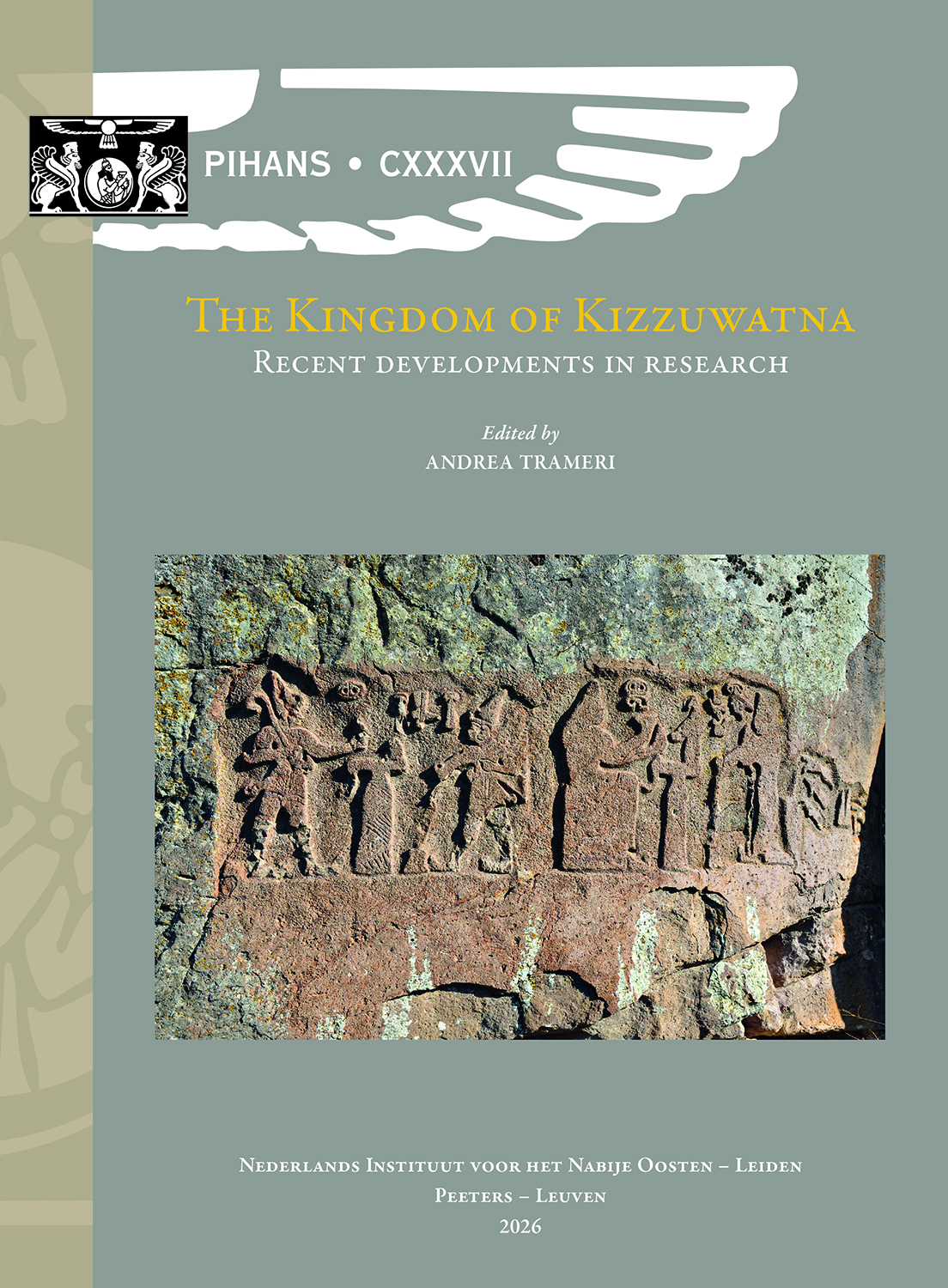 The Kingdom of Kizzuwatna: Recent Developments in Research
Proceedings of the Third NINO Postdoctoral Research Fellow Annual Conference, Leiden, 23rd-25th March 2023
Volume 137


 Die Entwicklung erdbebensicherer Bautechniken in der Frühen und Mittleren Eisenzeit in Ostanatolien
Volume 11
 Die JHWH-Religion und die Vorstellung göttlicher Gesetzgebung
Überschneidungen zwischen der Rechtsentwicklung und der Sphäre der Religion in der Geschichte des antiken Israel und Juda

 Kultur – Kontakt – Kultur
Beiträge anlässlich der 66. Rencontre Assyriologique Internationale in Frankfurt/Main und Mainz, 25.–29. Juli 2022
Volume 35
 Menschenwürde und Menschenrechte im Altem Orient, Israel und Hellas. Band 1
Human Dignity and Human Rights in the Ancient Near East, Ancient Israel, and Hellas. Volume 1
Volume 311
 Ptolemaiou Procheiroi Kanones. Les «Tables Faciles» de Ptolemée. Volume 2a: Tables A3-A13
Édition critique, Transcription
 Sprachwissenschaftliche und kulturhistorische Reflexionen
Festschrift zu Ehren von Jörg Klinger
Volume 31

 Vom Mädchen zur Frau
Weihgaben als Indikatoren rituellen und kommunikativen Handelns von Frauen in griechischen Kulten
Volume 188