
Textiles, Technical Practice, and Power in the Andes
Edited by Denise Y. Arnold Edited by Penny Dransart

Paperback (Published)
(June 2014)
ISBN: 9781909492080
8.27 x 11.69 inches
Price: $120.00
In stock
An examination of the central role of textiles in Andean societies, past and present, highlighting their function as expressions of technological knowledge, social identity, and cosmology. Approaching textiles from a weaver’s perspective, the editors explore how structure, technique, and iconography reflect a complex three-dimensional worldview. Tracing the full production process, the book reveals how textiles embody shared cultural experiences and serve as tools for social integration, linking technology with power, gender, and community.
This book explores the importance of textiles in Andean societies, past and present, as vital indicators of regional ideas about technique and technology, and the ways these interact with power relations, including gender and class relations. The focus is on Andean textiles from a weaver’s point of view, as living things which express a complex three-dimensional worldview through their structures, techniques and iconography. These ontological conceptions are traced through the various tasks and processes in the productive chain of textile making, and the manifold ways in which the ideas about a finished textile product refer back continually to these shared experiences in Andean societies. Different thematic approaches examine how the material existence of textiles served, and still serves, as a record of technological knowledge, at the heart of human-centred efforts to integrate and coordinate diverse populations into socio-cultural and productive endeavours in common.
Introduction: Denise Y. Arnold
Part I - Andean textiles as cultural records, and issues in their documentation
1. Textiles, knotted khipus, and a semiosis in common: Towards a woven language of documentation in the Andes - Denise Y. Arnold
2. Practice and meaning in spiral-wrapped batons and cords from Cerrillos, a Late Paracas site in the Ica Valley, Peru - Jeffrey Splitstoser
3. Andean calendrical knowledge in the royal tunics called tarco huallca: Inca, Huari and Tiahuanaco tunics read as fourfold almanacs - R. T. Zuidema
Part II - Andean textiles, technology and material culture: Textile technologies and their social consequences
4. Paracas Necropolis: Communities of textile production, exchange networks and social boundaries in the Central Andes, 150 BC to AD 250 - Ann H. Peters
5. Weaving the body politic: the integration of technological practice and embodied social identity in the late prehispanic Andes - Anne Tiballi
6. Technical reflections of highland-coastal relationships in late prehispanic textiles from Chillon and Chancay - Ann P. Rowe
Part III - Woven techniques, instruments and skilled bodies: being and doing though cloth
7. Technical competence in weaving as a means of distinction among young Macha women, in Northern Potosi, Bolivia - Cassandra Torrico
8. Thoughts on productive knowledge in Andean weaving with discontinuous warp and weft - Penelope Dransart
9. Prehispanic textile production in Highland Bolivia: instruments for spinning and weaving processes - Claudia Rivera Casanovas
Part IV - Textiles as visual records of technological knowledge and worldview
10. The Dumbarton Oaks royal tunic perceived as a register of Inca worldview - Gail Silverman
11. On the relation between Andean textile iconography and woven techniques - Denise Y. Arnold, Miriam de Diego and Elvira Espejo
12. Woven techniques and social interactions in the South Central Andes: ladder designs and the visualisation of productive output - Elvira Espejo and Denise Y. Arnold
13. On textiles and alterity in the Recuay culture (AD 200-700), Ancash, Peru - George Lau,
Contents
Introduction: Denise Y. Arnold
Part I - Andean textiles as cultural records, and issues in their documentation
1. Textiles, knotted khipus, and a semiosis in common: Towards a woven language of documentation in the Andes - Denise Y. Arnold
2. Practice and meaning in spiral-wrapped batons and cords from Cerrillos, a Late Paracas site in the Ica Valley, Peru - Jeffrey Splitstoser
3. Andean calendrical knowledge in the royal tunics called tarco huallca: Inca, Huari and Tiahuanaco tunics read as fourfold almanacs - R. T. Zuidema
Part II - Andean textiles, technology and material culture: Textile technologies and their social consequences
4. Paracas Necropolis: Communities of textile production, exchange networks and social boundaries in the Central Andes, 150 BC to AD 250 - Ann H. Peters
5. Weaving the body politic: the integration of technological practice and embodied social identity in the late prehispanic Andes - Anne Tiballi
6. Technical reflections of highland-coastal relationships in late prehispanic textiles from Chillon and Chancay - Ann P. Rowe
Part III - Woven techniques, instruments and skilled bodies: being and doing though cloth
7. Technical competence in weaving as a means of distinction among young Macha women, in Northern Potosí, Bolivia - Cassandra Torrico
8. Thoughts on productive knowledge in Andean weaving with discontinuous warp and weft - Penelope Dransart
9. Prehispanic textile production in Highland Bolivia: instruments for spinning and weaving processes - Claudia Rivera Casanovas
Part IV - Textiles as visual records of technological knowledge and worldview
10. The Dumbarton Oaks royal tunic perceived as a register of Inca worldview - Gail Silverman
11. On the relation between Andean textile iconography and woven techniques - Denise Y. Arnold, Miriam de Diego and Elvira Espejo
12. Woven techniques and social interactions in the South Central Andes: ladder designs and the visualisation of productive output - Elvira Espejo and Denise Y. Arnold
13. On textiles and alterity in the Recuay culture (AD 200-700), Ancash, Peru - George Lau
- Edited by Denise Y. Arnold
- Edited by Penny Dransart
Similar Books


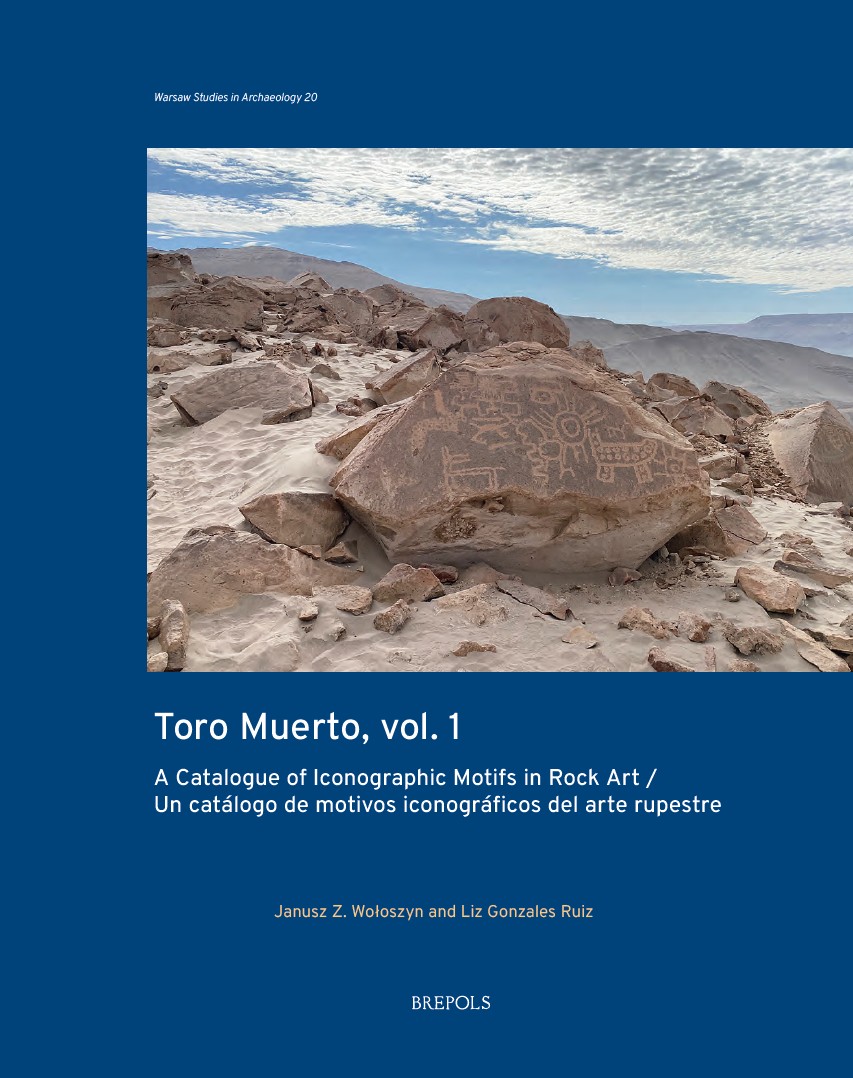 Toro Muerto, vol. I
A Catalogue of Iconographic Motifs in Rock Art / Un catálogo de motivos iconográficos del arte rupestre
Volume 20

 Outward Appearance versus Inward Significance
Addressing Identities through Attire in the Ancient World
Volume 15
 Textiles and War in Europe and the Mediterranean from Prehistory to Late Antiquity
Proceedings of the International Conference held at the Institute for Advanced Studies in Levant Culture and Civilisation in Bucharest, Romania, 17-19 May 2023


 Patrimonio antes del patrimonio
Una genealogía del pensamiento patrimonialista y la arqueología mexicana en un amplio siglo XIX


 From Sedentarisation to the Complex Society
Settlement, Economy, Environment, Cult. Proceedings of the workshops in Lisbon, Tehran and Lima (2016 − 2019)


 The Significance of Archaeological Textiles
Papers of the International Online Conference 24th–25th february 2021. THEFBO Volume II
 Adolescente de Jalpan
Primer estudio iconográfico y esbozo de interpretación iconológica sobre una escultura huasteca en la Sierra Gorda del Noreste de México


 Archaeological Investigations in Guadalupe, Northeast Honduras
Interaction Networks during the Late Pre-Hispanic Period (AD 900-1525)
Volume 19
 Flower World – Mundo Florido
Music Archaeology of the Americas - Arqueomusicologia de las Americas
Volume 7


 Obsidian Across the Americas
Compositional Studies Conducted in the Elemental Analysis Facility at the Field Museum of Natural History


 La fábrica del prestigio en Mesoamérica
Interacciones y alteridad en el Altiplano central durante el período epiclásico (600-900 d.C.)


