
Suites d’Homere de l’Antiquite a la Renaissance
edited by Diane Cuny and Arnaud Perrot
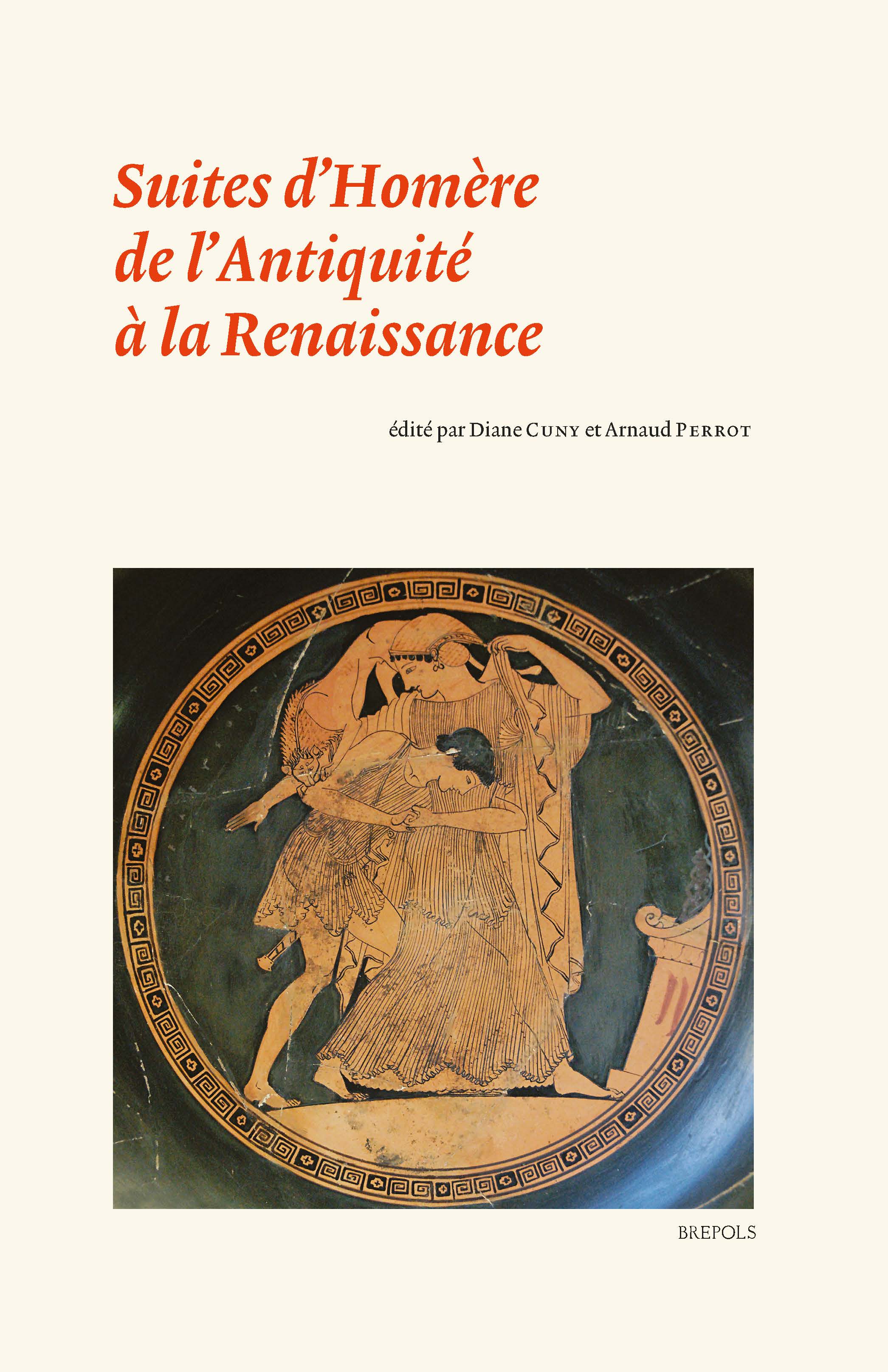
This book is the result of an international conference organized by the University of Tours in May 2021. It sets out to explore the notion of sequel in literature by examining the Homeric poems. While Gerard Genette evoked Homer in a considerable number of pages of his essay Palimpsestes, he however paid particular attention to forms of continuity from the front, from the back and from the sides, afterwards and sideways, which seem to make Homeric material the first victim of the cyclical additions that appear to constitute the ineluctable future of the great epics. In recent decades, however, these positions have been strongly nuanced and the time was ripe, therefore, for diachronic reflection on the validity of the notion of the ‘Homeric sequel’ by testing the meaning it has in various geographical and cultural contexts, from Antiquity to the Middle Ages and the Renaissance. The authors of this volume contribute to the discussion of the literary concept of ‘continuation’ and offer a wide panorama of the poet’s fruitful reception over time; they do so without neglecting the phenomena of transformation made possible by the survival of a mythology of Homeric origin which exists despite the absence of a direct reading of the Greek texts.
This book is the result of an international conference organized by the University of Tours in May 2021. It sets out to explore the notion of sequel in literature by examining the Homeric poems. While Gerard Genette evoked Homer in a considerable number of pages of his essay Palimpsestes, he however paid particular attention to forms of continuity from the front, from the back and from the sides, afterwards and sideways, which seem to make Homeric material the first victim of the cyclical additions that appear to constitute the ineluctable future of the great epics. In recent decades, however, these positions have been strongly nuanced and the time was ripe, therefore, for diachronic reflection on the validity of the notion of the ‘Homeric sequel’ by testing the meaning it has in various geographical and cultural contexts, from Antiquity to the Middle Ages and the Renaissance. The authors of this volume contribute to the discussion of the literary concept of ‘continuation’ and offer a wide panorama of the poet’s fruitful reception over time; they do so without neglecting the phenomena of transformation made possible by the survival of a mythology of Homeric origin which exists despite the absence of a direct reading of the Greek texts.
- Edited by Diane Cuny
- Edited by Arnaud Perrot
Other Titles in this Series
 La Bouquechardiere de Jean de Courcy
t. 4, La diaspora europeenne des Troyens. Edition critique et commentaire du Livre III
Volume 1.4
 La Bouquechardiere de Jean de Courcy
Introduction generale, edition critique et commentaire du recit des origines de la Grece jusqu'a Hercule
Volume 1.1
 La Bouquechardiere de Jean de Courcy
Tome VII : La fin des Seleucides et les Hasmoneens jusqu'a Herode
Volume 1.7
Similar Books
 A Collaborative Tapestry in Honour of Shirley Ann Brown / Une fresque brodée en l’honneur de Shirley Ann Brown
The Bayeux Tapestry Seen by her Colleagues and Friends / La Tapisserie de Bayeux vue par ses collègues et amis


 Balthasar Caymox of Nuremberg
Early Modern German Print Publishers: Popular Prints of the Seventeenth Century
 Behind the Scenes of Medieval Roofs
An Overview of the Roofing Systems of Italian Churches
Volume 90
 Beyond Sovereign Courts
Agents and Practices in Early Modern Spanish and Habsburg Diplomacy
Volume 3


 Circulation, Use, Impact
The Consumption of Architectural Books in the Early Modern Eastern Adriatic
Volume 1



 Contesting Labeled Identities
The Sociology of Gentilics in Biblical and Northwest Semitic Literature


 Councils, Conflicts, Correspondence
Urban Diplomacy in Reval (Tallinn) and Lübeck (c. 1470–1570)
Volume 67


 Drunk the Potion, No Whit Charmed
The Doctrine of Pure and Perfect Souls from Iamblichus to Damascius


 Epiphanies of the Divine in the Septuagint and the New Testament
Fifth International Symposium of the Corpus Judaeo-Hellenisticum Novi Testamenti (CJHNT), 14-17 May 2015, Nottingham




 Innovation and Medieval Communities
The Circulation of Ideas and Practices in and out of the Town (1200-1500)
Volume 63
 Innovationes Lovanienses: Arts, Law and Theology at the University of Louvain (1425–1797)
Studium Lovaniense: Learning across Borders, 2
Volume 18
 John Dunstaple Reading Boethius
John Dunstaple’s Annotations to Boethius’s “De institutione musica” in the Manuscript Oxford, Corpus Christi College Library, MS 118
 Language and Power in the Roman Empire and Early India
Hierarchy, Ambiguity, and the Art of Reading the Signs in Cosmopolitan Cultures