
St Gregory’s Minster, Kirkdale, North Yorkshire: Archaeological Investigations and Historical Context
By (author) Philip Rahtz† By (author) Lorna Watts
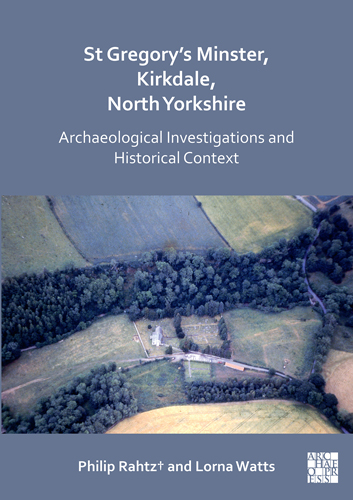
Paperback (Published)
(April 2021)
ISBN: 9781789694826
8.07 x 11.46 inches
Price: $68.00
In stock
The result of c. 20 years of work on and around the church of St Gregory’s Minster, Kirkdale, North Yorkshire, this work is concerned primarily with the 8th century onwards, but also extends the time-period of this isolated site, particularly for the post-Roman to middle Saxon period, but also as an earlier probably religious landsca
St Gregory’s Minster, Kirkdale, North Yorkshire: Archaeological Investigations and Historical Context is the result of c.20 years of work on and around the Anglo-Saxon church of St Gregory’s Minster, Kirkdale, North Yorkshire. It is primarily concerned with material relating to approximately the late 8th century onwards, detailing the fabric as well as excavations around the church and in the fields immediately adjacent. A succession of three church buildings are linked to a putative focus on the north side of the church, to which, it is argued, pre-Conquest elite burials were orientated. A pre-Conquest ‘building site’ to the north of the churchyard overlay an area of earlier burials. While the building is best-known for its mid-11th century inscription, the report extends the time-period of this isolated site, particularly for the post-Roman to middle Saxon period, but also as an earlier probably religious landscape. The volume integrates archaeological, landscape, place-name and historical approaches to consider the church in its wider setting, exploring the changing character of lordship from post-Roman to Anglo-Saxon and proposing an explanation for the long use of this non-settlement locale.
Summary Preface Chapter 1: The Site of Kirkdale Investigations in and around the Church Chapter 2: The West Exterior Chapter 3: The North Exterior Chapter 4: The South Exterior Chapter 5: The Chancel Exterior Chapter 6: The Church Interior Investigations in the locality Chapter 7: Adjacent Fields Assemblages Chapter 8: Human bones Chapter 9: The Artefacts Synthesis Chapter 10: Overview and Interpretation References, Summary ;
Preface ;
Chapter 1: The Site of Kirkdale ;
Investigations in and around the Church Investigations in the locality Assemblages Synthesis References
Professor Philip Rahtz was founder of the Department of Archaeology at the University of York, where he was primarily interested in equipping students with techniques that would enable them to be able to excavate and produce reports on all periods. ;
Lorna Watts has worked as a freelance archaeologist since the 1970s.
- By (author) Philip Rahtz†
- By (author) Lorna Watts
'This well-presented and thoughtful report will be of interest from a wide range of perspectives. The excavations show how to use targeted trenches disturbing only a fraction of the available archaeology to unravel the history of a church. The explanations of stratigraphic sequences and logical inferences from the structure of the building show how to go about distinguishing the phases of a building, and are revealing about how rebuilding was undertaken. The expert osteoarchaeological analysis of the bodies, by Lizzie Craig-Atkins, adds a valuable cemetery population to our corpus. The catalogue of individual artefacts encompasses fragments of stone sculpture, fired clay, pottery, glass, melon beads, jet, a copper alloy strap end, and metal-working slags. The final overview and interpretation shows the limits of what our broader historical models and interpretations of the Anglo-Saxon Church can do when they are confronted by the sequence of developments at a single site.'–Thomas Pickles (2021): Northern History, DOI: 10.1080/0078172X.2021.1968175
—
‘…this publication is a remarkable testament as to what can be achieved by the close scrutiny of a charismatic site such as this without recourse to largescale excavation or developer funding. It benefits greatly from its authors’ deep-time perspective, who seek to place their findings in a numinous landscape of abiding cult significance rather than fixating on the upstanding early medieval remains, and who do not shy away from placing the often-fragmentary information within its broader social, political and intellectual contexts.’ – Michael Shapland (2022): Medieval Archaeology, 65/2, 2021
—
‘The yield of significant data from this unfunded project, sustained by the enthusiasm of the excavators and local residents, exceeds that from many much larger ones. The report is straightforward, easily used, and provides all the necessary evidence. It passes the acid test for excavation reports in setting out the facts in an objective and non-dogmatic fashion and in suggesting interpretations while leaving the door open for different ones.’ – John Blair (2022): Medieval Settlement Research, Vol. 37
—
Similar Books
 «Solazoxa festa, stradolze e stracomplia»
Festschrift für Raymund Wilhelm zum 65. Geburtstag mit Beiträgen zu Diskurstraditionen und mittelalterlicher Philologie
Volume 249
 A Collaborative Tapestry in Honour of Shirley Ann Brown / Une fresque brodée en l’honneur de Shirley Ann Brown
The Bayeux Tapestry Seen by her Colleagues and Friends / La Tapisserie de Bayeux vue par ses collègues et amis

 Behind the Scenes of Medieval Roofs
An Overview of the Roofing Systems of Italian Churches
Volume 90

 Cahiers de recherches médiévales et humanistes – Journal of Medieval and Humanistic Studies
Volume 51







 Innovation and Medieval Communities
The Circulation of Ideas and Practices in and out of the Town (1200-1500)
Volume 63
 John Dunstaple Reading Boethius
John Dunstaple’s Annotations to Boethius’s “De institutione musica” in the Manuscript Oxford, Corpus Christi College Library, MS 118

 Medieval Debates on Foreknowledge: Future Contingents, Prophecy, and Divination
Acts of the XXVII Annual Colloquium of the SIEPM, Trento 12-15 September 2023
Volume 31

 Medieval Yeghegis, Armenia
History, Archaeology, Society. Local Multiplicities and Global Connections of a Rural Centre on the Silk Road(s)

 Nicholas of Lyra’s Commentaries on the Gospels of Matthew and Luke
Franciscan Exegesis in a Time of Crisis



 Power and Women in Southeast and Central Europe in Late Medieval and Early Modern Period (1300-1600)
Volume 10





 The Anglo-Norman Bible’s Books of Kings, a Critical Edition
(BL Royal 1 C III, fols 234r-274v)
Volume 37