
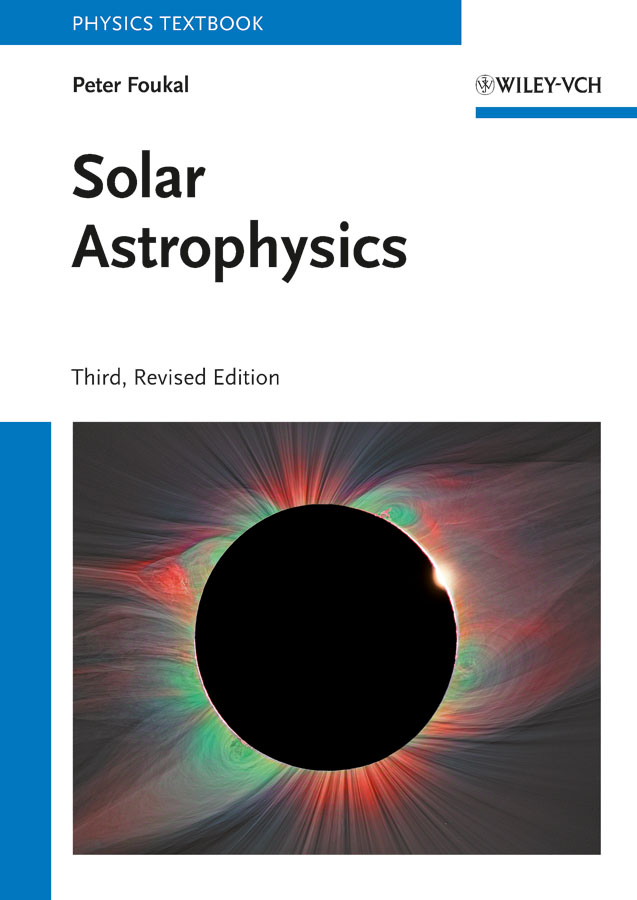
Solar Astrophysics
By (author) Peter V. Foukal
Paperback (Out of print)
(March 2013)
ISBN: 9783527411740
6.69 x 9.49 inches
Price: $103.00
On back order
This revised edition describes our current understanding of the sun — from its deepest interior, via the layers of the directly observable atmosphere to the solar wind, right up to its farthest extension into interstellar space. It includes a comprehensive account of the history of solar astrophysics and space weather, along with an overview of the key instruments used throughout the various periods.
In contrast to other books on the subject, the choice of material deals evenly with the entire scope of important topics covered in solar research, elucidating the advances in our understanding of the sun by the careful use of relatively simple physical concepts.
The result is an incisive, reliable, and well-planned look at all that is fascinating and new in studies of the sun for students and non-specialists.
Development of the ideas and instruments of modern solar research
Radiative transfer in the sun's atmosphere
Solar spectroscopy
Dynamics of solar plasmas
The photosphere
The sun's internal structure and energy generation
Rotation, convection, and oscillations in the sun
Observations of photospheric activity and magnetism
The chromosphere and corona
Prominences and flares
Dynamics of the solar magnetic field
The solar wind and heliosphere
The sun, our variable star
Influences of Solar Variability on the Earth
Peter V. Foukal is the founder and past-president of Cambridge Research and Instrumentation, Inc. He was awarded a NATO Senior Fellowship at Nice Observatory, France, in 1979, and has served as member or chairman of numerous panels and advisory boards of the National Science Foundation, NASA, and the National Academy of Sciences.
- By (author) Peter V. Foukal
"Das Buch setzt solide physikalische Grundkenntnisse voraus, es wird wegen seiner verständlichen und exakten Darstellung aber weiterhin für einen breiten Leserkreis vom Amateurastronomen und Physikstudenten bis zum erfahrenen Astrophysiker ein nützliches Handbuch bleiben."
Jürgen Staude
Physik Journal August/September 2004
—
Similar Books
 ‘For You I Study, For You I Work, For You I Live, For You I Am Ready To Even Give My Life’
Essays in Honour of Francis (Frank) J Moloney, SDB


 A Connecting Polemic in the Medieval Mediterranean
The Correspondence of Leo III and ʿUmar II
Volume 6





 Alabaster
An Interdisciplinary Study of the Sources and Uses of Calcite Alabaster in Antiquity
Volume 5









 Apocrypha, Magic, Liturgy
The Multiple Identities of Coptic Prayers in Late Antique and Early Islamic Egypt


