
Ravenna in the Imagination of Renaissance Art
Edited by Alexander Nagel Edited by Giancarla Periti
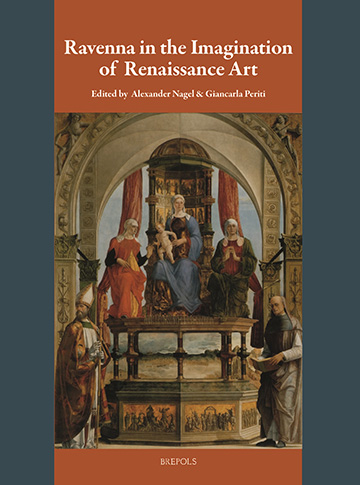
It is clear that Renaissance artists and their patrons were interested in Ravenna’s buildings and their decorations, both before Vasari’s negative pronouncements and after them. Contemporary European travelers and diarists have left descriptions of the city’s heritage, by then in ruinous condition. What happens if we reinsert this corpus of Ravenna’s treasures and their multiple imbrications into our histories of Renaissance art? How can our narratives change if we trace and study an almost forgotten, albeit rich and articulated series of intersections between Ravenna’s splendors and ambitious works of art and architecture from early modern Italy? We have ignored a series of visual engagements and imaginative plays with Ravenna’s forms, materials, and iconographies, folding the past into the present and the present into the past. These instances of creative imitations and recreations can best be recovered if we focus on the Renaissance production and humanists’ accounts of the city’s treasures, that is, works in various media and size, to map out an extended dimension of early modern visual culture.
It is clear that Renaissance artists and their patrons were interested in Ravenna’s buildings and their decorations, both before Vasari’s negative pronouncements and after them. Contemporary European travelers and diarists have left descriptions of the city’s heritage, by then in ruinous condition. What happens if we reinsert this corpus of Ravenna’s treasures and their multiple imbrications into our histories of Renaissance art? How can our narratives change if we trace and study an almost forgotten, albeit rich and articulated series of intersections between Ravenna’s splendors and ambitious works of art and architecture from early modern Italy? We have ignored a series of visual engagements and imaginative plays with Ravenna’s forms, materials, and iconographies, folding the past into the present and the present into the past. These instances of creative imitations and recreations can best be recovered if we focus on the Renaissance production and humanists’ accounts of the city’s treasures, that is, works in various media and size, to map out an extended dimension of early modern visual culture.
- Edited by Alexander Nagel
- Edited by Giancarla Periti
Similar Books
 A Collaborative Tapestry in Honour of Shirley Ann Brown / Une fresque brodée en l’honneur de Shirley Ann Brown
The Bayeux Tapestry Seen by her Colleagues and Friends / La Tapisserie de Bayeux vue par ses collègues et amis





 Balthasar Caymox of Nuremberg
Early Modern German Print Publishers: Popular Prints of the Seventeenth Century


 Beyond Sovereign Courts
Agents and Practices in Early Modern Spanish and Habsburg Diplomacy
Volume 3


 Circulation, Use, Impact
The Consumption of Architectural Books in the Early Modern Eastern Adriatic
Volume 1


 Councils, Conflicts, Correspondence
Urban Diplomacy in Reval (Tallinn) and Lübeck (c. 1470–1570)
Volume 67


 ENTANGLED AFRICA
Intra-African Relations Between Rain Forest and Mediterranean from Around 4,000 BCE to 1,500 CE


 Gold, Silver and Glass: Power Networks, Cultural Identities, Technology Transfers and Agency across the Old World (7th Century BC – 1st Century AD)
Proceedings of a Conference Held at the British Museum, 16–18 June 2023


 Homo-Politicus in the Balkans
Early Modern Southeast European History in Imperial and Regional Context

 Innovationes Lovanienses: Arts, Law and Theology at the University of Louvain (1425–1797)
Studium Lovaniense: Learning across Borders, 2
Volume 18
 Legal Visuality
Exegesis, Ambiguity, and Dissimulation of the Donation of Constantine in the Early Modern Period
 Listening to the Swan Song
More-than-Human Beings and Sounds in Literature and Culture Through the Ages


 Monastic Manuscripts from the Eastern Mediterranean (Sinai, Jerusalem, Antioch)
Production, Use, and Contexts


 Naples as Laboratory / Laboratorium Neapel
Style Options, Artistic Rivalry and Self Fashioning in Neapolitan Baroque Painting / Plurale Stilbildung, Kunstlerkonkurrenz und Self Fashioning in der neapolitanischen Barockmalerei

 Nurturing the Elite
Representations of Drinking, Eating, and Religious Vessels in Palmyrene Funerary Iconography
Volume 13

