
Pits and Boots: Excavation of Medieval and Post-medieval Backlands under the Bon Accord Centre, Aberdeen
By (author) Michael Roy
Paperback (Published)
(May 2021)
ISBN: 9781789694871
8.07 x 11.46 inches
Price: $77.00
On back order
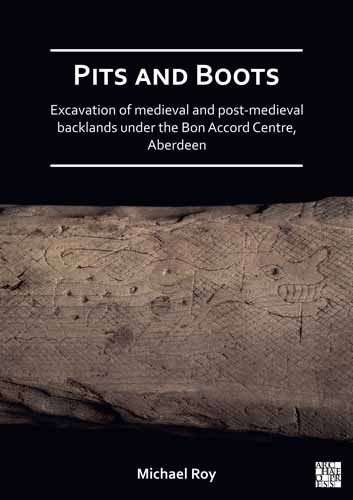
Excavations in 2007-8, ahead of an extension to the Bon Accord Centre in Aberdeen, uncovered backlands that would have formed part of the industrial quarter of the medieval town. The excavation charts the changing nature of the area, from an industrial zone in the medieval period, to horticultural and domestic spaces in post-medieval
Pits and Boots derives from excavations carried out in 2007-8, in advance of an extension to the Bon Accord Centre in Aberdeen, that uncovered the backlands of an area that would have formed part of the industrial quarter of the medieval town. The site is well-dated by dendrochronology, augmented by artefactual evidence, and indicates activity from the late 12th century AD into the early modern period, with a particularly intensive period in the 13th century. Structural evidence consists primarily of the backland boundaries, hearth/ovens, several wood-lined wells and many large pits. It is the contents of these pits and wells which forms the core of this monograph. The waterlogged conditions within the pits and wells has meant that a remarkable assemblage of organic remains including leather, wooden artefacts, textiles, animal pelts, fibres, and cordage has survived. The leather assemblage is the largest ever to be found in Scotland and has revealed a range of activities associated with the use of animal hides, from hide processing to tanning and shoemaking. The wood assemblage is also extensive and includes bowls, platters, coopered vessels and tools. Metalwork, crucibles, clay mould fragments and ceramics all testify to the industrial nature of the area, while the large quantities of animal and fishbone demonstrate that butchery on an industrial scale took place in the area. The excavation charts the changing nature of this once-peripheral area of Aberdeen, from an industrial zone in the medieval period, to horticultural and domestic spaces in post-medieval times, and has thus greatly enhanced our knowledge of Scottish urban development.
Preface 1 Introduction 1.1 Background to the archaeological works 1.2 The site and its setting 1.3 The archaeological works of 2007-08 1.4 Previous archaeological investigations around Gallowgate and Upperkirkgate 1.5 Dating and the chronology of the site 1.6 Structure of the monograph 1.7 The ceramic assemblage 2 Summary of Archaeological Remains by Phase 2.1 Introduction 2.2 Phase 1 - mid-to-late 12th century (figure 2.3) 2.3 Phase 2 - late 12th to mid 13th century (figure 2.14) 2.4 Phase 3 - mid-to-late 13th century(figure 2.41) 2.5 Phase 4 (early) - late 13th to 14th century (figure 2.53) 2.6 Phase 4 (late) - 14th to early 15th century (figure 2.62) 2.7 Phase 5 (early) - 15th to 16th century (figure 2.66) 2.8 Phase 5 (mid) - 15th to 16th century (figure 2.68) 2.9 Phase 5 (late) - 15th/16th to mid-to-late 18th century (figure 2.74) 2.10 Phase 6 - mid-to-late 18th to 20th century (figure 2.78) 3 Presentation of Artefactual and Ecofactual Evidence by Phase and Feature 3.1 Introduction 3.2 Phase 1 (mid-to-late 12th century) (figure 2.3) 3.3 Phase 2 (late 12th to mid 13th century) (figure 2.14) 3.4 Phase 3 (mid-to-late 13th century) (figure 2.41) 3.5 Phase 4 (early) (late 13th to 14th century) (figure 2.53) 3.6 Phase 4 (late) (14th to early 15th century) (figure 2.63 & Table 3.4) 3.7 Phase 5 (early) (15th to 16th century) (figure 2.66) 3.8 Phase 5 (mid) (15th to 16th century) (figure 2.68 & Table 3.5) 3.9 Phase 5 (late) (15th/16th to mid-to-late 18th century) (figure 2.74 & Table 3.5) 4 Specialist Reports - Summaries of the Evidence 4.1 Dating evidence 4.2 Organic artefacts 4.3 Inorganic artefacts 4.4 Structural materials 4.4.4 Socketed stone 4.5 Ecofact analyses 5 Discussion: The Site in Its Context 5.1 The origins of Upperkirkgate and Gallowgate (phases 1 to 3) 5.2 Industrial activity in the medieval gallowgate (phases 1 to 4) 5.2.1 Leatherworking and associated processes 5.2.2 Other industrial processes 5.3 Late medieval and early post-medieval properties (phase 4 to mid phase 5) 5.4 Later post-medieval occupation: the gardens of aberdeen (mid-to-late phase 5) 5.5 Later post-medieval occupation: houses of the gentry (late phase 5) 5.6 The late 18th century onwards: expansion of commerce and industry (phase 6) 5.7 Late 19th and 20th century development 6 Conclusions References Appendices 1 Radiocarbon dating programme 2 Ceramic building materials 3 Macroplant remains 4 Fish bone 5 Ceramics, Preface ;
1 Introduction ;
1.1 Background to the archaeological works1.2 The site and its setting1.3 The archaeological works of 2007–081.4 Previous archaeological investigations around Gallowgate and Upperkirkgate1.5 Dating and the chronology of the site1.6 Structure of the monograph1.7 The ceramic assemblage 2 Summary of Archaeological Remains by Phase ;
2.1 Introduction2.2 Phase 1 – mid-to-late 12th century (figure 2.3)2.3 Phase 2 – late 12th to mid 13th century (figure 2.14)2.4 Phase 3 – mid-to-late 13th century(figure 2.41)2.5 Phase 4 (early) – late 13th to 14th century (figure 2.53)2.6 Phase 4 (late) – 14th to early 15th century (figure 2.62)2.7 Phase 5 (early) – 15th to 16th century (figure 2.66)2.8 Phase 5 (mid) – 15th to 16th century (figure 2.68)2.9 Phase 5 (late) – 15th/16th to mid-to-late 18th century (figure 2.74)2.10 Phase 6 – mid-to-late 18th to 20th century (figure 2.78) 3 Presentation of Artefactual and Ecofactual Evidence by Phase and Feature ;
3.1 Introduction3.2 Phase 1 (mid-to-late 12th century) (figure 2.3)3.3 Phase 2 (late 12th to mid 13th century) (figure 2.14)3.4 Phase 3 (mid-to-late 13th century) (figure 2.41)3.5 Phase 4 (early) (late 13th to 14th century) (figure 2.53)3.6 Phase 4 (late) (14th to early 15th century) (figure 2.63 & Table 3.4)3.7 Phase 5 (early) (15th to 16th century) (figure 2.66)3.8 Phase 5 (mid) (15th to 16th century) (figure 2.68 & Table 3.5)3.9 Phase 5 (late) (15th/16th to mid-to-late 18th century) (figure 2.74 & Table 3.5) 4 Specialist Reports – Summaries of the Evidence ;
4.1 Dating evidence4.2 Organic artefacts4.3 Inorganic artefacts4.4 Structural materials4.4.4 Socketed stone4.5 Ecofact analyses 5 Discussion: The Site in Its Context ;
5.1 The origins of Upperkirkgate and Gallowgate (phases 1 to 3)5.2 Industrial activity in the medieval gallowgate (phases 1 to 4)5.2.1 Leatherworking and associated processes5.2.2 Other industrial processes5.3 Late medieval and early post-medieval properties (phase 4 to mid phase 5)5.4 Later post-medieval occupation: the gardens of aberdeen (mid-to-late phase 5)5.5 Later post-medieval occupation: houses of the gentry (late phase 5)5.6 The late 18th century onwards: expansion of commerce and industry (phase 6)5.7 Late 19th and 20th century development 6 Conclusions ;
References ;
Appendices ;
1 Radiocarbon dating programme2 Ceramic building materials3 Macroplant remains4 Fish bone5 Ceramics
Michael Roy currently works as a Project manager in the Post-Excavation sector at AOC Archaeology Group. After graduating from the University of Cambridge in 1993 and the University of Leicester in 1994, Michael has worked in archaeology across the UK, working for several years for the Scottish Urban Archaeological Trust and Essex County Council’s Field Archaeology Unit. Joining AOC Archaeology in 2004, he has directed substantial urban excavations in Edinburgh (Parliament House), Aberdeen (Bon Accord) and Dunbar, in addition to working in their Consultancy sector.
- By (author) Michael Roy
‘…the monograph provides a clear, well-researched and well-presented account of excavations undertaken in Aberdeen in 2007–8; it examines medieval backland industry followed by later, more affluent domestic occupants; it explores the burgh’s wider trade connections in Britain and beyond; it synthesises a wealth of remarkable organic material; it discusses extraordinary finds such as a late 12th- or early 13th-century stone-and-wooden composite grinding lathe; and it does all this with good photographs and figures throughout, using clear print on quality paper.’ – Brian Ayers (2022): Medieval Archaeology, 65/2, 2021
—
Similar Books
 «Solazoxa festa, stradolze e stracomplia»
Festschrift für Raymund Wilhelm zum 65. Geburtstag mit Beiträgen zu Diskurstraditionen und mittelalterlicher Philologie
Volume 249
 A Collaborative Tapestry in Honour of Shirley Ann Brown / Une fresque brodée en l’honneur de Shirley Ann Brown
The Bayeux Tapestry Seen by her Colleagues and Friends / La Tapisserie de Bayeux vue par ses collègues et amis

 Behind the Scenes of Medieval Roofs
An Overview of the Roofing Systems of Italian Churches
Volume 90

 Cahiers de recherches médiévales et humanistes – Journal of Medieval and Humanistic Studies
Volume 51







 Innovation and Medieval Communities
The Circulation of Ideas and Practices in and out of the Town (1200-1500)
Volume 63
 John Dunstaple Reading Boethius
John Dunstaple’s Annotations to Boethius’s “De institutione musica” in the Manuscript Oxford, Corpus Christi College Library, MS 118

 Medieval Debates on Foreknowledge: Future Contingents, Prophecy, and Divination
Acts of the XXVII Annual Colloquium of the SIEPM, Trento 12-15 September 2023
Volume 31

 Medieval Yeghegis, Armenia
History, Archaeology, Society. Local Multiplicities and Global Connections of a Rural Centre on the Silk Road(s)

 Nicholas of Lyra’s Commentaries on the Gospels of Matthew and Luke
Franciscan Exegesis in a Time of Crisis


 Power and Women in Southeast and Central Europe in Late Medieval and Early Modern Period (1300-1600)
Volume 10





 The Anglo-Norman Bible’s Books of Kings, a Critical Edition
(BL Royal 1 C III, fols 234r-274v)
Volume 37