
Panhellenism and the Barbarian in Archaic and Classical Greece
by Lynette Mitchell
Hardback (Out of print)
(December 2007)
ISBN: 9781905125142
6.1 x 9.17 inches
Price: $80.00
On back order
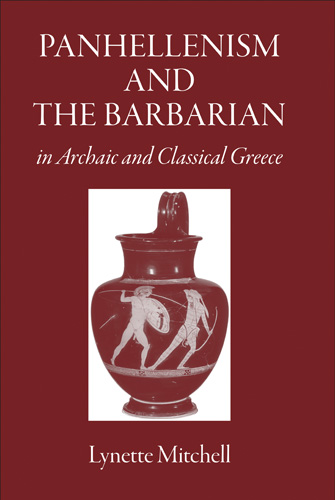
This is the first book in English to provide a systematic treatment of Panhellenism. The author argues that in archaic and classical Greece Panhellenism defined the community of the Hellenes and gave it political substance. Panhellenism also responded to other needs of the community, in particular serving to locate the Hellenes in time and space. One of the chief Panhellenic narratives, the war against the barbarian, provided the conceptual framework in which Alexander the Great could imagine his Asian campaign.
- By (author) Lynette Mitchell
Other Titles in this Series
 The Power of Individual and Community in Ancient Athens and Beyond
Essays in Honour of John K. Davies
Similar Books

 Drunk the Potion, No Whit Charmed
The Doctrine of Pure and Perfect Souls from Iamblichus to Damascius

 Epiphanies of the Divine in the Septuagint and the New Testament
Fifth International Symposium of the Corpus Judaeo-Hellenisticum Novi Testamenti (CJHNT), 14-17 May 2015, Nottingham


 Language and Power in the Roman Empire and Early India
Hierarchy, Ambiguity, and the Art of Reading the Signs in Cosmopolitan Cultures
 Late Antique villae in the Balkans (3rd–7th c. AD): Current Research Questions and Perspectives
HAEMUS Companion to the Late Antique Balkans 1
Volume 4
 Nurturing the Elite
Representations of Drinking, Eating, and Religious Vessels in Palmyrene Funerary Iconography
Volume 13


 The Compositional History of the Book of Kings
An Analysis of the Evaluative Frameworks in 1 Kings 14–2 Kings 25
 Contesting Labeled Identities
The Sociology of Gentilics in Biblical and Northwest Semitic Literature


 After Life in Roman Paganism. L’Égypte des astrologues. Les Mages hellénisés
Introductions historiographiques
Volume 7


 Diodor über den ersten Sklavenaufstand auf Sizilien
Ein philologischer und historischer Kommentar
Volume 67


 Frauen im römischen Erbrecht
Historische Entwicklungen, familiäre Rollenbilder und die erbrechtliche Reskriptenpraxis
Volume 241

 Frieden schaffen durch ein gemeinsames Bekenntnis?
Eine Predigtreihe zur Vergegenwärtigung des Nizänischen Glaubensbekenntnises von 325
Volume 7
 I Germani e l’Impero Romano. Storia e diritti
Saggi delle edizioni degli incontri 2024-2025
Volume 14


 Nach der Zerstörung
Die gewaltsame Einnahme von Städten von der Antike bis zum 20. Jahrhundert zwischen Disruption und Kontinuität

 Religiöse Erfahrung in Korinth
Paulus und die frühchristliche Bewegung im Kontext ihrer griechisch-römischen Erfahrungswelt


 But the Wise Shall Understand
Reuse of Prophecies, Chronotope, and Merging of Eschatological Horizons in Daniel 10-12

