Narratives of Ethnic Identity, Migration and Politics
A Multidisciplinary Perspective
edited by Monika Banas and Mariusz Dzieglewski
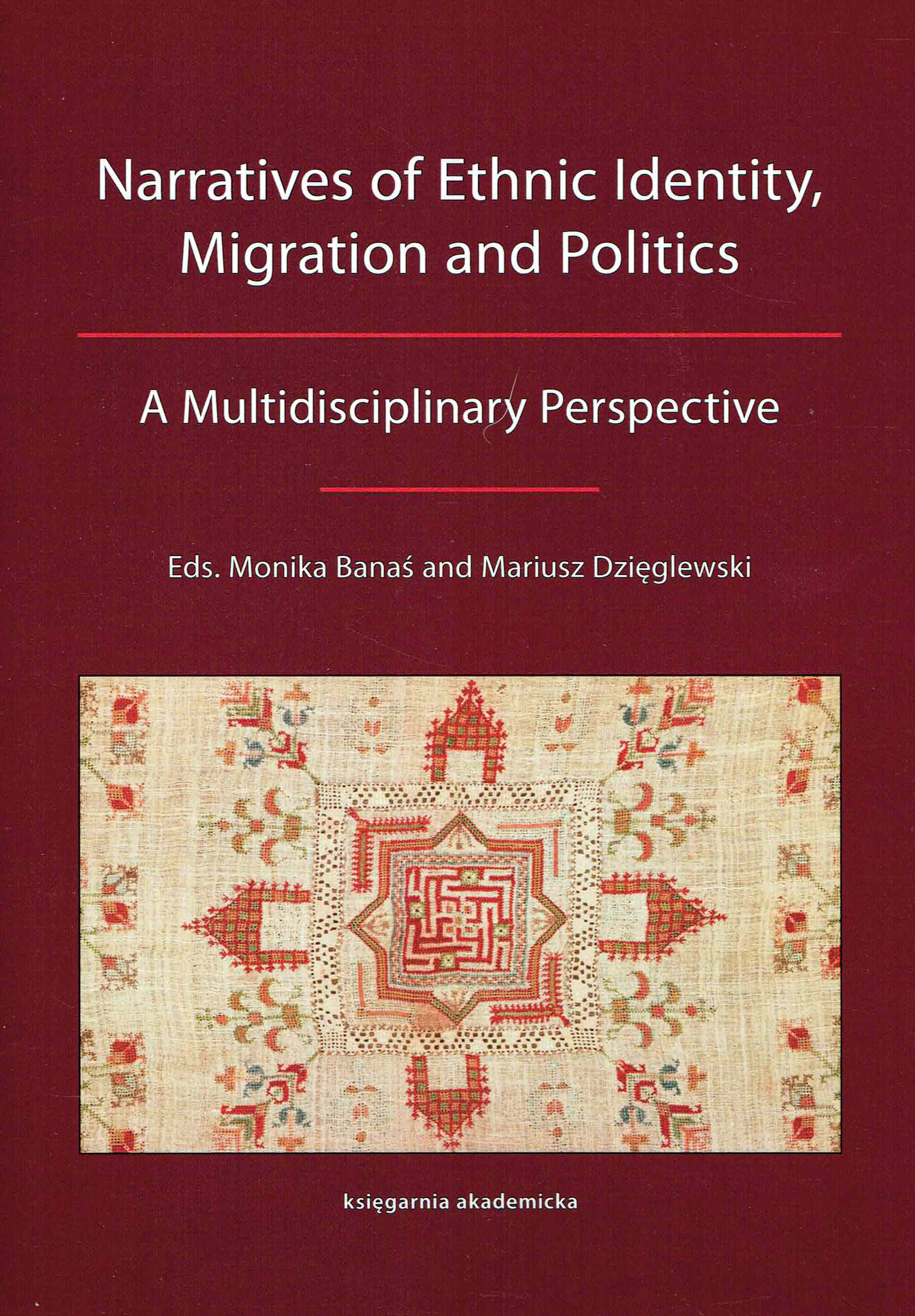
Ethnicity, as a conceptual category developed by representatives of various scientific disciplines, refers to extensive and complex sets of social and psychological phenomena that take place both in the public and private spheres. On the one hand, it is a very useful analytical instrument, yet, on the other hand, it is a set of features of individuals and communities that can be practically distinguished and that create individual and collective identity, on the basis of such attributes as e.g. language, origin, race, culture or multigenerational traditions. The foundations of ethnicity are very often rooted in deep primordial, conscious elements that constitute a bond based on a real or symbolic relationship, in which individuals that create a community express their belief and approval. A territorial, temporary, historical, ideological or even – when observing current times – economical component very often appears among these elements. The classical presentation of ethnicity is no longer sufficient to describe phenomena that we observe today; it requires supplementation – a subsequent extension of the limits of this concept that is originally associated with a private, almost intimate sphere of consciousness that gives meaning to the life of an individual and a sense of belonging to a community.
Ethnicity, as a conceptual category developed by representatives of various scientific disciplines, refers to extensive and complex sets of social and psychological phenomena that take place both in the public and private spheres. On the one hand, it is a very useful analytical instrument, yet, on the other hand, it is a set of features of individuals and communities that can be practically distinguished and that create individual and collective identity, on the basis of such attributes as e.g. language, origin, race, culture or multigenerational traditions. The foundations of ethnicity are very often rooted in deep primordial, conscious elements that constitute a bond based on a real or symbolic relationship, in which individuals that create a community express their belief and approval. A territorial, temporary, historical, ideological or even – when observing current times – economical component very often appears among these elements. The classical presentation of ethnicity is no longer sufficient to describe phenomena that we observe today; it requires supplementation – a subsequent extension of the limits of this concept that is originally associated with a private, almost intimate sphere of consciousness that gives meaning to the life of an individual and a sense of belonging to a community.
- By (author) Archeobooks
Similar Books

 As Messianism Turns to Heresy
The Regenstein Chair Lectures On Lurianic Kabbalah and Shabbatai Tzevi at Hebrew Union College - Cincinnati

 Beyond Sovereign Courts
Agents and Practices in Early Modern Spanish and Habsburg Diplomacy
Volume 3





 Food Security under Armed Conflict
Global Knowledge Landscape and Public Attention to Social, Economic, and Humanitarian Dimensions

 Innovationes Lovanienses: Arts, Law and Theology at the University of Louvain (1425–1797)
Studium Lovaniense: Learning across Borders, 2
Volume 18


 Myths and Tales of the Inughuit
Erik Holtved's Polar Eskimo Texts Revised and Re-translated into Danish and English
Volume 475, 12


 Students, Scholars and Their Books at the University of Louvain (1425-1797)
Studium Lovaniense: Learning across Borders, 1
Volume 17


 The Exeter Companion to Fairies, Nereids, Trolls and other Social Supernatural Beings
European Traditions


 The Phantom Hitchhiker
Italian Literature, Japanese Lore, and the Transnational Afterlives of a Global Ghost Story