
Morgantina Studies VII. The City Plan and Political Agora
Results of the excavations conducted by Princeton University, the University of Illinois, and the University of Virginia
By (author) Malcolm Bell, III
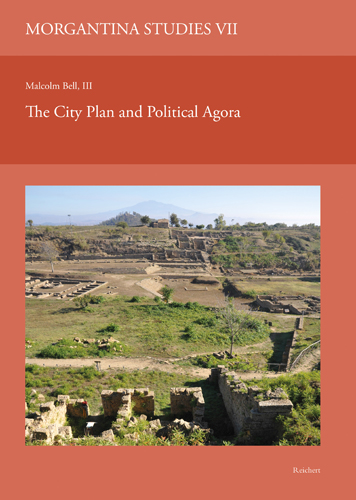
Hardback (Published)
(December 2022)
ISBN: 9783752000214
9.45 x 12.4 inches
Price: $239.00
In stock
The orthogonal city plan was adopted in the mid-fifth century BCE and implies a democratic constitution. Almost entirely excavated, Morgantina’s large agora offers a detailed picture of the civic architecture of an early Hellenistic western Greek city. Ten major civic monuments and buildings are described; these include meeting places for the assembly and council, and three large stoas housing a law court, public offices, and a prytaneion. Several structures document new Greek building types, including a public bank and an agoranomion or headquarters of the agora supervisors.
English summary: Excavations beginning in 1955 have made Morgantina into one of the most extensively known ancient cities in Sicily. Volume VII in the series Morgantina Studies describes both the new urban plan of the fifth century BCE and the city’s public center or agora, where ten major buildings were added between the late classical and early Hellenistic periods, ca. 400-200 BCE. The ambitious city plan, probably owed to the charismatic indigenous leader Douketios, is shown to reflect the democratic movements of the early century BCE. The plan is characterized by lots of equal size and an unusually large agora for political assemblies. From the start the agora at Morgantina has been a focus of the U.S. excavations. Most buildings belong to an ambitious program adopted ca. 250 BCE, when the city lay under the sway of Hellenistic Syracuse. This was the age of Archimedes, Theokritos, and King Hieron II, whose economic and political reforms are perceptible at Morgantina. The building program exploited the generous available space. The result was a scenographic assemblage of monuments that took advantage of sight lines and changes in level to create a visually coherent whole. Volume VII of Morgantina Studies presents the material evidence for this major Hellenistic complex, offers reconstructions in the form of plans and drawings, and includes catalogues of objects from each structure. Political institutions are identified along with unusual building types and innovative details. While the agora of Morgantina offers a unique window on the lost civic architecture of Hellenistic Syracuse, it also documents the drastic local consequences of the second Punic war. Falling to Rome in 211 BCE, the city was depopulated and assigned to a band of mercenaries. Buildings that formerly housed political institutions were now largely given over to commerce and industry. Morgantina thus offers dramatic and detailed evidence for the traumatic effects on one Sicilian city of the transition from Syracusan to Roman rule. The book is intended for the interested public of scholars and students of ancient architecture and urbanism. Analysis of the relationship between architecture and political institutions will make it of interest to historians, as will the documentation of the specific consequences of depopulation and mercenary resettlement. Included is a study of the geology of the site by the late Sheldon Judson of Princeton University. German description: Die 1955 begonnenen Ausgrabungen haben Morgantina zu einer der am besten bekannten antiken Stadte Siziliens gemacht. Band VII der Reihe Morgantina Studies beschreibt sowohl den neuen Stadtplan aus dem funften Jahrhundert v. Chr. als auch das offentliche Zentrum oder die Agora der Stadt, wo zwischen der spatklassischen und der fruhhellenistischen Periode (ca. 400-200 v. Chr.) zehn bedeutende Gebaude errichtet wurden. Der ehrgeizige Stadtplan, der wahrscheinlich dem charismatischen einheimischen Fuhrer Douketios zu verdanken ist, spiegelt nachweislich die demokratischen Bewegungen des fruhen Jahrhunderts v. Chr. wider. Der Plan zeichnet sich durch gleich grosse Grundstucke und eine ungewohnlich grosse Agora fur politische Versammlungen aus. Die Agora von Morgantina stand von Anfang an im Mittelpunkt der U.S.-amerikanischen Ausgrabungen. Die meisten Gebaude gehoren zu einem ehrgeizigen Programm, das ca. 250 v. Chr. beschlossen wurde, als die Stadt unter der Herrschaft des hellenistischen Syrakus stand. Dies war die Zeit von Archimedes, Theokritos und Konig Hieron II., deren wirtschaftliche und politische Reformen in Morgantina spurbar sind. Das Baukonzept schopfte die grosszugigen Raumverhaltnisse ganz aus. Das Ergebnis war eine szenografische Anordnung von Monumenten, die Sichtachsen und Hohenunterschiede nutzten, um ein visuell koharentes Ganzes zu schaffen. Band VII der Studienreihe Morgantina prasentiert die materiellen Zeugnisse dieses bedeutenden hellenistischen Komplexes, bietet Rekonstruktionen in Form von Planen und Zeichnungen und enthalt Kataloge der Objekte eines jeden Bauwerks. Politische Institutionen werden ebenso identifiziert wie ungewohnliche Gebaudetypen und innovative Details. Die Agora von Morgantina bietet nicht nur einen einzigartigen Einblick in die verlorene Stadtarchitektur des hellenistischen Syrakus, sondern dokumentiert auch die drastischen lokalen Folgen des Zweiten Punischen Krieges. Nachdem die Stadt 211 v. Chr. an Rom gefallen war, wurde sie entvolkert und einer Soldnerbande uberlassen. Gebaude, die fruher politische Institutionen beherbergt hatten, wurden nun grosstenteils dem Handel und der Industrie uberlassen. Morgantina bietet somit dramatische und detaillierte Belege fur die traumatischen Auswirkungen des Ubergangs von der syrakusanischen zur romischen Herrschaft auf eine sizilianische Stadt. Das Buch richtet sich vornehmlich an Wissenschaftler*innen und Studierende von Architektur und Stadtebau der Antike. Durch die Analyse der Beziehung zwischen Architektur und politischen Institutionen sowie die Dokumentation der spezifischen Folgen von Entvolkerung und Soldnerumsiedlung ist das Buch auch fur Historiker*innen von Interesse. Das Buch enthalt ferner eine Studie des leider verstorbenen, renommierten Archaologen Sheldon Judson von der Princeton University zur Geologie des Ortes.
- By (author) Malcolm Bell, III
Similar Books

 Caesar’s Visions and Impact on the Roman Empire
Revisiting the Archaeological and Historical Record of the 40s BC
Volume 2

 Drunk the Potion, No Whit Charmed
The Doctrine of Pure and Perfect Souls from Iamblichus to Damascius

 Epiphanies of the Divine in the Septuagint and the New Testament
Fifth International Symposium of the Corpus Judaeo-Hellenisticum Novi Testamenti (CJHNT), 14-17 May 2015, Nottingham


 Etruscan and Roman Hellenistic Anatomical ex votos
Reassessing Popular Religious Expressions in Central Italy
Volume 8


 Invisible Labour in Antiquity
Visualizing Obscure Work in the Ancient Mediterannean and West Asia
Volume 1
 Language and Power in the Roman Empire and Early India
Hierarchy, Ambiguity, and the Art of Reading the Signs in Cosmopolitan Cultures
 Late Antique villae in the Balkans (3rd–7th c. AD): Current Research Questions and Perspectives
HAEMUS Companion to the Late Antique Balkans 1
Volume 4

 Nurturing the Elite
Representations of Drinking, Eating, and Religious Vessels in Palmyrene Funerary Iconography
Volume 13


 Portraying the Individual in the Roman East
Local–Imperial Entanglements in Sculpture, Mosaics, and Paintings (First–Fourth Centuries AD)
Volume 18

 Small Worlds and Relational Agencies: Local Societies in Early Medieval Iberia
Pequeños mundos y Agencias relacionales: Sociedades locales altomedievales en la Península Ibérica
 The Compositional History of the Book of Kings
An Analysis of the Evaluative Frameworks in 1 Kings 14–2 Kings 25


 Contesting Labeled Identities
The Sociology of Gentilics in Biblical and Northwest Semitic Literature


 After Life in Roman Paganism. L’Égypte des astrologues. Les Mages hellénisés
Introductions historiographiques
Volume 7

 Atlante tematico di topografia antica 36-2026
Urbanistica e monumenti, porti, Roma. Ricerche sui monti Aurunci
Volume 36
 Cerámica común romana y ciclo haliéutico
Análisis de los contextos de las cetariae de Iulia Traducta


 Diodor über den ersten Sklavenaufstand auf Sizilien
Ein philologischer und historischer Kommentar
Volume 67

