
Leibniz’s Dynamics
Origin and Structure of a New Science
By (author) François Duchesneau

Paperback (Published)
(October 2023)
ISBN: 9783515135207
6.69 x 9.45 inches
Price: $75.00
In stock
Gottfried Wilhelm Leibniz (1646-1716) launched a new science dedicated to the theory of force. His “dynamics” is an important episode in the history of the scientific revolution. Its starting point has been a particular theory of the combination of motions placed within the framework of a mechanistic natural philosophy. Its turning point was Leibniz’s discovery in 1678 of a new principle later known as principle of conservation of live force, which he proposed in 1686 as replacement for Descartes’ principle of conservation of quantity of motion. In Dynamica de potentia (1689-90), Specimen dynamicum (1695), Essay de dynamique (ca. 1700), and various pieces of correspondence, Leibniz applied his creative methodology, fostered original scientific models and hypotheses, and refined demonstrative arguments in support of his theory. As a result, the dynamics would comprise the conceptual and architectonic fundamental elements for a revised “system of nature”. Our endeavor has been to unveil the genesis and explain the makeup of this Leibnizian scientific and philosophical achievement.
- By (author) François Duchesneau
Similar Books


 Balthasar Caymox of Nuremberg
Early Modern German Print Publishers: Popular Prints of the Seventeenth Century
 Beyond Sovereign Courts
Agents and Practices in Early Modern Spanish and Habsburg Diplomacy
Volume 3


 Circulation, Use, Impact
The Consumption of Architectural Books in the Early Modern Eastern Adriatic
Volume 1

 Constitutional Conflict as Judicial Civil Disobedience and Conscientious Objection
Reconceptualising National Constitutional Court Rulings in the European Union Legal Space

 Councils, Conflicts, Correspondence
Urban Diplomacy in Reval (Tallinn) and Lübeck (c. 1470–1570)
Volume 67


 Drunk the Potion, No Whit Charmed
The Doctrine of Pure and Perfect Souls from Iamblichus to Damascius


 Formulary apportionment in international tax law
An allocation method for the age of globalization and digitalization
Volume 210


 Hofmann oder Vorkämpfer der „philosophes“?
Deutsche Voltaire-Bildnisse und -Imaginationen im Zeitalter der Aufklärung

 Innovationes Lovanienses: Arts, Law and Theology at the University of Louvain (1425–1797)
Studium Lovaniense: Learning across Borders, 2
Volume 18

 Legal Unification through Case Law?
Supreme Courts and the Emergence of Uniform Law in the Modern Era
Volume 242
 Legal Visuality
Exegesis, Ambiguity, and Dissimulation of the Donation of Constantine in the Early Modern Period
 Libertinage et philosophie à l’époque classique (XVIe-XVIIIe siècle)
Athéisme, Modernité et Sécularisation / Atheism, Modernity and Secularization
Volume 23
 Linguistic and Cultural Dynamics in a Frontier Society
New Perspectives on Northeastern Bavaria and Western Bohemia in the Early Middle Ages
Volume 9

 Naples as Laboratory / Laboratorium Neapel
Style Options, Artistic Rivalry and Self Fashioning in Neapolitan Baroque Painting / Plurale Stilbildung, Kunstlerkonkurrenz und Self Fashioning in der neapolitanischen Barockmalerei

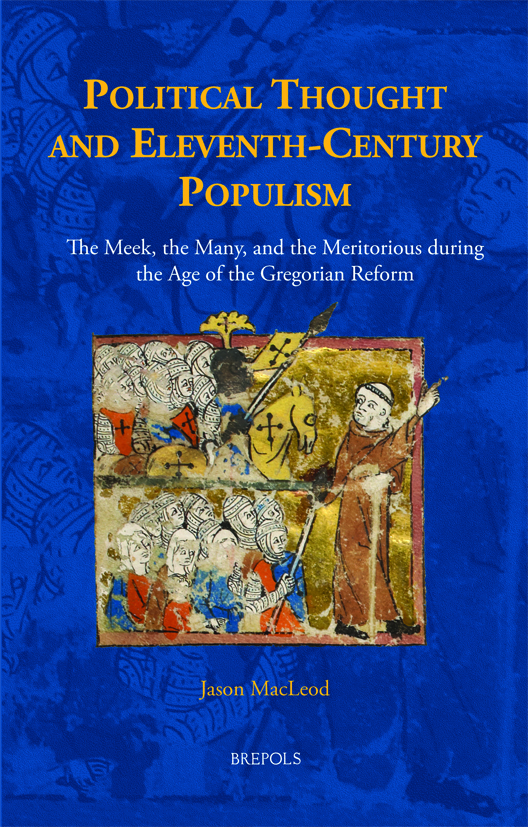 Political Thought and Eleventh-Century Populism
The Meek, the Many, and the Meritorious during the Age of the Gregorian Reform
Volume 38


