
Le guerrier, le chat, l’aigle, le poisson et la colonne: la voie spiralée des signes
Approche sémiologique, structurale et archéologique du disque de Phaistos
By (author) Serge Collet

Paperback (Published)
(June 2017)
ISBN: 9781784916169
5.94 x 8.31 inches
Price: $28.00
In stock
Collet brings a new approach to the study of the Phaistos Disc, one of the most studied documents of the Minoan civilization. It’s not a deciphering but an interpretation, a depiction of the Minoan Weltanschauung through the symbols on the Disc and their connections with reality.
The Phaistos Disc is one of the most studied documents of Minoan civilization, enticing scholars and simple enthusiasts with the mysterious aura that envelops it and with its singularity among Minoan scriptures. It has entered the collective imagination, both at academic and popular levels. Archaeologists digging at Phaistos are often asked ‘Where was the Disc found?’ Representations of the Disc can be found abundantly in popular culture, from appearances in Mickey Mouse comics to props amidst the curios on the tables of television magicians. It is this very overexposure that risks undermining the understanding of an object that is, first and foremost, an archaeological artefact found in a chronological and cultural context. Much has been said and much has been written about the Disc. Collet brings a new approach. It is not a deciphering but an interpretation, a depiction of the Minoan Weltanschauung through the symbols on the Disc and their connections with reality. This begins with the spiral-shaped construction of the inscription and its possible temporal allusions, and moves on to a structuralist view of use of the signs, in which the repetitions take on almost ritual significance. Hence it is a pictorial interpretation rather than syllabic, whereby the pictograph is not intended as a rigid reproduction of logical discourse, but rather a path.
- By (author) Serge Collet
Other Titles in this Series

 The Dialectic of Practice and the Logical Structure of the Tool
Philosophy, Archaeology and the Anthropology of Technology
 Un sistema per la gestione dell’affidabilità e dell’interpretazione dei dati archeologici
Percezione e potenzialità degli small finds: il caso studio di Festòs e Haghia Triada
Similar Books


 Caesar’s Visions and Impact on the Roman Empire
Revisiting the Archaeological and Historical Record of the 40s BC
Volume 2


 Etruscan and Roman Hellenistic Anatomical ex votos
Reassessing Popular Religious Expressions in Central Italy
Volume 8


 Invisible Labour in Antiquity
Visualizing Obscure Work in the Ancient Mediterannean and West Asia
Volume 1
 Late Antique villae in the Balkans (3rd–7th c. AD): Current Research Questions and Perspectives
HAEMUS Companion to the Late Antique Balkans 1
Volume 4
 Making and Meaning in the Bronze and Iron Ages
Chronology, Landscapes and Societies across Europe. Proceedings from the METALAGES2024 Colloquium (Florence, 23 October 2024)


 Portraying the Individual in the Roman East
Local–Imperial Entanglements in Sculpture, Mosaics, and Paintings (First–Fourth Centuries AD)
Volume 18


 Small Worlds and Relational Agencies: Local Societies in Early Medieval Iberia
Pequeños mundos y Agencias relacionales: Sociedades locales altomedievales en la Península Ibérica


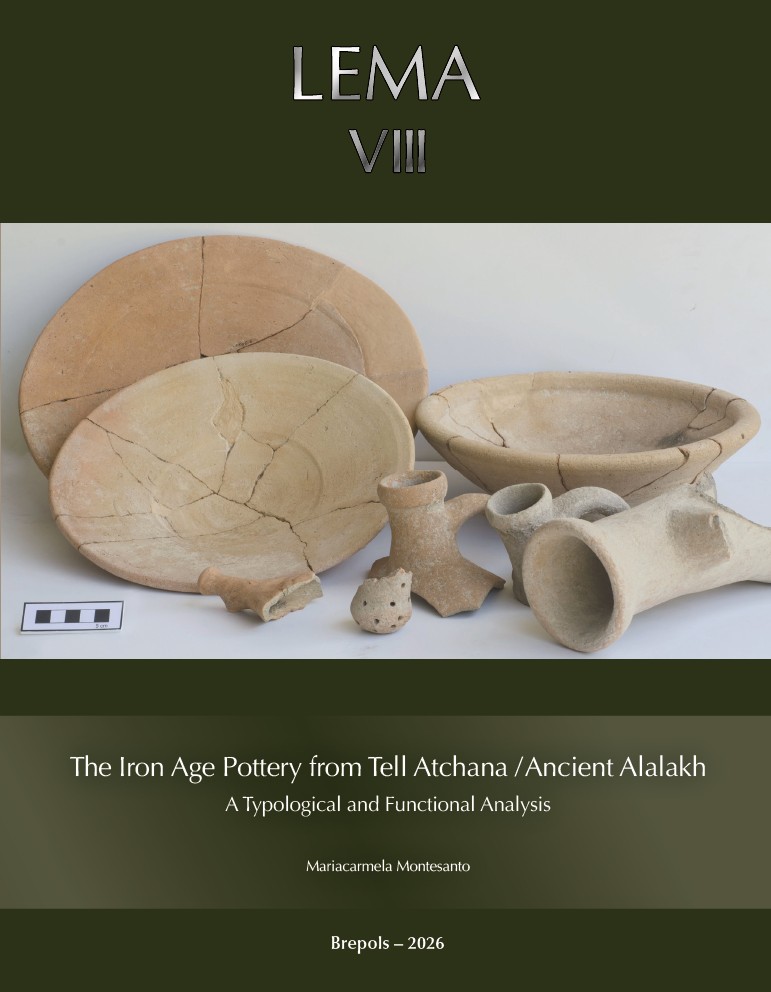 The Iron Age Pottery from Tell Atchana / Ancient Alalakh
A Typological and Functional Analysis
Volume 8

 Writing in the Church of the Nativity in Bethlehem
Inscription and Graffiti in a Multilingual and Multigraphic Perspective
Volume 45


 Atlante tematico di topografia antica 36-2026
Urbanistica e monumenti, porti, Roma. Ricerche sui monti Aurunci
Volume 36
 Cerámica común romana y ciclo haliéutico
Análisis de los contextos de las cetariae de Iulia Traducta

 Nuove scoperte e progressi nelle metodologie di rilievo e analisi dell’arte rupestre post-paleolitica in Italia
New discoveries and progress in the tracing and analysis methodologies of the post-Paleolithic rock art in Italy


 A Dramatic Event in Late Roman Florence
The Anomalous Burial Site Discovered beneath the Uffizi Gallery

 Alexander the Great and the Campaign of Gaugamela
New Research on Topography and Chronology. IAMNI 1 (Italian Archaeological Mission to Northern Iraq)
Volume 53