
La necropole hellenistique de Plinthine
Edited by Marie-Francoise Boussac Edited by Olivier Callot Edited by Patrice Georges-Zimmermann
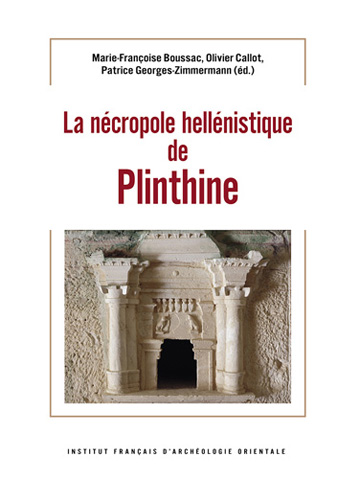
The Hellenistic necropolis of Plinthine, located about 800 m west of the urban settlement of Kom el Nogus/Plinthine, on the western margins of the Alexandrian chora, was built on and in the calcarenite ridge or taenia that separates the Mediterranean from Lake Mariut. It has been celebrated as a miniature version of the great Alexandrian necropolises since the first excavations by Achille Adriani in 1937, followed by various unpublished explorations. Nevertheless, it had not been the subject of a comprehensive study combining architectural analysis and investigation of funerary practices. The policy followed by the French expedition (MFTMP)-systematic architectural survey of a necropolis too often previously analyzed through the prism of a few hypogeas, emphasis on phasing, anthropological studies-made it possible to give a more global vision of the Plinthine necropolis than that provided by earlier studies: the dead are no longer absent and the necropolis reveals a history parallel to that of the Plinthine Hellenistic town.
The Hellenistic necropolis of Plinthine, located about 800 m west of the urban settlement of Kom el Nogus/Plinthine, on the western margins of the Alexandrian chora, was built on and in the calcarenite ridge or taenia that separates the Mediterranean from Lake Mariut. It has been celebrated as a miniature version of the great Alexandrian necropolises since the first excavations by Achille Adriani in 1937, followed by various unpublished explorations. Nevertheless, it had not been the subject of a comprehensive study combining architectural analysis and investigation of funerary practices. The policy followed by the French expedition (MFTMP)-systematic architectural survey of a necropolis too often previously analyzed through the prism of a few hypogeas, emphasis on phasing, anthropological studies-made it possible to give a more global vision of the Plinthine necropolis than that provided by earlier studies: the dead are no longer absent and the necropolis reveals a history parallel to that of the Plinthine Hellenistic town.
- Edited by Marie-Francoise Boussac
- Edited by Olivier Callot
- Edited by Patrice Georges-Zimmermann
Other Titles in this Series
 Mirgissa V
Les empreintes de sceaux. Apercu sur l'administration de la Basse Nubie au Moyen Empire
Volume 80

 Ostraca de Krokodilo II
La correspondance privee et les reseaux personnels de Philokles, Apollos et Ischyras
Volume 81



 Ports & Fortifications in the Muslim World
Coastal Military Architecture from the Arab Conquest to the Ottoman Period
Volume 85
 Du côté de chez Zeus
Fouilles de la Mission archéologique française du désert Oriental à Abû Qurayya (Dios) et Bi’r Bayza (y inclus O.Dios I 1-67)
Volume 98



Similar Books


 Caesar’s Visions and Impact on the Roman Empire
Revisiting the Archaeological and Historical Record of the 40s BC
Volume 2


 Construction Processes in Historical Western Societies (5th c. BC – 10th c. AD)
Case Studies on Techniques, Models, and Costs
 Contesting Labeled Identities
The Sociology of Gentilics in Biblical and Northwest Semitic Literature

 Drunk the Potion, No Whit Charmed
The Doctrine of Pure and Perfect Souls from Iamblichus to Damascius

 Epigraphic “Shades” from Hellenistic Thrace
Contextualizing Inscriptions in Greek from Thracian Tombs

 Epiphanies of the Divine in the Septuagint and the New Testament
Fifth International Symposium of the Corpus Judaeo-Hellenisticum Novi Testamenti (CJHNT), 14-17 May 2015, Nottingham


 Etruscan and Roman Hellenistic Anatomical ex votos
Reassessing Popular Religious Expressions in Central Italy
Volume 8


 Gold, Silver and Glass: Power Networks, Cultural Identities, Technology Transfers and Agency across the Old World (7th Century BC – 1st Century AD)
Proceedings of a Conference Held at the British Museum, 16–18 June 2023


 Invisible Labour in Antiquity
Visualizing Obscure Work in the Ancient Mediterannean and West Asia
Volume 1

 Language and Power in the Roman Empire and Early India
Hierarchy, Ambiguity, and the Art of Reading the Signs in Cosmopolitan Cultures
 Late Antique villae in the Balkans (3rd–7th c. AD): Current Research Questions and Perspectives
HAEMUS Companion to the Late Antique Balkans 1
Volume 4




 Nurturing the Elite
Representations of Drinking, Eating, and Religious Vessels in Palmyrene Funerary Iconography
Volume 13


 Portraying the Individual in the Roman East
Local–Imperial Entanglements in Sculpture, Mosaics, and Paintings (First–Fourth Centuries AD)
Volume 18


