‘I never Knew the Man’
The Coptic Act of Peter (Papyrus Berolinensis 8502.4), Its Independence from the Apocryphal Acts of Peter, Genre and Legendary Origins
By (author) A.L. Molinari

The Act of Peter, Papyrus Berolinensis 8502.4 was discovered in Egypt some years before the end of the 19th century and subsequently published in 1903 by Carl Schmidt. Since Schmidt’s study, much of the overall debate has centered on this text’s relationship with the apocryphal Acts of Peter (preserved in the Latin manuscript, Actus Vercellenses). Schmidt viewed the Act of Peter as part of the long-lost first third of the Acts of Peter, a position which has since attained general acceptance. Molinari contends that scholars have been hasty in their acceptance of Schmidt’s position, which under scrutiny reveals itself to be built on assumptions that are tenuous at best. Molinari makes his argument in two parts. The first part refutes Schmidt’s theory that the Act of Peter was originally part of the Acts of Peter. The second part discusses the issue of genre and origins.
The Act of Peter, Papyrus Berolinensis 8502.4 was discovered in Egypt some years before the end of the 19th century and subsequently published in 1903 by Carl Schmidt. Since Schmidt’s study, much of the overall debate has centered on this text’s relationship with the apocryphal Acts of Peter (preserved in the Latin manuscript, Actus Vercellenses). Schmidt viewed the Act of Peter as part of the long-lost first third of the Acts of Peter, a position which has since attained general acceptance. Molinari contends that scholars have been hasty in their acceptance of Schmidt’s position, which under scrutiny reveals itself to be built on assumptions that are tenuous at best. Molinari makes his argument in two parts. The first part refutes Schmidt’s theory that the Act of Peter was originally part of the Acts of Peter. The second part discusses the issue of genre and origins.
- By (author) A.L. Molinari
Other Titles in this Series
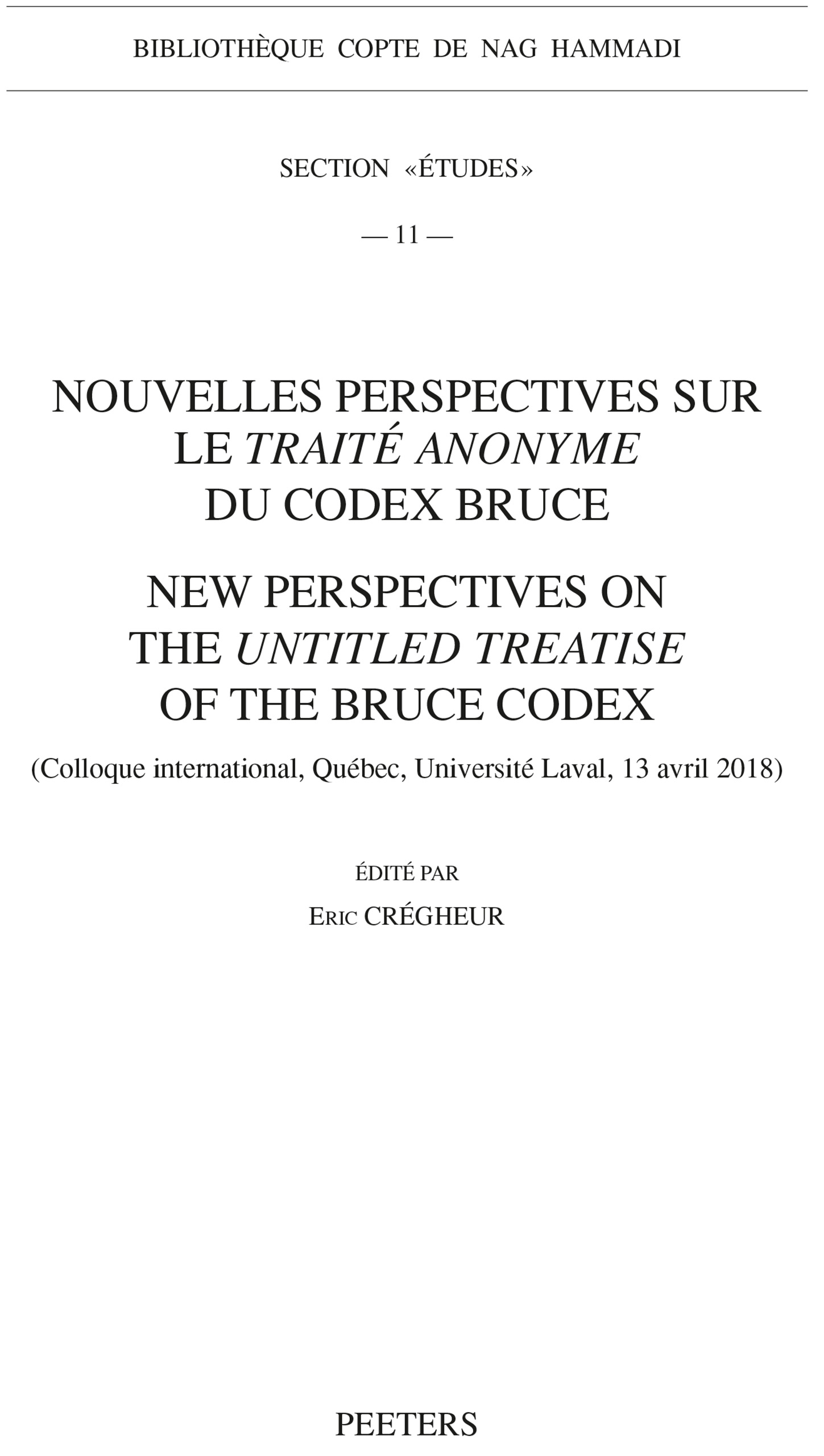 Nouvelles perspectives sur le Traité anonyme du Codex Bruce. New Perspectives on the Untitled Treatise of the Bruce Codex
(Colloque international, Québec, Université Laval, 13 avril 2018)
Volume 11
 Nag Hammadi à 70 ans. Qu’avons-nous appris? Nag Hammadi at 70: What Have We Learned?
(Colloque international, Québec, Université Laval, 29-31 mai 2015)
Volume 10
 Colloque international «L’Évangile selon Thomas et les textes de Nag Hammadi»
(Québec, 29-31 mai 2003)
Volume 8


Similar Books


 Cahiers de lexicologie
Particules floues — Nouvelles études sur le français et l'espagnol
Volume 128

 Contesting Labeled Identities
The Sociology of Gentilics in Biblical and Northwest Semitic Literature

 Des mots aux actes
Traduction épistémique et littéraire. Nouvelles tendances en histoire et didactique
Volume 15


 Deutsch als Fremdsprache nach Englisch an chinesischen Hochschulen
Eine empirische Forschung über Lernstrategien zum Wortschatzlernen
 Drunk the Potion, No Whit Charmed
The Doctrine of Pure and Perfect Souls from Iamblichus to Damascius


 Epigraphic “Shades” from Hellenistic Thrace
Contextualizing Inscriptions in Greek from Thracian Tombs

 Epiphanies of the Divine in the Septuagint and the New Testament
Fifth International Symposium of the Corpus Judaeo-Hellenisticum Novi Testamenti (CJHNT), 14-17 May 2015, Nottingham


 Gold, Silver and Glass: Power Networks, Cultural Identities, Technology Transfers and Agency across the Old World (7th Century BC – 1st Century AD)
Proceedings of a Conference Held at the British Museum, 16–18 June 2023


 Language and Power in the Roman Empire and Early India
Hierarchy, Ambiguity, and the Art of Reading the Signs in Cosmopolitan Cultures
 Late Antique villae in the Balkans (3rd–7th c. AD): Current Research Questions and Perspectives
HAEMUS Companion to the Late Antique Balkans 1
Volume 4