
Gregoire de Rimini, Cinq tables inedites sur des ouvrages de saint AugustinN
edited by Pascale Bermon

Hardback (Published)
(December 2023)
ISBN: 9782851213327
Price: $100.00
On back order
Born around 1300 and elected General of the Order of Hermits of Saint Augustine in 1357, Gregory of Rimini died in Vienna (Austria) the following year. A contemporary of early humanism, he became famous during his lifetime for the in-depth use he made of the works of Saint Augustine in his commentary on the Sentences. Pascale Bermon here edits his tables on four authentic works by Saint Augustine (On Free Will, the Reconsiderations, the Enchiridion, Eighty-three Different Questions) and one pseudepigraph (the Rule of Faith of Fulgentius of Ruspe). Recently identified in four manuscripts, they form a series of one thousand five hundred and twenty-five theses, illustrating the exhaustive reading and elaborate interpretation of the Authentic Doctor. The text of Augustine’s Free Will and Enchiridion is reproduced in the appendix, with Gregory’s personal segmentation and the theses extracted opposite. These tables provide an exceptional example of the continuous reading of Augustinian works in the Scholastic period. They enrich our understanding of the efforts made to appropriate patristic literature in Petrarch’s time.
Born around 1300 and elected General of the Order of Hermits of Saint Augustine in 1357, Gregory of Rimini died in Vienna (Austria) the following year. A contemporary of early humanism, he became famous during his lifetime for the in-depth use he made of the works of Saint Augustine in his commentary on the Sentences. Pascale Bermon here edits his tables on four authentic works by Saint Augustine (On Free Will, the Reconsiderations, the Enchiridion, Eighty-three Different Questions) and one pseudepigraph (the Rule of Faith of Fulgentius of Ruspe). Recently identified in four manuscripts, they form a series of one thousand five hundred and twenty-five theses, illustrating the exhaustive reading and elaborate interpretation of the Authentic Doctor. The text of Augustine’s Free Will and Enchiridion is reproduced in the appendix, with Gregory’s personal segmentation and the theses extracted opposite. These tables provide an exceptional example of the continuous reading of Augustinian works in the Scholastic period. They enrich our understanding of the efforts made to appropriate patristic literature in Petrarch’s time.
- Edited by Pascale Bermon
Other Titles in this Series
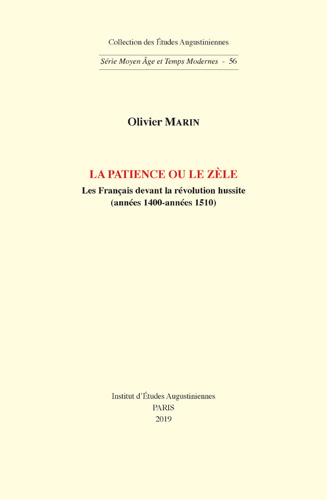 La patience ou le zele
Les Francais devant la revolution hussite (annees 1400-annees 1510)
Volume 56
Similar Books
 «Solazoxa festa, stradolze e stracomplia»
Festschrift für Raymund Wilhelm zum 65. Geburtstag mit Beiträgen zu Diskurstraditionen und mittelalterlicher Philologie
Volume 249

 A Collaborative Tapestry in Honour of Shirley Ann Brown / Une fresque brodée en l’honneur de Shirley Ann Brown
The Bayeux Tapestry Seen by her Colleagues and Friends / La Tapisserie de Bayeux vue par ses collègues et amis
 A Companion to Christianity and Sport in Europe and North America (19th-21st centuries)
Volume 1: Western and Eastern Europe
 A Connecting Polemic in the Medieval Mediterranean
The Correspondence of Leo III and ʿUmar II
Volume 6








 Ars Prophetica
Theology in the Poetry of Twentieth-Century Hebrew Poets Avraham Halfi, Shin Shalom, Amir Gilboa, and T. Carmi
 As Messianism Turns to Heresy
The Regenstein Chair Lectures On Lurianic Kabbalah and Shabbatai Tzevi at Hebrew Union College - Cincinnati


 Behind the Scenes of Medieval Roofs
An Overview of the Roofing Systems of Italian Churches
Volume 90


 Cahiers de recherches médiévales et humanistes – Journal of Medieval and Humanistic Studies
Volume 51



 Creating the Woman in Antiquity
Proceedings of the 16th Melammu Workshop, Innsbruck, 2–3 June 2022
Volume 13
 Cultic Kisses
Fruitful Encounters Between Deities and Humans. Festschrift for Angelika Berlejung on the Occasion of Her 65th Birthday
 De/colonizing Theologies
Glocal Histories, Contemporary Challenges, Theoretical Reflections
Volume 4

 Drunk the Potion, No Whit Charmed
The Doctrine of Pure and Perfect Souls from Iamblichus to Damascius

