
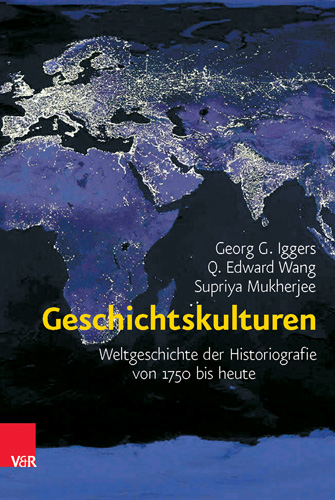
Geschichtskulturen
Weltgeschichte der Historiografie von 1750 bis heute
By (author) Georg G. Iggers By (author) Q. Edward Wang By (author) Supriya Mukherjee Translated by Susanne Hornfeck Translated by Andrea Ott
Hardback (Published)
(September 2013)
ISBN: 9783525300503
6.34 x 9.33 inches
Price: $94.00
On back order
Ein internationales Gemeinschaftswerk, das erstmals die Vielfalt der Geschichtsschreibungen in aller Welt als Panorama vor Augen führt.
English summary: This is the first text on historiography to adopt a comparative, global perspective for the modern era looking not only at developments in the West but at other historiographical traditions in East Asia, India, the Middle East, Latin America, and Sub-Saharan Africa as well. Beginning in the late eighteenth century, the book examines the impact of Western ideas of history on historical writing elsewhere and their interaction with the local traditions in an age of imperialism and colonialism. The authors argue that Western ideas of history were nowhere directly adopted but were accommodated to long standing intellectual and cultural traditions facing the challenges of modernization in an increasingly global environment. The book follows these developments into the current period and discusses the criticisms of postmodernism and postcolonialism of the modern historical profession and the reactions and resonances of historians around the world today. Originally published in 2008, this is not a direct translation of the English edition but a careful revision and updating taking into account the discussions of recent years, With this in mind certain sections have been rewritten, particularly those dealing with global history, feminist and gender history, history and memory, Marxism, and Latin America. German description: Ein internationales Gemeinschaftswerk, das erstmals die Vielfalt der Geschichtsschreibungen in aller Welt als Panorama vor Augen fuhrt. Weltregionen sind geografische Areale, Klimazonen, sie reprasentieren Kulturen und Ethnien unterschiedlichster Art. Sie weisen die vielfaltigsten Geschichten in Raum und Zeit auf. Dass uberdies jede dieser Weltkulturen ihre je eigene Geschichtsschreibung hervorgebracht hat, ist erst im Zeitalter interkultureller Vernetzung und Kommunikation ganz ins Bewusstsein getreten. Es sind diese Geschichtskulturen, deren Charakteristik, Wechselwirkung, Erkenntnisinteressen und politische Motive so faszinieren. Das Werk bietet erstmalig eine vergleichende Zusammenschau der Welthistoriografie.
- By (author) Georg G. Iggers
- By (author) Q. Edward Wang
- By (author) Supriya Mukherjee
- Translated by Susanne Hornfeck
- Translated by Andrea Ott
Similar Books



 Dis/United States of Vulnerability
Literary and Cultural Transgressions in U.S. Poetry Since the 1960s
Volume 330


 European Drama and Performance Studies
Dramatisations politiques. Théâtre, politique et idéologie au XIXe siècle (1806-1914)
Volume 27


 Modernization, Crises, Cultural Revolutions
Yugoslavia’s 1960s and 1970s through the amateur film lens


 Visual Memory and Oblivion
Monuments and Conflicts in Urban Spaces in Central and Eastern Europe from the Nineteenth Century to the Present Day



 “Tod durch Erschießen”
Generaloberst Nikolaus von Falkenhorst. Wehrmachtsbefehlshaber in Norwegen 1940–1945. Erinnerungen – Verhörprotokolle – Urteilssprüche
Volume 63
 “Zum Siege unserer menschenfreundlichen Prinzipien”
Ungarische Freimaurernetzwerke im „Orient“ 1886-1920


 Coburgs südöstliche Netzwerke – Coburg’s Networks in Southeastern Europe
Bulgarien, Rumänien und Ostmitteleuropa im 19. und 20. Jahrhundert. Hrsg. von Franziska Bartl und Frank-Lothar Kroll mit einem Grußwort Seiner Majestät des Königs der Bulgaren Simeon II.
Volume 39


 Dark Like You
Zur medienreflexiven Modernität der Kinder- und Jugendzeitschrift ‚The Brownies’ Book‘ (1920–1921)
Volume 191
 Das Generalgouvernement Belgien im Ersten Weltkrieg 1914-17–1918
Die Erinnerungen des Generalobersten Ludwig Freiherrn von Falkenhausen
Volume 64
 Das Werden einer Universität
Die Protokolle des Akademischen Senats der Hamburgischen Universität 1919–1921