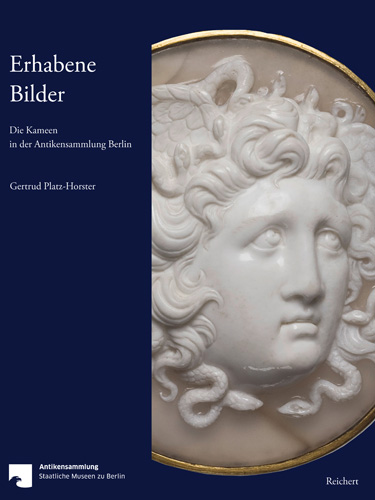
Erhabene Bilder
Die Kameen in der Antikensammlung Berlin
Bearbeitet von Gertrud Platz-Horster. Fotografiert von Bernhard Platz und Johannes Laurentius
Hardback (Published)
(December 2012)
ISBN: 9783895009068
8.31 x 11.02 inches
Price: $121.00
In stock
This volume presents the cameos of the Antikensammlung in Berlin, which essentially stem from the holdings of the private collections of the prince-electors of Brandenburg. Mainly unpublished until now, the collection holds 875 ancient, baroque, and classicistic cameos. In addition to detailed descriptions and full color photographs, the catalogue also contains studies on material, form, iconography, function, and chronology of the gems. German text.
English summary: The cameos in the Department of Antiquities at the State Museums in Berlin originate in the Kunstkammer of the Brandenburg Electors. The largely unpublished stock of 875 ancient, baroque and classicistic cameos mirror its changeful history of acquisition, loss and growth through 400 years. Cut from precious stone in high relief, these cimelia since the 3rd century BC have been estimated as embodiment of luxury and as delicate medium of power. Investigation in material and form, in depiction, function and dating, leads the catalogue; several appendices contain inventories and archival documents, concordances and indices. All objects are presented in new colour photos. German description: Die Kameen in der Antikensammlung Berlin gehen im Kern zuruck auf die Kunstkammer der brandenburgischen Kurfursten. Der grossenteils unpublizierte Bestand an 875 antiken, barocken und klassizistischen Kameen spiegelt die wechselvolle Geschichte von Erwerbung, Verlust und Zuwachs uber vierhundert Jahre. Diese erhaben in Edelstein geschnittenen Bilder galten seit dem 3. Jahrhundert v. Chr. als Inbegriff von Luxus und als erlesenes Medium der Macht. Untersuchungen zu Material und Form, zu Darstellungen, Funktion und Datierung der Kleinodien sind dem Katalog vorangestellt; der Anhang umfasst Inventare und Archivalien, Konkordanzen und Register; alle Objekte werden in neuen Farbaufnahmen prasentiert.
Dr. Gertrud Platz-Horster (* 1942), former vice-director at the Department of Antiquities, State Museums in Berlin, studied Classical Archeology, Ancient Greek, Ancient History and Early Christian Archeology. Since her dissertation in 1970, she has been into engraved gems. Her research mainly in jewelry, precious stones, and silver ware, glass, ivories, mummy portraits and sculpture always focused on its making in antiquity and its revival in modern time. During her 35 years at the State Museums of Berlin, she as well published about the museum’s history and politics, and lectured at the Universities of Berlin, Heidelberg and Leipzig. Recent exhibitions covered the 175th Anniversary of the Berlin Museums, MEDEAs Gold from Georgia, Might and Myth on Cameos, and the unique Glass Amphora from Olbia – Original and Reconstruction. After her retirement, she worked on the full catalogue of the cameo collection in Berlin.
- By (author) Gertrud Platz-Horster
- Photographs by Bernhard Platz
- Photographs by Johannes Laurentius
„Une riche bibliographie et un indcx par matériaux, provenances, personnes et thèmes (p. 313-328) font de ce catalogue un outil de travail indispensable à toute recherche future sur la glyptique, permettant de saisir la finesse et la complexite du travail des graveurs.“<br/><br/>Von Véronique Dasen<br/><br/>In: Museum Helveticum, Vol. 71/1, Juni 2014, S.123.<br/><br/>------------------------------<br/>„Zusammengenommen werden alle Erwartungen, die man an eine zeitgemäße Erschließung von Museumsbeständen haben kann, mustergültig erfüllt. Die Verf. hat den Berliner Museen und der Fachwelt mit großer Akribie einen Bestandskatalog erarbeitet, dessen Texte12 um nahezu durchgängig farbige Abbildungen von hoher Qualität (angefertigt von Bernhard Platz und Johannes Laurentius) ergänzt werden. In diesen sind zudem verlorene Stücke und ausgewählte<br/>Objekte auch in Detailaufnahmen sowie mit Rückseiten dokumentiert (z.B. Taf. 6 Nr. 31; Taf. 7 Nr. 34; Taf. 12f. Nr. 57; Taf. 30 Nr. 167), so daß auch nachantike Einfassungen der Steine Berücksichtigung finden können. Die Kameen wurden vermutlich aufgrund des Größenspektrums der Objekte nicht maßstabsgetreu abgebildet, doch herrscht auf den Tafeln eine innere Maßstäblichkeit, durch die Verzerrungen vermieden werden konnten. Die Tafeln<br/>sind übersichtlich gestaltet, einzig auf den Taf. 37 und 46 erschweren kleine Unstimmigkeiten die Orientierung.14 Indem die Möglichkeiten, die der Berliner Bestand bietet, zur Gänze ausgeschöpft werden, ist es gelungen, nicht nur einen Bestandskatalog vorzulegen, sondern dem Band zugleich einen Handbuchcharakter zu Kameen von der Antike bis in die Neuzeit zu verleihen. Auch der Preis vermag diesen rundum positiven Eindruck nicht einzuschränken, da er angesichts der grosszügigen farbigen Ausstattung äußerst bibliotheksfreundlich ausgefallen ist.“<br/><br/>Jörn Lang<br/><br/>In: Göttinger Forum für Altertumswissenschaft 16 (2013) S. 1181-1192.
—
Similar Books



 Balthasar Caymox of Nuremberg
Early Modern German Print Publishers: Popular Prints of the Seventeenth Century





 Drunk the Potion, No Whit Charmed
The Doctrine of Pure and Perfect Souls from Iamblichus to Damascius

 ENTANGLED AFRICA
Intra-African Relations Between Rain Forest and Mediterranean from Around 4,000 BCE to 1,500 CE
 Epigraphic “Shades” from Hellenistic Thrace
Contextualizing Inscriptions in Greek from Thracian Tombs


 Gold, Silver and Glass: Power Networks, Cultural Identities, Technology Transfers and Agency across the Old World (7th Century BC – 1st Century AD)
Proceedings of a Conference Held at the British Museum, 16–18 June 2023
 Language and Power in the Roman Empire and Early India
Hierarchy, Ambiguity, and the Art of Reading the Signs in Cosmopolitan Cultures
 Late Antique villae in the Balkans (3rd–7th c. AD): Current Research Questions and Perspectives
HAEMUS Companion to the Late Antique Balkans 1
Volume 4
 Legal Visuality
Exegesis, Ambiguity, and Dissimulation of the Donation of Constantine in the Early Modern Period
 Listening to the Swan Song
More-than-Human Beings and Sounds in Literature and Culture Through the Ages


 Naples as Laboratory / Laboratorium Neapel
Style Options, Artistic Rivalry and Self Fashioning in Neapolitan Baroque Painting / Plurale Stilbildung, Kunstlerkonkurrenz und Self Fashioning in der neapolitanischen Barockmalerei

 Nurturing the Elite
Representations of Drinking, Eating, and Religious Vessels in Palmyrene Funerary Iconography
Volume 13


 Portraying the Individual in the Roman East
Local–Imperial Entanglements in Sculpture, Mosaics, and Paintings (First–Fourth Centuries AD)
Volume 18