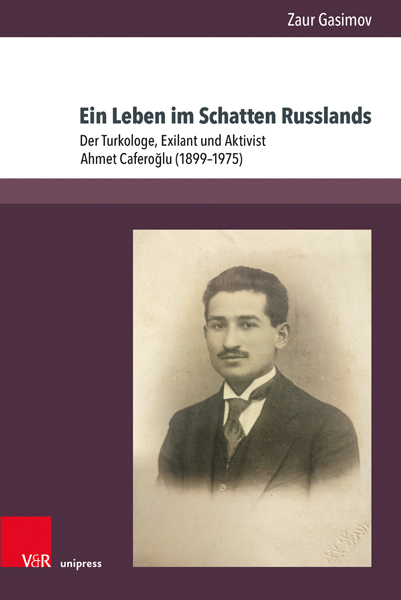
Ein Leben im Schatten Russlands
Der Turkologe, Exilant und Aktivist Ahmet Caferoğlu (1899–1975)
By (author) Zaur Gasimov
Hardback (Published)
(May 2026)
ISBN: 9783847119838
6.34 x 9.33 inches
Price: $69.00
In stock
Eine Geschichte über Auswanderung, Leidenschaft für Aserbaidschan, Philologie und Sehnsucht
Der international anerkannte Turkologe Ahmet Caferoğlu wurde im spätzaristischen Kaukasus geboren und absolvierte seine Ausbildung in Kyjiw, Baku, Breslau und Berlin. Er verwandelte die Universität Istanbul in ein wichtiges turkologisches Zentrum – nicht zuletzt durch seine eigenen Großprojekte wie die mehrbändige »Geschichte der türkischen Sprache«. Caferoğlu war der Begründer der türkischen Dialektforschung, ein leidenschaftlicher Verfechter der NATO-Integration der Türkei sowie ein vehementer Antikommunist. Hierzu dienten seine akademischen und intellektuellen Zeitschriftenprojekte, wie »Azerbaycan Yurt Bilgisi« und »Türk Amacı«, sowie seine zahlreichen Vorträge und Schriften. Die sprach- und literaturwissenschaftliche Forschung zu Aserbaidschan gehörte zu seinen wichtigen Forschungsfeldern.
The internationally renowned Turkologist Ahmet Caferoglu was born in the late Tsarist Caucasus and completed his education in Kyiv, Baku, Breslau, and Berlin. He transformed Istanbul University into an important center for Turkology – not least through his own major projects such as the multi-volume “History of the Turkish Language.” Caferoglu was the founder of dialect research in Turkey, a passionate advocate of Turkey’s integration into NATO, and a vehement anti-communist and critic of the Soviet Union. His academic and intellectual journal projects, such as “Azerbaycan Yurt Bilgisi” and “Türk Amacı,” as well as his numerous lectures and writings, served this purpose. Linguistic and literary research on Azerbaijan was one of his important fields of research.
- By (author) Zaur Gasimov
Other Titles in this Series

 Knowledge on the Move in a Transottoman Perspective
Dynamics of Intellectual Exchange from the Fifteenth to the Early Twentieth Century


 Translating Late Ottoman Modernity in Palestine
Debates on Ethno-Confessional Relations and Identity in the Arab Palestinian Newspaper Filasṭīn (1911–1914)



 From the Frontiers of the Empire to the Borders of the Nations
Borderland Security and Safety in the (post-)Ottoman Spaces (1700–1939)


Similar Books



 Cities through Time
Glimpses into Urbanity and Community in Mediaeval to Modern West Asia and Egypt
Volume 1
 Cuneiform Artefacts from Archaeological Contexts: New Research on Ancient Iraq
Proceedings of a Conference Held at the Bavarian Academy of Sciences and Humanities, July 4–5, 2024
Volume 2

 Dis/United States of Vulnerability
Literary and Cultural Transgressions in U.S. Poetry Since the 1960s
Volume 330


 European Drama and Performance Studies
Dramatisations politiques. Théâtre, politique et idéologie au XIXe siècle (1806-1914)
Volume 27

 From the Frontiers of the Empire to the Borders of the Nations
Borderland Security and Safety in the (post-)Ottoman Spaces (1700–1939)
 Global Gulf
Geo-Economic, Geo-Political, and Geo-Technological Transformation in Saudi Arabia, the United Arab Emirates, and Qatar


 Islamic Rituals Beyond the Mosque
Historical Evolution of Prayer and Devotion in Physical Space and Cyberspace
 Ismail Hakki Bursevi’s translation of and commentary on Fusus al-Hikam By Muhyiddin Ibn ‘Arabi
Volumes 1-4


 Modernization, Crises, Cultural Revolutions
Yugoslavia’s 1960s and 1970s through the amateur film lens
 Monastic Manuscripts from the Eastern Mediterranean (Sinai, Jerusalem, Antioch)
Production, Use, and Contexts


 Qatar’s Societal Security
Towards the Inclusive National Concept of ‘Baladna’ Identity, Migration and External Threats Since 2017

 The Biblical Tale of Judah and Tamar in Fourteenth-Century Iran
A Judeo-Persian Versified Account by Shāhīn with Scholarly Edition, Annotated Translation and Persian Transliteration
Volume 94, 951
 The Discourse of Rites
Shaping and Reshaping the (Counter-)Priestly Rituals Conducted Outside the Tabernacle


 Visual Memory and Oblivion
Monuments and Conflicts in Urban Spaces in Central and Eastern Europe from the Nineteenth Century to the Present Day