
Diversity in Archaeology
Proceedings of the Cambridge Annual Student Archaeology Conference 2020/2021
Edited by Elifgül Doğan Edited by Mariana Pinto Leitão Pereira Edited by Oliver Antczak Edited by Min Lin Edited by Phoebe Thompson Edited by Camila Alday

Paperback (Published)
(September 2022)
ISBN: 9781803272818
7.99 x 10.91 inches
Price: $90.00
In stock
30 papers explore a wide range of topics such as women’s voices in archaeological discourse; researching race and ethnicity across time; use of diversified science methods in archaeology; critical ethnographic studies; diversity in the archaeology of death, heritage studies, and archaeology of ‘scapes’.
Diversity in Archaeology is the result of the fourth Cambridge Annual Student Archaeology Conference (CASA 4), held virtually from January 14-17, 2021. CASA developed out of the Annual Student Archaeology Conference, first held in 2013, which was formed by students at Cambridge, Oxford, Durham and York. In 2017, Cambridge became the home of the conference and the name was changed accordingly. The conference was developed to give students (from undergraduate to PhD candidates) in archaeology and related fields the chance to present their research to a broad audience. The theme for the 2020/2021 conference was Diversity in Archaeology which opened our conference to multiple interpretations, varied presentations and sundry perspectives from different regions of the world. This volume consists of 30 papers which were presented in 7 different sessions. The papers present a great variety in both geography and chronology and explore a wide range of topics such women’s voices in archaeological discourse; researching race and ethnicity across time; use of diversified science methods in Archaeology; critical ethnographic studies; diversity in the Archaeology of Death, heritage studies, and archaeology of ‘scapes’.
Elifgül Doğan is an archaeologist and a PhD candidate, specialising in museum studies and heritage management in the Department of Archaeology in Cambridge. Her PhD research focuses on the management of archaeological human remains collections in Turkish museums and investigates the ways in which the bodies of the ancient dead shape the public perceptions of national heritage and identity.
Mariana Pinto Leitão Pereira is a PhD Candidate at the Cambridge Heritage Research Centre (University of Cambridge), researching how diaspora communities negotiate identity through cultural heritage. She is a member of ICOMOS Portugal and the Association of Critical Heritage Studies.
Oliver Antczak is a Venezuelan and Polish PhD Student in the Department of Archaeology at the University of Cambridge. His research has focused on the relationship between heritage and identity and how it is impacted by different colonialisms. His area of research is the Southern Caribbean where he employs a comparative perspective between the islands of Trinidad, Margarita, and Bonaire.
Min Lin is a PhD candidate in Archaeology at the University of Cambridge. Her PhD research focuses on Sino-Hellenic comparison with a sustained interest in gender issues and social development. She is currently looking at the construction of social identity in Early Iron Age Greek and Eastern Zhou Dynasty rich burials.
Phoebe Thompson is a Classical Archaeologist, who has worked in Italy and Scotland. Her research primarily focuses on reconstructing past human-geology interaction, particularly within the context of cult activity and the creation of sacred space in the ancient Mediterranean. Phoebe’s other research interests include geomythology, traditional environmental knowledge, geoarchaeology, geohazards, landscape archaeology, and settlement modelling.
Camila Alday is an archaeologist specialised in bast fibres and weaving technologies of Pre-Columbian South America. In her doctoral research, Alday studied bast fibre materials to understand how the production of nets, looped bags, mats and other fibre materials underpinned maritime subsistence strategies during the Andean Preceramic Period (10,000 – 3,500 BP). She is also interested in understanding how containers – mostly made of plants, and basketry were critical material culture for past human societies.
- Edited by Elifgül Doğan
- Edited by Mariana Pinto Leitão Pereira
- Edited by Oliver Antczak
- Edited by Min Lin
- Edited by Phoebe Thompson
- Edited by Camila Alday
Similar Books


 Archaeological Excavations at Irmis Rka: An Investigation of a Multi-Layered Settlement in Southwest Georgia
Results from the 2020 Season: Early Bronze Age to Medieval Occupations


 Catuvellaunia and Rome: Economic and Political Relations during the Final Decades Pre-conquest
The Role of Grain from Southeastern Britain and Its Potential for Maintenance of the Roman Military along the Frontier on the Rhine

 Colour Concept “Secoli bui” a colori
Codici cromatici e architetture dipinte nell’età tardoantica e medievale
 Creating the Woman in Antiquity
Proceedings of the 16th Melammu Workshop, Innsbruck, 2–3 June 2022
Volume 13

 Crossing Disciplines in the Study of Archaeology and Prehistoric Art: Insights from the Sahara and Mediterranean Africa
Proceedings of the XX UISPP World Congress (5–9 September 2023, Timișoara, Romania) Volume / Session 18

 Economic Trends in China During the Age of Confucius (1000–250 BC)
The Archaeological Evidence
Volume 10
 ENTANGLED AFRICA
Intra-African Relations Between Rain Forest and Mediterranean from Around 4,000 BCE to 1,500 CE

 Exploring Prehistoric Pottery in Japan
A Study of Organic Inclusions, Adhering Materials, and Impressions of Woven Items

 From Coast to Coast
Current Archaeological Research on Cultural Exchange along and across the Baltic Sea
Volume 19
 Frontiers of the Roman Empire: The Frontier of the Roman Province of Raetia
Grenzen des Römischen Reiches: Die Grenze der Römischen Provinz Raetien

 Gold, Silver and Glass: Power Networks, Cultural Identities, Technology Transfers and Agency across the Old World (7th Century BC – 1st Century AD)
Proceedings of a Conference Held at the British Museum, 16–18 June 2023

 Harvesting the Margins of the Viking World
Decentralizing Economies in Late Iron Age Fennoscandia
Volume 6
 Images of Anonymous Women
A Semiotic Approach to Image-Text Relations in Interpretation of Ancient Near Eastern Art and the Hebrew Bible
Volume 310


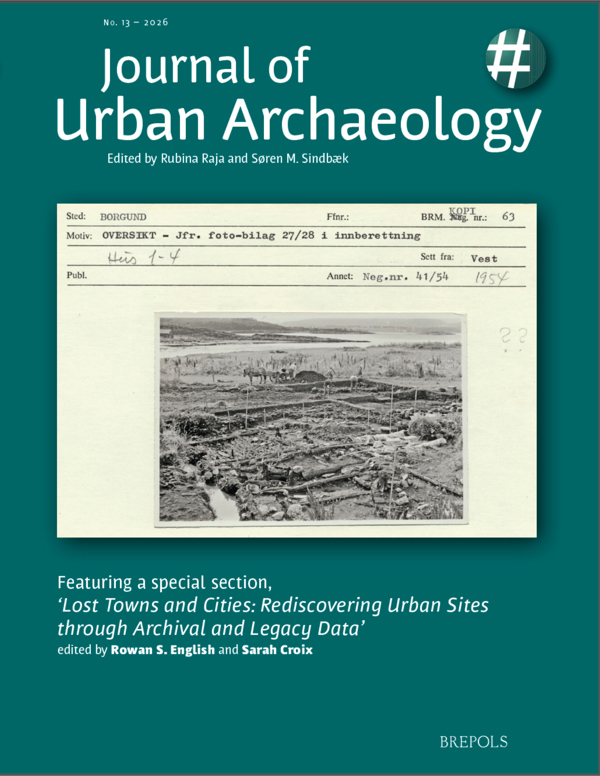 Journal of Urban Archaeology 13 (2026)
Featuring a special section, ‘Lost Towns and Cities: Rediscovering Urban Sites through Archival and Legacy Data’


 Linguistic and Cultural Dynamics in a Frontier Society
New Perspectives on Northeastern Bavaria and Western Bohemia in the Early Middle Ages
Volume 9


 Making and Meaning in the Bronze and Iron Ages
Chronology, Landscapes and Societies across Europe. Proceedings from the METALAGES2024 Colloquium (Florence, 23 October 2024)

 Medieval Yeghegis, Armenia
History, Archaeology, Society. Local Multiplicities and Global Connections of a Rural Centre on the Silk Road(s)