
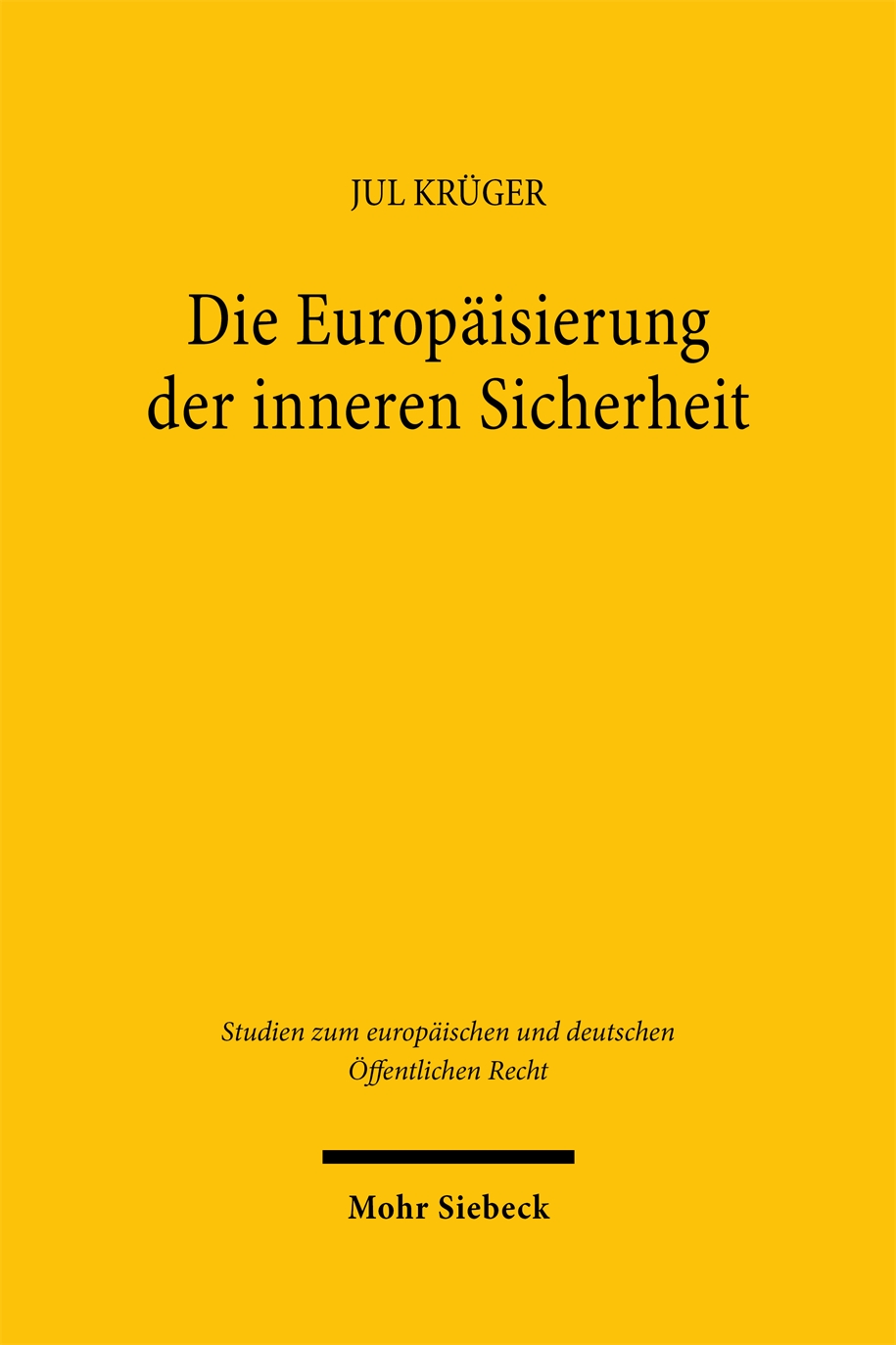
Die Europäisierung der inneren Sicherheit
Möglichkeiten und Grenzen der Übertragung und Ausübung von Zwangsbefugnissen am Beispiel der Bekämpfung der organisierten Kriminalität
Paperback (Forthcoming)
(January 2027)
ISBN: 9783162008329
6.1 x 9.13 inches
Price: $165.00
Cross-border organised crime poses growing challenges for Europe. Jul Krüger demonstrates the scope and limits that the state’s monopoly on the legitimate use of force places on European integration in the field of internal security.
Due to persistently high levels of cross-border organised crime within the European Union, a mismatch can currently be observed between the European area of criminal activity and the European area of security. Member States face difficulties in adequately responding to the European dimension of internal security, not only for political but also for legal reasons. This is because the provision of internal security is closely linked to the state’s monopoly on the legitimate use of force, which in turn constitutes a central element of state sovereignty. What has received little attention so far is that the state’s monopoly on the legitimate use of force is not an entirely untouchable domain.
Jul Krüger defines a scope within which the state’s monopoly on the legitimate use of force can be modified-and thus Europeanised-in accordance with the concept of shared sovereignty in a union of states and constitutional orders. The four-level model of the monopoly on the use of force developed to capture this scope enables not only a differentiated analysis of the Europeanisation of the state’s monopoly on the legitimate use of force (i.e. the status quo), but also an assessment of the extent to which modifications are compatible with the constitutional limits on the transfer of powers under Article 23(1), third sentence, in conjunction with Article 79(3) of the German Basic Law (i.e. an extension of the status quo).
Transfers and exercises of competences that are currently under discussion can be incorporated into the model developed in the study. On an abstract level, this allows for an initial assessment of whether modifications of the civilian monopoly on the legitimate use of force are compatible with constitutional and European legal requirements. The author illustrates this approach through a range of case studies.
Other Titles in this Series
 Verbundidentitat
Schutzgehalt, Funktionen und gerichtliche Durchsetzung des Art. 4 Abs. 2 S. 1 Var. 2 EUV
Volume 34
 Der grenzuberschreitende Sachverhalt im Unionsrecht
Eine Analyse anhand der Rechtsprechung des Europaischen Gerichtshofs zu den Kontrollkompetenzen
Volume 5

 Europaische Aussenpolitik
Die Gemeinsame Aussen- und Sicherheitspolitik der Europaischen Union im Spannungsfeld zwischen politischem Reformbedarf und mitgliedstaatlicher Souveranitat
 Die Warenausfuhrfreiheit: ein Beschrankungsverbot
Eine Synthese unionsverfassungsrechtlicher, rechtsokonomischer und rechtsprechungsbasierter Auslegung zu einem 'Wettbewerbsgleichheits-Rechtswahlmechanismus'
Volume 22


 Europarechtsordnung als Rahmenordnung
Versuch einer Uberwindung der dualistischen Konstruktion von staatlichen und uberstaatlichen Rechtsordnungen
Volume 29
 Die Europaisierung des kirchlichen Individualarbeitsrechts
Der Einfluss von EMRK und Unionsrecht unter Berucksichtigung seiner verfassungsrechtlichen Grenzen
Volume 41
 Integration durch Koordinierung?
Rechtsfragen der Politikkoordinierung am Beispiel der nationalen Wirtschaftspolitiken
Volume 23
 Schutz der Rechtsstaatlichkeit durch europaisches Haushaltsrecht
Pladoyer fur einen neuen Sanktionsmechanismus
Volume 35
 Europaische Solidaritat und nationale Identitat
Uberlegungen im Kontext der Krise im Euroraum
Volume 6

 Europaische Verteidigung
Von der EVG zur Europaischen Armee? Analyse und Modell aus europa- und verfassungsrechtlicher Perspektive
Volume 43
 Internationales Staatensanierungsverwaltungsrecht
Programmierung der Sanierungsverwaltung im Verbund
Volume 24
 Die Rangfrage im europaischen Normenverbund
Theoretische Grundlagen und dogmatische Grundzuge des Verhaltnisses von Unionsrecht und nationalem Recht
Volume 8
 Frontex im Zentrum der Europaischen Grenz- und Kustenwache
Bestandsaufnahme, Unionsrechtmassigkeit und Verantwortlichkeit
Volume 36

 European Economy and People’s Mobility
Project Conference of the Jean Monnet Centre of Excellence Jena
Volume 14

 Europäisierung der Verteidigungsgüter
Zum rechtlichen Rahmen einer Europäischen Verteidigungsunion durch gemeinsames Verteidigungsgütereigentum
 Regulierte Selbstregulierung im europaischen Chemikalienrecht
Eine Untersuchung der kontrollierten Eigenverantwortung fur den Schutz der Umwelt unter der REACH-Verordnung
Volume 9
 Zur Integration staatlicher und europaischer Verfassungsidentitat
Das europaische Demokratieprinzip des Art. 2 EUV als Massstab der europaischen Vertragsanderungsverfahren?
Volume 37


 Die Bedeutung der EU-Grundrechtecharta fur das nationale Steuerrecht
Eine Untersuchung am Beispiel des unionsrechtlichen allgemeinen Gleichheitssatzes
Volume 44
 Das Rückschrittsverbot als Instrument Europäischen Werteschutzes
Schutz unionaler Werte im Spannungsfeld nationalstaatlichen Pluralismus
 Der Einzelne im Spannungsfeld von Teleologie und Deontologie in der Rechtsprechung des EuGH
Zugleich ein Beitrag zur Folgeorientierung bei der Auslegung der Vertrage
Volume 10
 Der Netzausbauverbund
Strukturen des Energienetzausbaus im Europaischen Verwaltungsverbund
Volume 38
 Umweltschutz und EU-Beihilfenrecht
Die Berücksichtigung und Bedeutung von Umweltschutzaspekten im EU-Beihilfenrecht – nach dem more economic approach ein "ever greener approach"?