
Die ‚Alleinherrschaft‘ der russischen Zaren in der ‚Zeit der Wirren‘ in transkultureller Perspektive
Contributions by Dittmar Dahlmann Contributions by Mechthild Albert Contributions by Linda Dohmen Contributions by Konrad Vössing Contributions by Lena Ringen Contributions by Theresa Wilke Contributions by Diana Ordubadi Contributions by Christoph Witzenrath Contributions by Ekaterina Makhotina Contributions by Shigekazu Kondo Contributions by David Khunchukashvili Contributions by Christian Werner Contributions by Daniela Mathuber Edited by Diana Ordubadi Edited by Dittmar Dahlmann
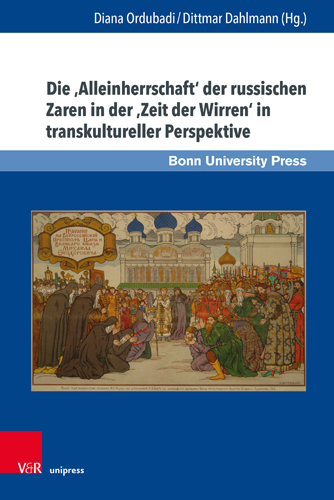
Hardback (Published)
(January 2021)
ISBN: 9783847112419
6.34 x 9.25 inches
Price: $74.00
On back order
Ausgehend vom moskowitischen Beispiel setzt sich dieser Band mit historischen Analogien in Japan, Kaschmir, Kastilien, dem Karolingerreich und Byzanz auseinander. Grenz- und epochenubergreifend werden einige spannungsreiche Forschungsschwerpunkte in Bezug auf die Vormoderne behandelt, darunter die praktische Umsetzung autokratischer Herrschaftsmodelle in verschiedenen Kulturen, Formen der weiblichen Teilhabe an der Macht, die Rolle von Herrschaftseliten in politischen Umbruchphasen sowie die Bedeutung religioser Ideen fur dynastische Herrschaftslegitimationen. Interdisziplinar reflektiert werden die Ideen uber das dritte Rom, die Schicksale ‘falscher Zaren’ oder der ersten gekronten russischen Zarin Marina Mniszech.
Starting with the Muscovite example, the book deals with the phenomena of ‘Macht’ and ‘Herrschaft’ in a period of crisis, using historical analogies in Japan, Kashmir, Castile, Carolingian Empire and Constantinople. Across borders and epochs, such key aspects of research are dealt with concerning the pre-modern age, as the practical implementation of autocratic models of rule in different cultures, forms of female participation in power, the influence of ruling elites in phases of political upheaval, and the significance of religious ideas for the legitimation of political and dynastic power. Thus, the idea of the Third Rome, the fates of ‘false tsars’ or the first crowned Russian tsarina Marina Mniszech get an interdisciplinary reflection.
- Contributions by Dittmar Dahlmann
- Contributions by Mechthild Albert
- Contributions by Linda Dohmen
- Contributions by Konrad Vössing
- Contributions by Lena Ringen
- Contributions by Theresa Wilke
- Contributions by Diana Ordubadi
- Contributions by Christoph Witzenrath
- Contributions by Ekaterina Makhotina
- Contributions by Shigekazu Kondō
- Contributions by David Khunchukashvili
- Contributions by Christian Werner
- Contributions by Daniela Mathuber
- Edited by Diana Ordubadi
- Edited by Dittmar Dahlmann
Other Titles in this Series
 Geschlecht macht Herrschaft – Interdisziplinäre Studien zu vormoderner Macht und Herrschaft
Gender Power Sovereignty – Interdisciplinary Studies on Premodern Power


 Herrscher und Eliten zwischen Symbiose und Antagonismus
Kommunizieren in vormodernen Herrschaftsstrukturen
 Erzählen von Macht und Herrschaft
Die ‚Kaiserchronik‘ im Kontext zeitgenössischer Geschichtsschreibung und Geschichtsdichtung

 Machterhalt und Herrschaftssicherung
Namen als Legitimationsinstrument in transkultureller Perspektive
 Von den Handschriften bis zu den Videospielen
Annäherungen an Konstruktionen von Ketzern in Mittelalter und Moderne
 Transkulturelle Annäherungen an Phänomene von Macht und Herrschaft
Spannungsfelder und Geschlechterdimensionen
 Criticising the Ruler in Pre-Modern Societies – Possibilities, Chances, and Methods
Kritik am Herrscher in vormodernen Gesellschaften – Möglichkeiten, Chancen, Methoden
 The Agency of the Conquered
Muslim Communities in the Emergence of Norman Sicily and the Kingdom of Valencia
 Entscheiden und Regieren
Konsens als Element vormoderner Entscheidungsfindung in transkultureller Perspektive
 Textualität von Macht und Herrschaft
Literarische Verfahren im Horizont transkultureller Forschungen


Similar Books
 «Solazoxa festa, stradolze e stracomplia»
Festschrift für Raymund Wilhelm zum 65. Geburtstag mit Beiträgen zu Diskurstraditionen und mittelalterlicher Philologie
Volume 249
 A Collaborative Tapestry in Honour of Shirley Ann Brown / Une fresque brodée en l’honneur de Shirley Ann Brown
The Bayeux Tapestry Seen by her Colleagues and Friends / La Tapisserie de Bayeux vue par ses collègues et amis

 Behind the Scenes of Medieval Roofs
An Overview of the Roofing Systems of Italian Churches
Volume 90

 Cahiers de recherches médiévales et humanistes – Journal of Medieval and Humanistic Studies
Volume 51








 Innovation and Medieval Communities
The Circulation of Ideas and Practices in and out of the Town (1200-1500)
Volume 63
 John Dunstaple Reading Boethius
John Dunstaple’s Annotations to Boethius’s “De institutione musica” in the Manuscript Oxford, Corpus Christi College Library, MS 118

 Medieval Debates on Foreknowledge: Future Contingents, Prophecy, and Divination
Acts of the XXVII Annual Colloquium of the SIEPM, Trento 12-15 September 2023
Volume 31

 Medieval Yeghegis, Armenia
History, Archaeology, Society. Local Multiplicities and Global Connections of a Rural Centre on the Silk Road(s)

 Nicholas of Lyra’s Commentaries on the Gospels of Matthew and Luke
Franciscan Exegesis in a Time of Crisis


 Power and Women in Southeast and Central Europe in Late Medieval and Early Modern Period (1300-1600)
Volume 10




 The Anglo-Norman Bible’s Books of Kings, a Critical Edition
(BL Royal 1 C III, fols 234r-274v)
Volume 37
