
Classics outside Classics
By (author) Kai Brodersen
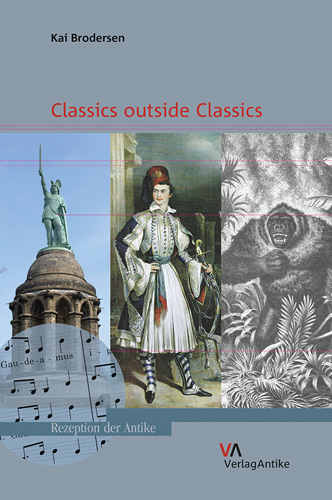
Classics as an academic discipline appears to belong to the lecture hall and the seminar. But Classics is alive outside Classics, as the studies collected in this volume show. We engage with Classics in the 19th century through the hymn “Gaudeamus Igitur” and a popular song on Herman the German, we meet Classics in the Early Modern school, in the 19th century celebrating the Olympics in King Otto’s Greece, and identifying the gorilla, and in the 20th century invention of Spartacus as a Bulgarian. We encounter frauds, hoaxes, and the lexicographical tradition, by looking at two works fraudulently ascribed to a Byzantine author, at a joke presented as a New Testament “agraphon”, at the lexicographical invention of Euboean Cyme, and at the tradition of poking fun at lexica in lexica themselves. We learn about classicists ousted from Classics through the lives of Richard Laqueur and Victor Ehrenberg, and we engage with two publications which were highly influential in popularizing Classics: Falke’s cultural history of Greece and Rome, and Asterix. The volume thus presents fourteen studies on Classics outside Classics.
Classics as an academic discipline appears to belong to the lecture hall and the seminar. But Classics is alive outside Classics, as the studies collected in this volume show. We engage with Classics in the 19th century through the hymn “Gaudeamus Igitur” and a popular song on Herman the German, we meet Classics in the Early Modern school, in the 19th century celebrating the Olympics in King Otto’s Greece, and identifying the gorilla, and in the 20th century invention of Spartacus as a Bulgarian. We encounter frauds, hoaxes, and the lexicographical tradition, by looking at two works fraudulently ascribed to a Byzantine author, at a joke presented as a New Testament “agraphon”, at the lexicographical invention of Euboean Cyme, and at the tradition of poking fun at lexica in lexica themselves. We learn about classicists ousted from Classics through the lives of Richard Laqueur and Victor Ehrenberg, and we engage with two publications which were highly influential in popularizing Classics: Falke’s cultural history of Greece and Rome, and Asterix. The volume thus presents fourteen studies on Classics outside Classics.
Classics in 19th Century Student Culture Gaudeamus Igitur: Aspects of an Academic Hymn (2010) Als die Romer frech geworden: Contexts of a Volkslied (2009) Classics outside the World of Academic Classics Principia geographiae: How to Teach Modern Geography using Ancient Texts (1996) Philostratus and the Oktoberfest: How the Rediscovery of an Ancient Text Shaped the Modern Olympics (2014) Savage's savages: How the Gorillas became Savage Beasts because of Hanno's Periplus (2001) How Spartacus became a Bulgarian (2011) Frauds, Hoaxes, and the Lexicographical Tradition The Geographical Works of "Nikephoros Blemmydes" (1995) Triphyodontismos: Is the Agraphon on a Third Set of Teeth a Pious Fraud? (2011) The "Urban Myth" of Euboean Cyme: A Study in Lexicographical Tradition (2001) Apopudobalia: Poking Fun at Lexica - in Lexica (2005) Classicists Ousted from Classics Richard Laqueur (1992) Victor Ehrenberg (2003) Popularizing Classics Then and Now Falke's Culturgeschichte (2014) Asterix (2001) Appendix First Publications Cumulative Bibliography Index
- By (author) Kai Brodersen
"(...) es [handelt] sich um eine sehr mannigfaltige Sammlung von Ansatzen, Themen und Methoden, die genau die Interessenvielfalt und die verschiedenen Forschungsgebiete des Autors, von der antiken Geographie bis zur Antikenrezeption in Asterix, von der Wissenschaftsgeschichte bis zur Verwendung der Antike bei der Konstruktion moderner nationaler Identitaten, spiegelt. (...) der wichtigste Punkt des Bandes ist: die Relevanz der Antike auaerhalb der Universitaten sowie die Erkenntnis, dass sie unsere Welt kontinuierlich beeinflusst bzw. beeinflussen kann und dass es aufgrund der Vielfaltigkeit und der Moglichkeit verschiedener Ansatze absolut unmoglich ist, die "Antikenrezeption" zu definieren oder zu kategorisieren." Filippo Carla-Uhink, H-Soz-u-Kult, 09.05.2016 "(...) un exemple et une ressource precieuse pour tous ceux qui, dans lenseignement superieur, dans le secondaire, mais egalement au sein des institutions culturelles, sinteressent aux "Classical Reception Studies". Catherine Psilakis, BMCR 2016.08.05
—
Other Titles in this Series



 La Retorica e la Scienza dell’Antico / Between Rhetoric and Classical Scholarship
Lo Stile dei Classicisti Italiani nel Ventesimo Secolo / The Style of Italian Classicists in the Twentieth Century
 Antike Mythen im schwäbischen Gewand
Gustav Schwabs Sagen des klassischen Altertums und ihre antiken Quellen
Similar Books


 Contesting Labeled Identities
The Sociology of Gentilics in Biblical and Northwest Semitic Literature

 Drunk the Potion, No Whit Charmed
The Doctrine of Pure and Perfect Souls from Iamblichus to Damascius

 Epigraphic “Shades” from Hellenistic Thrace
Contextualizing Inscriptions in Greek from Thracian Tombs

 Epiphanies of the Divine in the Septuagint and the New Testament
Fifth International Symposium of the Corpus Judaeo-Hellenisticum Novi Testamenti (CJHNT), 14-17 May 2015, Nottingham


 Gold, Silver and Glass: Power Networks, Cultural Identities, Technology Transfers and Agency across the Old World (7th Century BC – 1st Century AD)
Proceedings of a Conference Held at the British Museum, 16–18 June 2023
 Language and Power in the Roman Empire and Early India
Hierarchy, Ambiguity, and the Art of Reading the Signs in Cosmopolitan Cultures
 Late Antique villae in the Balkans (3rd–7th c. AD): Current Research Questions and Perspectives
HAEMUS Companion to the Late Antique Balkans 1
Volume 4


 Nurturing the Elite
Representations of Drinking, Eating, and Religious Vessels in Palmyrene Funerary Iconography
Volume 13





 Roman Copies, Collecting, and Culture in the Bay of Naples and Beyond
Papers in Honor of Eugene J. Dwyer



 The Compositional History of the Book of Kings
An Analysis of the Evaluative Frameworks in 1 Kings 14–2 Kings 25




 Zooarchaeology of Ancient Greek Sanctuaries in Southwestern Sicily
Faunal Analysis from Selinus and Akragas as Evidence of Differences in the Treatment of Animals for Ritual Purposes


