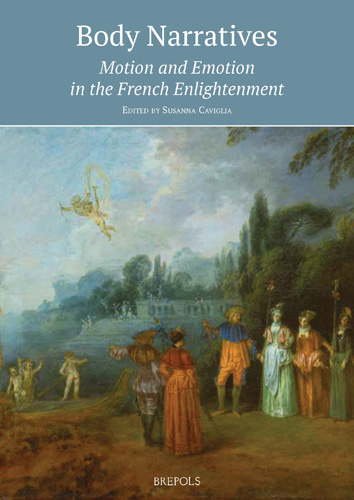
Body Narratives
Motion and Emotion in the French Enlightenment
Edited by S. Caviglia
Paperback (Published)
(March 2017)
ISBN: 9782503574745
8.46 x 10.98 inches
Price: $138.00
In stock
This book explores, in broad terms, the representations and understandings of the body’s physical and psychological movement’s meanings during the French Enlightenment in its many guises –artistic, esthetic, social, and erotic. It is centered on the fundamental tension between stasis and movement, which is both constitutive of art historical reflection and embedded in the body’s existence. Stasis and movement not only correspond to the potential modalities of the body’s visual representations, but they are also the conditions which govern the relationship between the viewer and the artwork as well as that between the viewers and the spaces in which they encounter the represented body. Based on this dialectic, the present book proposes a dynamic approach of the body considered as a focus of composition, an object of interrogation and a site of meaning during a time when the body became the focus of an increasing number of artistic, technical, scientific and philosophical inquiries directly connected to larger historical forces and discourses. During this time, the body’s stasis and movement became the vehicles for recording cultural and social transformations, but also the producers of new meanings inherent to the body itself and unveiled by the development of the new scientific and philosophical approaches of it.
Introduction by Susanna Caviglia, University of Chicago PART I BODY LANGUAGE: NARRATIVE STASIS The Body Speaks: Anatomical Narratives in French Enlightenment Sculptures by Dorothy Johnson, University of Iowa Anti-Pygmalion: Jean-Baptiste Restout's Diogenes and materiality as truth by Etienne Jollet, Universite Paris 1 Pantheon-Sorbonne PART II THE MOBILE BODY: SOCIAL IDENTITY AND VISUAL DYNAMICS Engaging Tapestries at the Hotel de Soubise: Attention, Mobility, Intercorporeality by Mimi Hellman, Skidmore College Watching Her Step: Women and the Art of Walking after Marie-Antoinette by Melissa Hyde, University of Florida PART III BODY TEMPORALITY: AESTHETICS OF WALKING Movement and Stasis: Mapping Cythera by Mary Sheriff, University of North Carolina at Chapel Hill Strolling Time by Ewa Lajer-Burcharth, Harvard University
- Edited by S. Caviglia
Other Titles in this Series
Similar Books
 Alabaster
An Interdisciplinary Study of the Sources and Uses of Calcite Alabaster in Antiquity
Volume 5


 Legal Visuality
Exegesis, Ambiguity, and Dissimulation of the Donation of Constantine in the Early Modern Period
 Naples as Laboratory / Laboratorium Neapel
Style Options, Artistic Rivalry and Self Fashioning in Neapolitan Baroque Painting / Plurale Stilbildung, Kunstlerkonkurrenz und Self Fashioning in der neapolitanischen Barockmalerei

 Nurturing the Elite
Representations of Drinking, Eating, and Religious Vessels in Palmyrene Funerary Iconography
Volume 13

 Portraying the Individual in the Roman East
Local–Imperial Entanglements in Sculpture, Mosaics, and Paintings (First–Fourth Centuries AD)
Volume 18


 Technical Studies of Asian Art
Proceedings of the Seventh Forbes Symposium at the Freer Gallery of Art


 Tricks of the Medieval Trades
The Trinity Encyclopedia, a collection of 14th century English craft recipes


 Art and Mysticism in Silesia in the Baroque Period
Angelus Silesius, Bernhard Rosa, and Michael Willmann


 Die (Ent-)Politisierung der Kunstwissenschaft/(De)Politicising Art Studies
Marxistische Traditionslinien seit 1968/Marxist Traditions since 1968
Volume 27

 Gender in Gandharan Art
Representations and Interactions in the Buddhist Context (1st-4th centuries CE)

 Jheronimus Bosch, Conservation and Restoration
From Former Glory to Changing Appearances (Volume 1: Text, Volume 2: Images)