Between Snow and Desert Heat
Russian Influences on Hebrew Literature, 1870-1970
by Rina R. Lapidus

Hebrew literature, from the second half of the 19th century to well into the 20th, was unmistakably influenced in style and substance by Russian prose and poetry. Rina Lapidus systematically identifies those Hebrew authors and poets upon whom Russian influence is most striking and upon whom it seems to have exerted the greatest power.
Hebrew literature, from the second half of the nineteenth century to well into the twentieth, was unmistakably influenced in style and substance by Russian prose and poetry. These influences have been readily acknowledged but have been studied only in an episodic and fragmented way. Rina Lapidus systematically identifies those Hebrew authors and poets upon whom Russian influence is most striking and upon whom it seems to have exerted the greatest power. After examining the textual parallels in the works of both the influencing and the influenced authors, she presents intertextual sources for the passages discussed, focusing on various idioms or linguistic and literary patterns commonly found in Russian literature. Nine case studies illustrate this influence. For each case, Lapidus answers three questions: How, precisely, is the literary influence expressed? With what belletristic, intellectual, ideological, or philosophical category may it be connected? and What were its primary sources, even before the influencing author absorbed them from authentic Russian culture? Lapidus explores the influence of Russian language, literature, and culture upon Y. H. Brenner in his novel Around the Point; the influence of the Russian version of decadence as found in Turgenev’s novels Rudin and Fathers and Sons on Yeshaya Bershadsky’s novel Aimless; the poetics of humor and satire in the fiction of Gogol and Mendele Mocher Sefarim; the influence of classic Russian autobiographical novels-primarily the Tolstoy trilogy Childhood, Boyhood, Youth-on Y. D. Berkowitz’s Chapters of Childhood; the impact of the poetry of Afanasii Fet on Hayyim Lensky; Russian influences on two novels by Hayyim Hazaz; and the poetic influence of Mikhail Lermontov on the works of the young Saul Tchernichowsky. A theoretical introductory chapter discusses the contributions of Harold Bloom, Julia Kristeva, and others to the contemporary study of influence.
- By (author) Rina R. Lapidus
Other Titles in this Series



 Modernism and Cultural Transfer
Gabriel Preil and the Tradition of Jewish Literary Bilingualism
Volume 10




 My Dear Daughter
Rabbi Benjamin Slonik and the Education of Jewish Women in Sixteenth-Century Poland
Volume 33


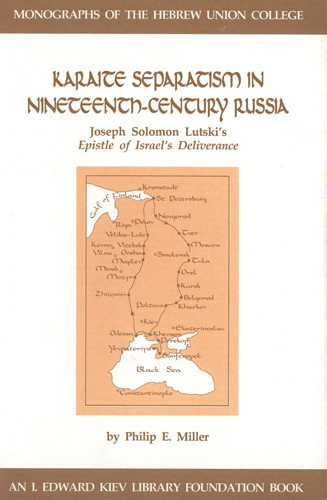 Karaite Separatism in Nineteenth-Century Russia
Joseph Solomon Lutski's Epistle of Israel's Deliverance
Volume 16


 Remember Amalek!
Vengeance, Zealotry, and Group Destruction in the Bible according to Philo, Pseudo-Philo, and Josephus
Volume 31


Similar Books



 Ars Prophetica
Theology in the Poetry of Twentieth-Century Hebrew Poets Avraham Halfi, Shin Shalom, Amir Gilboa, and T. Carmi


 Cahiers de l’Association internationale des études françaises
J. M. G. Le Clézio - Enseigner les littératures francophones aujourd’hui - Récit de soi et expérience de l’illusion (XVIIe-XVIIIe siècles)
Volume 78
 Cahiers de littérature française
Les Métamorphoses du texte. Enjeux intertextuels et transpositions visuelles
Volume 25
 Cahiers de recherches médiévales et humanistes – Journal of Medieval and Humanistic Studies
Volume 51
 Cahiers de sémiotique des cultures
Ponctuation et sens. Nouvelles perspectives / Punctuation and meaning. New perspectives
Volume 6


 CompLit
Myth, Folklore and Magic in European Literatures. Critical and Contemporary Reconfigurations


 Dis/United States of Vulnerability
Literary and Cultural Transgressions in U.S. Poetry Since the 1960s
Volume 330


 European Drama and Performance Studies
Dramatisations politiques. Théâtre, politique et idéologie au XIXe siècle (1806-1914)
Volume 27


 La Lettre clandestine
La littérature philosophique clandestine, ses éditeurs et ses éditions
Volume 34


 La Revue des lettres modernes
« Afin que rien ne meure ». Le deuil dans et de l’œuvre de Marguerite Duras
Volume 9