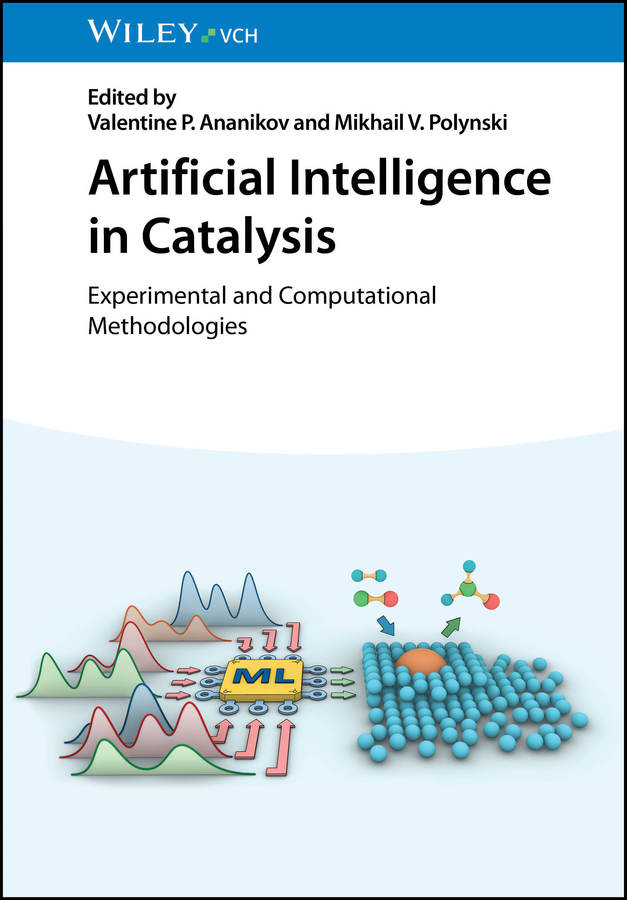
Artificial Intelligence in Catalysis
Experimental and Computational Methodologies
Edited by Valentine P. Ananikov Edited by Mikhail V. Polynski
Hardback (Published)
(August 2025)
ISBN: 9783527353859
6.69 x 9.65 inches
Price: $174.00
On back order
Aimed at enhancing catalyst design and optimizing chemical processes by using machine learning techniques, the book is a must-have for researchers in academia and industry interested in developing new catalysts, improving organic synthesis, and minimizing waste and energy use.
PART 1. MACHINE LEARNING APPLICATIONS IN STRUCTURAL ANALYSIS AND REACTION MONITORING
1) Computer Vision in Chemical Reaction Monitoring and Analysis
2) Machine Learning Meets Mass Spectrometry: a Focused Perspective
3) Application of Artificial Neural Networks in Analysis of Microscopy Data
PART 2. QUANTUM CHEMICAL METHODS MEET MACHINE LEARNING
4) Construction of Training Datasets for Chemical Reactivity Prediction Through Computational Means
5)Machine Learned Force Fields: Fundamentals, its Reach, and Challenges
PART 3. CATALYST OPTIMIZATION AND DISCOVERY WITH MACHINE LEARNING
6) Optimization of Catalysts using Computational Chemistry, Machine Learning, and Cheminformatics
7) Predicting Reactivity with Machine Learning
8) Predicting Selectivity in Asymmetric Catalysis with Machine Learning
9) Artificial Intelligence-assisted Heterogeneous Catalyst Design, Discovery, and Synthesis Utilizing Experimental Data
Valentine P. Ananikov is a Professor and Laboratory Head at the Zelinsky Institute of Organic Chemistry at the Russian Academy of Sciences in Moscow, Russia. His research interests are focused on the development of new concepts in transition metal and nanoparticle catalysis, sustainable organic synthesis, and new methodologies for mechanistic studies of complex chemical transformations.
Mikhail V. Polynski is a Senior Research Fellow at the National University of Singapore. His current research focuses on the automation of computational chemistry, machine learning for chemical applications, Born-Oppenheimer molecular dynamics modeling, and the theory of catalysis.
- Edited by Valentine P. Ananikov
- Edited by Mikhail V. Polynski
Similar Books




 Diagnostic Techniques in Public Health
Analytical and Chemometric Approaches in Disease Detection and Management









 Medicinal Chemistry of Plant-Derived Natural Products
A Chemical Exploration of Plants as a Source of Modern Drugs