
An Iron Age Settlement and Roman Complex Farmstead at Brackmills, Northampton
By (author) Chris Chinnock

Paperback (Published)
(December 2023)
ISBN: 9781803276861
8.07 x 11.42 inches
Price: $90.00
On back order
MOLA undertook archaeological excavations at Brackmills, Northampton, investigating part of a large Iron Age settlement and Roman complex farmstead. The remains were very well preserved having, in places, been shielded from later truncaton by colluvial deposits. Earlier remains included a late Bronze Age/early Iron Age pit alignment.
MOLA (Museum of London Archaeology) undertook archaeological excavations at Brackmills, Northampton, investigatng part of a large Iron Age settlement and Roman complex farmstead. The remains were very well preserved having, in places, been shielded from later truncaton by colluvial deposits. Earlier remains included a late Bronze Age/early Iron Age pit alignment. The main focus of occupation spanned the middle Iron Age to the late 4th century/early 5th century AD. The initial late middle Iron Age enclosed farmstead was defined by a series of enclosures and boundary features. From the late Iron Age the core of the settlement shifted and the range of activity increased dramatically, both in complexity and density through the 1st and 2nd centuries AD. The pottery assemblage associated with the beginning of this development is dominated by utilitarian jars with no clear evidence of higher status activity. Two well preserved pottery kilns date from this period, adding to our understanding of local pottery traditions. Funerary evidence for this period was limited to two late Iron Age/early Roman crouched inhumations, and a small assemblage of disarticulated human bone. By the second century the settlement had developed further, and a well-constructed road surface had been laid, leading to the stone roundhouses at the core of the settlement. The re-establishment or expansion of the farmstead with stone rectangular buildings in the late 3rd to 4th century AD marks a clear shift in the status of the site. Industrial remains included a drying oven. Of note for a rural site were 17 inhumation burials and a single cremation burial. Following the decline of the settlement, there was only a short reoccupation when there was a single sunken featured building. Later the site became part of an open field system in the medieval period.
Chapter 1: Introduction
Chapter 2: Research objectives
Chapter 3: Phasing and chronological framework
Chapter 4: The excavation results
Chapter 5: The finds
Chapter 6: The Human Remains
Chapter 7: The faunal and environmental evidence
Chapter 8: Discussion
Abbreviations and references
Bibliography
Appendices
,
Chapter 1: Introduction
Chapter 2: Research objectives
Chapter 3: Phasing and chronological framework
Chapter 4: The excavation results
Chapter 5: The finds
Chapter 6: The Human Remains
Chapter 7: The faunal and environmental evidence
Chapter 8: Discussion
Abbreviations and references
Bibliography
Appendices
- By (author) Chris Chinnock
Similar Books


 Caesar’s Visions and Impact on the Roman Empire
Revisiting the Archaeological and Historical Record of the 40s BC
Volume 2


 Etruscan and Roman Hellenistic Anatomical ex votos
Reassessing Popular Religious Expressions in Central Italy
Volume 8


 Invisible Labour in Antiquity
Visualizing Obscure Work in the Ancient Mediterannean and West Asia
Volume 1
 Late Antique villae in the Balkans (3rd–7th c. AD): Current Research Questions and Perspectives
HAEMUS Companion to the Late Antique Balkans 1
Volume 4
 Making and Meaning in the Bronze and Iron Ages
Chronology, Landscapes and Societies across Europe. Proceedings from the METALAGES2024 Colloquium (Florence, 23 October 2024)


 Portraying the Individual in the Roman East
Local–Imperial Entanglements in Sculpture, Mosaics, and Paintings (First–Fourth Centuries AD)
Volume 18


 Small Worlds and Relational Agencies: Local Societies in Early Medieval Iberia
Pequeños mundos y Agencias relacionales: Sociedades locales altomedievales en la Península Ibérica


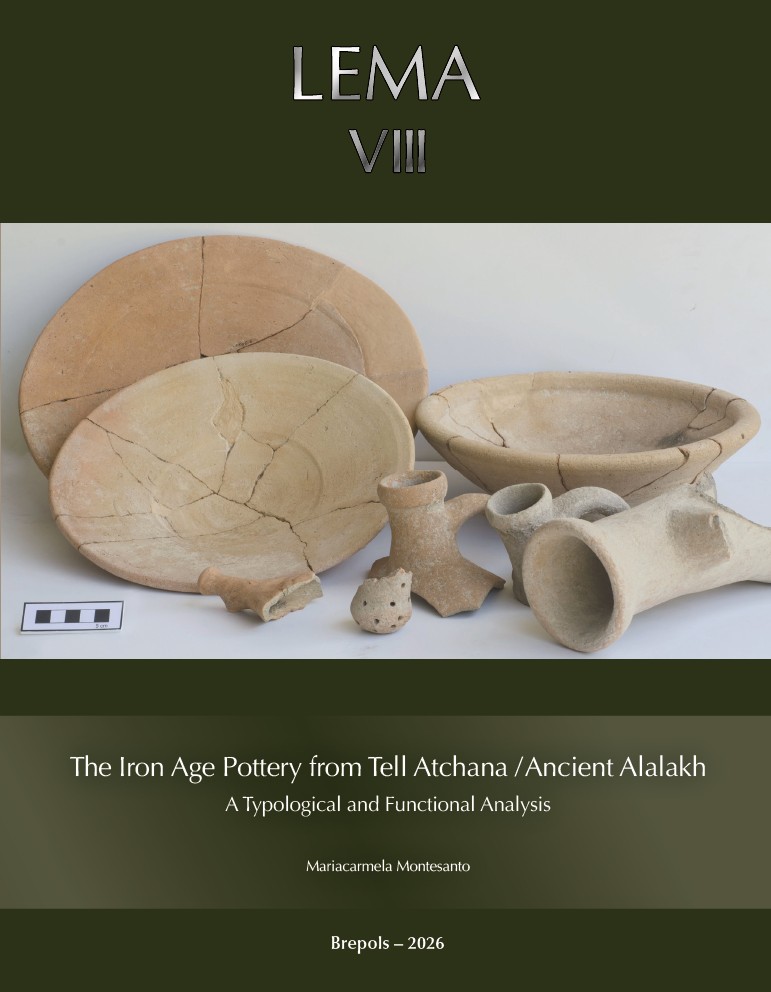 The Iron Age Pottery from Tell Atchana / Ancient Alalakh
A Typological and Functional Analysis
Volume 8

 Writing in the Church of the Nativity in Bethlehem
Inscription and Graffiti in a Multilingual and Multigraphic Perspective
Volume 45


 Atlante tematico di topografia antica 36-2026
Urbanistica e monumenti, porti, Roma. Ricerche sui monti Aurunci
Volume 36
 Cerámica común romana y ciclo haliéutico
Análisis de los contextos de las cetariae de Iulia Traducta

 Nuove scoperte e progressi nelle metodologie di rilievo e analisi dell’arte rupestre post-paleolitica in Italia
New discoveries and progress in the tracing and analysis methodologies of the post-Paleolithic rock art in Italy


 A Dramatic Event in Late Roman Florence
The Anomalous Burial Site Discovered beneath the Uffizi Gallery

 Alexander the Great and the Campaign of Gaugamela
New Research on Topography and Chronology. IAMNI 1 (Italian Archaeological Mission to Northern Iraq)
Volume 53