
A Primer on Chiefs and Chiefdoms
by Timothy Earle
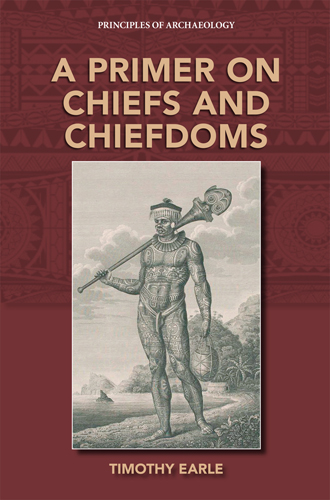
Chiefs are political operatives who hold titles of leadership over groups larger than intimate kin-based communities. Although they rule with the consent of their group, they are all about building personal power and respect. Many scholars have viewed chiefs as problem solvers–defending groups against aggressors, resolving disputes, providing support under hardship, organizing labor for community projects, and redistributing goods among those in need. Chiefs do these things, but much of what chiefs do is accumulate benefits for themselves, staying in power and legitimizing control. Anthropological archaeology is well suited to pursue the study of chiefs, their leadership institutions (chiefdoms), and long-term historical processes. The author argues that studying chiefdoms is essential to understanding the role of elemental powers in social evolution. As an illustration, he studies chiefs and their power strategies in historically independent prehistoric and traditional societies and discusses how they continue to exist as powerful actors within modern states.
Chiefs are political operatives who hold titles of leadership over groups larger than intimate kin-based communities. Although they rule with the consent of their group, they are all about building personal power and respect. Many scholars have viewed chiefs as problem solvers–defending groups against aggressors, resolving disputes, providing support under hardship, organizing labor for community projects, and redistributing goods among those in need. Chiefs do these things, but much of what chiefs do is accumulate benefits for themselves, staying in power and legitimizing control. Anthropological archaeology is well suited to pursue the study of chiefs, their leadership institutions (chiefdoms), and long-term historical processes. The author argues that studying chiefdoms is essential to understanding the role of elemental powers in social evolution. As an illustration, he studies chiefs and their power strategies in historically independent prehistoric and traditional societies and discusses how they continue to exist as powerful actors within modern states.
- By (author) Timothy Earle
"Earle has spent a career studying chiefdoms-the dominant form of human organization in the Holocene-and masterfully brings together his lifetime of work on the political, economic, and ideological relationships in these precursors to modern states. This book is a foremost example of understanding power in traditional and modern societies." Charles S. Stanish, University of South Florida
—
"Recommended. Advanced undergraduates through faculty." --CHOICE, March 2022
—
". . . if you are interested in the social, political, and ideological engines that drive the creation of complex societies, you need to have Earle's Primer on Chiefs on your library shelf." Emerson, Thomas E., MCJA Book Reviews Volume 46, 2021
—
"Earle expertly summarizes a career's worth of knowledge on the political and economic underpinnings of early complex societies. . . . as a primer on current social evolutionary thinking it is a highly accessible volume for interested scholars working in California, North America, and beyond." --Fauvelle, Mikael, Journal of California and Great Basin Anthropology u Vol. 41, No. 2 (2021)
—
"Given the scope and depth of Earle's work, this book can justifiably be described as a tour de force. . . . Earle's comprehensive and well-researched work should be considered essential reading for those inter- ested in understanding the processes that resulted in the advent of chiefdoms around the world." --Chacon, Richard J., Winthrop University, Latin American Antiquity, vol. 32, no. 4, 2021
—
"A synthetic tour de force for general readers. Earle navigates theoretically complex waters and makes good sense of the complex ethnographic and archaeological record that we call chiefdoms. The book is a unique blend of archaeology and political science-well crafted, reader-friendly, and inspiring." Brian Hayden, University of British Columbia
—
"Earle distills everything he has learned about chiefs and chiefdoms in human history. Students of anthropology and archaeology-and just anyone wishing to understand political relations-can learn about how power and rulers emerged and were controlled. His argument is relevant today and will be into the future. Highly recommended." Kristian Kristiansen, University of Gothenburg
—
Other Titles in this Series



Similar Books


 Archaeological Excavations at Irmis Rka: An Investigation of a Multi-Layered Settlement in Southwest Georgia
Results from the 2020 Season: Early Bronze Age to Medieval Occupations
 As Messianism Turns to Heresy
The Regenstein Chair Lectures On Lurianic Kabbalah and Shabbatai Tzevi at Hebrew Union College - Cincinnati


 Beyond Sovereign Courts
Agents and Practices in Early Modern Spanish and Habsburg Diplomacy
Volume 3


 Catuvellaunia and Rome: Economic and Political Relations during the Final Decades Pre-conquest
The Role of Grain from Southeastern Britain and Its Potential for Maintenance of the Roman Military along the Frontier on the Rhine


 Colour Concept “Secoli bui” a colori
Codici cromatici e architetture dipinte nell’età tardoantica e medievale

 Creating the Woman in Antiquity
Proceedings of the 16th Melammu Workshop, Innsbruck, 2–3 June 2022
Volume 13

 Crossing Disciplines in the Study of Archaeology and Prehistoric Art: Insights from the Sahara and Mediterranean Africa
Proceedings of the XX UISPP World Congress (5–9 September 2023, Timișoara, Romania) Volume / Session 18
 Cuneiform Artefacts from Archaeological Contexts: New Research on Ancient Iraq
Proceedings of a Conference Held at the Bavarian Academy of Sciences and Humanities, July 4–5, 2024
Volume 2




 ENTANGLED AFRICA
Intra-African Relations Between Rain Forest and Mediterranean from Around 4,000 BCE to 1,500 CE



 Exploring Prehistoric Pottery in Japan
A Study of Organic Inclusions, Adhering Materials, and Impressions of Woven Items

 Food Security under Armed Conflict
Global Knowledge Landscape and Public Attention to Social, Economic, and Humanitarian Dimensions

