
A Narrative Theology of the New Testament
Exploring the Metanarrative of Exile and Restoration
by Timo Eskola

Focusing on the metanarrative of exile and restoration Timo Eskola claims that a post-liberal, narrative New Testament theology is both consistent and explanative. Combining a post-New Quest perspective on Jesus with an eschatological reading of Paul, the author states that Jesus’ temple criticism aims at restoration eschatology. Jesus starts a priestly community that expects God’s jubilee to begin with Jesus’ work, and proceed with the preaching of the new gospel.
Focusing on the metanarrative of exile and restoration Timo Eskola claims that a post-liberal, narrative New Testament theology is both consistent and explanative. Combining a post-New Quest perspective on Jesus with an eschatological reading of Paul, the author states that Jesus’ temple criticism aims at restoration eschatology. Jesus starts a priestly community that expects God’s jubilee to begin with Jesus’ work, and proceed with the preaching of the new gospel. The reception of this message in the post-Easter church results in resurrection Christology that proclaims Jesus’ Davidic kingship on God’s throne of glory. Both Paul and Jewish Christian teachers later present Christ’s community as a new temple where believers serve the Lord as priests of the new covenant. Furthermore, restoration eschatology provides a new basis for understanding Paul’s contrast with the words of the law, and his teaching of justification.
- By (author) Timo Eskola
"A Narrative Theology of the New Testament has the potential to generate helpful and meaningful conversations not only about the temple motif and the exile and restoration eschatology but also about narrative methodology, intertextuality, the theological content and formation of Jesus's teaching and message, its relation to the Old Testament and Second Temple writings, and its appropriation by the early Christian theologians." --Abson Joseph, Indiana Wesleyan University, Review of Biblical Literature 8.3.2017
—
Other Titles in this Series


 Le Jour de Dieu – Der Tag Gottes
5. Symposium Strasbourg, Tubingen, Uppsala. 11.-13. September 2006 in Uppsala
Volume 245
 Paul and the Imperial Authorities at Thessalonica and Rome
A Study in the Conflict of Ideology
Volume 273
 Doing Gender – Doing Religion
Fallstudien zur Intersektionalitat im fruhen Judentum, Christentum und Islam
Volume 302
 Reading the First Century
On Reading Josephus and Studying Jewish History of the First Century
Volume 300

 Semitisms in Luke’s Greek
A Descriptive Analysis of Lexical and Syntactical Domains of Semitic Language Influence in Luke's Gospel
Volume 401

 Eine Jesus-Vita aus flavischer Zeit
Das Markusevangelium im narratologischen Vergleich mit den Biographien Plutarchs
Volume 480
 Ptolemaeus Gnosticus?
Untersuchungen zur Valentinianischen Gnosis II mit einem Kommentar zu dem Brief des Ptolemaeus an Flora und seiner Kommentierung bei Epiphanius von Salamis
Volume 512


 Epochs and Styles
Selected Writings on the New Testament, Greek Language and Greek Culture in the Post-Classical Era
Volume 179


 The Canon and Beyond
Collected Essays on the History and Hermeneutics of Biblical and Parabiblical Traditions

 Der Adammythos bei Paulus und im hellenistischen Judentum Jerusalems
Eine theologische und religionsgeschichtliche Studie zu Römer 7,7-25
Similar Books


 Athanasius of Alexandria, Epistula ad episcopos Aegypti et Libyae
Old Slavonic Version and English Translation
Volume 261


 Cyril of Alexandria’s Christological Exegesis
Explorations of Partitive Exegesis in the Dialogues on the Trinity
Volume 70


 Epiphanies of the Divine in the Septuagint and the New Testament
Fifth International Symposium of the Corpus Judaeo-Hellenisticum Novi Testamenti (CJHNT), 14-17 May 2015, Nottingham

 Extracanonical Traditions and the Holy Land
Texts, Rituals, and Material Culture in Late Antique Palestine
 From Joseph to Jesus
The Joseph Narrative as a Compositional Template from Old Greek Esther to the Gospel of Luke
Volume 125


 Paradise Lost in Transmission
The Return to Eden in the Apocalypse of Peter within Its Ethiopic and Early Christian Contexts



 Punning in Odd or Elegant Constructions in Jeremiah
The Convergence of Linguistics, Rhetoric, and Textuality in the Hebrew Text of Jeremiah

 Shame in the Worlds of the Hebrew Bible and Akkadian Texts
A Linguistic Study and Its Implications
Volume 33

 Tabernacle, Table, Ark, and Text
Richard of Saint Victor on the Interpretation of Scripture
Volume 67
 The Anglo-Norman Bible’s Books of Kings, a Critical Edition
(BL Royal 1 C III, fols 234r-274v)
Volume 37
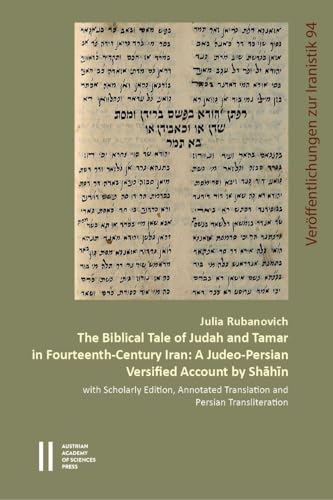 The Biblical Tale of Judah and Tamar in Fourteenth-Century Iran
A Judeo-Persian Versified Account by Shāhīn with Scholarly Edition, Annotated Translation and Persian Transliteration
Volume 94, 951
 The Body
Lived, Cultured, Adorned: Essays on Dress and the Body in the Bible and Ancient Near East in Honor of Nili S. Fox

 The Compositional History of the Book of Kings
An Analysis of the Evaluative Frameworks in 1 Kings 14–2 Kings 25
 The Discourse of Rites
Shaping and Reshaping the (Counter-)Priestly Rituals Conducted Outside the Tabernacle


