
79 Stories about Pompeii. That no one ever told you …
by Lara Anniboletti

Paperback (Published)
(May 2018)
ISBN: 9788891316547
8.27 x 9.45 inches
Price: $43.00
In stock
Pompeii. a 2000-year old city frozen in time one famous day during the late summer of 79 AD, is full of monuments that have ignited the passion of ancient art experts for over 200 years, but also that of travellers, fascinated by the uniqueness of this city in a country already unparalleled historically in the rest of the world. But this is not all that Pompeii offers. First and foremost, it is a city full of stories about people from thousands of years ago who worked, loved, played, ate, were politicians, traders, hated each other, and stole from each other … This book contains 79 unusual stories that reveal the magic of the pulsating life and interesting facts that made up the daily life of the inhabitants who lived there. At times, it was a long way off from the habits of our time and at other times, it was surprisingly similar – they are stories that transport us to a distant world, a world that otherwise would have been lost forever.
Pompeii. a 2000-year old city frozen in time one famous day during the late summer of 79 AD, is full of monuments that have ignited the passion of ancient art experts for over 200 years, but also that of travellers, fascinated by the uniqueness of this city in a country already unparalleled historically in the rest of the world. But this is not all that Pompeii offers. First and foremost, it is a city full of stories about people from thousands of years ago who worked, loved, played, ate, were politicians, traders, hated each other, and stole from each other … This book contains 79 unusual stories that reveal the magic of the pulsating life and interesting facts that made up the daily life of the inhabitants who lived there. At times, it was a long way off from the habits of our time and at other times, it was surprisingly similar – they are stories that transport us to a distant world, a world that otherwise would have been lost forever.
Introduction by Massimo Osanna 1. What was Vesuvius like before the eruption? 2. What happened afterwards? 3. A strange news story from ancient times 4. Domenico Fontana's cover-up of Pompeii 5. Strange coincidences at Pompeii: August 24th 6. The earthquake of 62AD: a "photo" of the time 7. Who were the victims of the eruption that destroyed Pompeii? 8. Lover's gossip on the walls of Pompeii 9. The Amphitheater of Pompeii: were there really fights between animals and beasts? 10. Pompeii during an election campaign 11. Clashes between Pompeiian and Nucerian Fans 12. A Pompeiian banker: Lucius Caecilius Jucundus 13. A clever entrepreneur: the perfumer of Pompeii 14. Lets have lunch at the thermopolium of Lucius Vetutius Placidus! 15. Profane love at Pompeii... 16. After work... lets all go to the baths! 17. Gladiators at Pompeii: morituri te salutant? (We, who are about to die, salute you?) 18. Pink Floyd: Live at Pompeii 19. Mensa Ponderaria and Public Washrooms in the Forum of Pompeii: signs of civilization!!! 20. The lanista of Pompeii 21. "Pleasure baths" at Pompeii 22. The Large Theater 23. A Sator Square: were there Christians at Pompeii? 24. Pompeii: Vine Leaves are back, Human Life is back! 25. Today, December 17th at Pompeii 26. Isis: the crying goddess 27. The jeweled matron and the gladiator 28. A walk along Via dell'Abbondanza on a Saturday 29. Cave canem (Beware of the dog)!!! 30. Priestess Eumachia 31. Inside Salvius Caupona (tavern): gambling in Pompeii 32. The last war of Pompeii 33. The last baked goods from Modesto's bakery 34. Castellum Aquae in Pompeii: the story of Marcus Attilius Primus 35. A normal working day in Pompeii 36. The guard at Porta Ercolano 37. The fullonica (fullery) of L. Veranius Hypsaeus 38. Naevoleia Tyche and Munatius Faustus: a Pompeiian love story 39. Pompeii and peplum-movies (sword-and-sandal) 40. What was there to eat in Pompeii? 41. Empress Poppaea Sabina at Pompeii 42. Selling shoes 43. House of the Sarno Lararium 44. Aulus Umbricius Scaurus: garum manufacturer 45. Why did Pompeii need a smaller theater? . 46. Numerius Popidius Celsinus and Isis 47. "I wouldn't sell my husband for all the gold in the world" 48. A day at the Macellum (market) of Pompeii 49. A Pompeiian column in Japan 50. The textile workshop of Marcus Vecilius Verecundus 51. The ship Europa 52. Women in Pompeii 53. Was Pulcinella at the Theater of Pompeii? 54. Where did Pompeiian children go to school? 55. Ancient VIPs at Pompeii 56. What did the Pompeiians look like? 57. Giuseppe Garibaldi in Pompeii 58. The tomb of Caius Vestorius Priscus 59. Publius Cornelius Faventinus, the tonsor (barber) 60. Why were Pompeiian house given names? 61. Two stories told in graffiti: one of Successus, Iris and Severus and the other of Novellia Primigenia 62. Fashionable Pompeii 63. Arria Marcella, a heroine from the Romantic era 64. Pompeiian fortifications 65. Pistrina (bakeries) in Pompeii 66. Asellina 67. Water fountains 68. Julia Felix 69. Scribbles, drawings and caricatures 70. Doctors in Pompeii 71. Marcus Nonius Campanus 72. At the House of Quintus Poppaeus Secundus 73. Of love, death, and other nonsense 74. Marcus Epidius Sabinus, juris doctor (doctor of law) 75. The House of Casca Longus 76. The House of the Vettii 77. Marcus Epidius Hymenaeus, the Moralist 78. Pious, modest, frugal, and chaste... 79. "Quota hora est?" What time is it?
- By (author) Lara Anniboletti
Other Titles in this Series


Similar Books

 Caesar’s Visions and Impact on the Roman Empire
Revisiting the Archaeological and Historical Record of the 40s BC
Volume 2


 Drunk the Potion, No Whit Charmed
The Doctrine of Pure and Perfect Souls from Iamblichus to Damascius

 Epiphanies of the Divine in the Septuagint and the New Testament
Fifth International Symposium of the Corpus Judaeo-Hellenisticum Novi Testamenti (CJHNT), 14-17 May 2015, Nottingham


 Etruscan and Roman Hellenistic Anatomical ex votos
Reassessing Popular Religious Expressions in Central Italy
Volume 8



 Invisible Labour in Antiquity
Visualizing Obscure Work in the Ancient Mediterannean and West Asia
Volume 1
 Language and Power in the Roman Empire and Early India
Hierarchy, Ambiguity, and the Art of Reading the Signs in Cosmopolitan Cultures
 Late Antique villae in the Balkans (3rd–7th c. AD): Current Research Questions and Perspectives
HAEMUS Companion to the Late Antique Balkans 1
Volume 4

 Nurturing the Elite
Representations of Drinking, Eating, and Religious Vessels in Palmyrene Funerary Iconography
Volume 13


 Portraying the Individual in the Roman East
Local–Imperial Entanglements in Sculpture, Mosaics, and Paintings (First–Fourth Centuries AD)
Volume 18

 Small Worlds and Relational Agencies: Local Societies in Early Medieval Iberia
Pequeños mundos y Agencias relacionales: Sociedades locales altomedievales en la Península Ibérica
 The Compositional History of the Book of Kings
An Analysis of the Evaluative Frameworks in 1 Kings 14–2 Kings 25

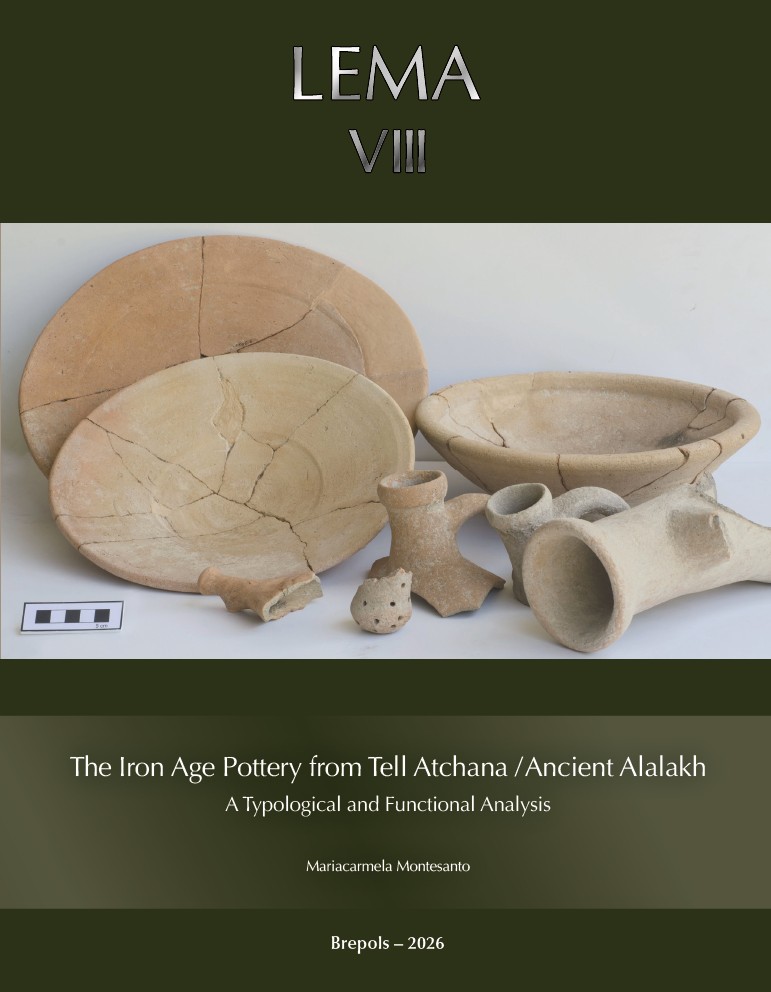 The Iron Age Pottery from Tell Atchana / Ancient Alalakh
A Typological and Functional Analysis
Volume 8

 Writing in the Church of the Nativity in Bethlehem
Inscription and Graffiti in a Multilingual and Multigraphic Perspective
Volume 45
 Contesting Labeled Identities
The Sociology of Gentilics in Biblical and Northwest Semitic Literature


 After Life in Roman Paganism. L’Égypte des astrologues. Les Mages hellénisés
Introductions historiographiques
Volume 7

 Atlante tematico di topografia antica 36-2026
Urbanistica e monumenti, porti, Roma. Ricerche sui monti Aurunci
Volume 36
 Cerámica común romana y ciclo haliéutico
Análisis de los contextos de las cetariae de Iulia Traducta


 Diodor über den ersten Sklavenaufstand auf Sizilien
Ein philologischer und historischer Kommentar
Volume 67