
The Astynomoi Law from Pergamon
A New Commentary
By (author) Sara Saba
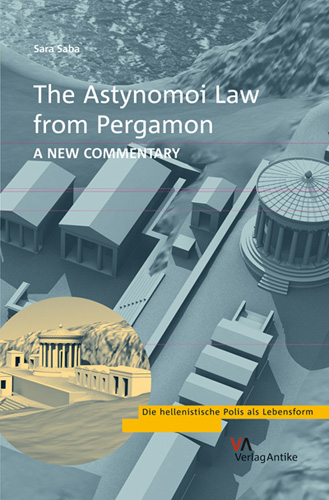
Hardback (Published)
(February 2013)
ISBN: 9783938032534
6.34 x 9.33 inches
Price: $82.00
In stock
This monograph is a new commentary on the famous epigraphic document known as the Astynomoi Law from Pergamon. In 1953/4 G. Klaffenbach published his excellent philological commentary on this prostagma and now, after six decades of archaeological and epigraphic discoveries a fresh, thorough study of it is needed. The monograph is divided into two parts: the first analyses the text line by line, the second focuses instead on the officials called astynomoi in a study of evidence from the entire Greek World which allows us to reassess their role and standing in city administration. Over decades scholars have tended to assume that the duties testified for the Athenian astynomoi were a template for those of the homonymous officials in all the other Greek communities. Only a complete reviewing of all now available evidence can reveal whether their tasks were universally identical or not.
Sara Saba is a lecturer in the History Department of the LMU of Munich. Her main interests are political and institutional history in the Hellenistic period and epigraphy.
- By (author) Sara Saba
"Historians of the Attalid kingdom and of the institutions of the ancient Greek city will find much of use in this book (...)." Peter Thonemann, sehepunkte 13 (2013), Nr. 5 "Una nuova analisi e commento del testo epigrafico della legge di Pergamo sugli astynomoi, pubblicata da Gunther Klaffenbach negli anni cinquanta del Novecento, con un approfondimento del ruolo degli astynomoi nel mondo greco e di magistrati con funzioni equivalenti e un'appendice conclusiva sull'Astynomikos Monobiblos contenuto nei Digesta giustinianei, in D. 43.10.1." Fabiana Tuccillo, Index. Quaderni camerti di studi romanistici, 42 (2014)
—
Other Titles in this Series

 Das Xanthostal Lykiens in archaisch-klassischer Zeit
Eine archaologisch-historische Bestandsaufnahme
Volume 7

Similar Books


 Contesting Labeled Identities
The Sociology of Gentilics in Biblical and Northwest Semitic Literature

 Drunk the Potion, No Whit Charmed
The Doctrine of Pure and Perfect Souls from Iamblichus to Damascius

 Epigraphic “Shades” from Hellenistic Thrace
Contextualizing Inscriptions in Greek from Thracian Tombs

 Epiphanies of the Divine in the Septuagint and the New Testament
Fifth International Symposium of the Corpus Judaeo-Hellenisticum Novi Testamenti (CJHNT), 14-17 May 2015, Nottingham


 Gold, Silver and Glass: Power Networks, Cultural Identities, Technology Transfers and Agency across the Old World (7th Century BC – 1st Century AD)
Proceedings of a Conference Held at the British Museum, 16–18 June 2023
 Language and Power in the Roman Empire and Early India
Hierarchy, Ambiguity, and the Art of Reading the Signs in Cosmopolitan Cultures
 Late Antique villae in the Balkans (3rd–7th c. AD): Current Research Questions and Perspectives
HAEMUS Companion to the Late Antique Balkans 1
Volume 4


 Nurturing the Elite
Representations of Drinking, Eating, and Religious Vessels in Palmyrene Funerary Iconography
Volume 13





 Roman Copies, Collecting, and Culture in the Bay of Naples and Beyond
Papers in Honor of Eugene J. Dwyer



 The Compositional History of the Book of Kings
An Analysis of the Evaluative Frameworks in 1 Kings 14–2 Kings 25




 Zooarchaeology of Ancient Greek Sanctuaries in Southwestern Sicily
Faunal Analysis from Selinus and Akragas as Evidence of Differences in the Treatment of Animals for Ritual Purposes