
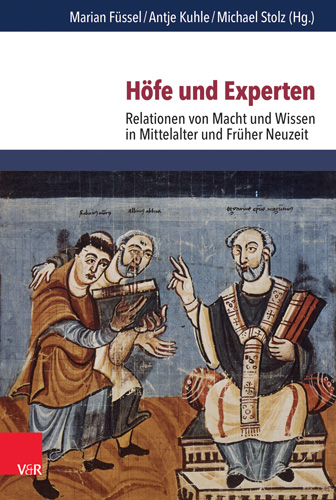
Höfe und Experten
Relationen von Macht und Wissen in Mittelalter und Früher Neuzeit
Contributions by Anna-Victoria Bognár Contributions by Benjamin Müsegades Contributions by Annette Caroline Cremer Contributions by Sabine Herrmann Contributions by Leonhard Horowski Contributions by Timo Reuvekamp-Felber Contributions by Gerrit Deutschländer Contributions by Jörg Bölling Edited by Marian Füssel Edited by Antje Kuhle Edited by Michael Stolz
Hardback (Published)
(March 2018)
ISBN: 9783525301234
6.34 x 9.33 inches
Price: $82.00
In stock
Wie wandelten sich höfische Expertenkulturen vom 12. bis 18. Jahrhundert?
English summary: In pre-modern societies, the Court constituted a complex space of power and knowledge. Expertise was important on several levels. In the beginning, the nobility took on the role of experts of their own world, which was shaped by the court, its rules, and the pan-European network of courtly society, which was expressed through practices such as the cavalier tour or institutions like the knight’s academies. The rulers themselves could appear as experts when they conducted themselves as generals, collectors, writers, or composers. As a center of cultural hegemony and courtly patronage, the court was also a magnet for non-aristocratic experts such as doctors, learned councillors, court artists, and alchemists. The presence, number, and quality of experts at court became a resource of a prestige economy, and played an important role in the competition between different courts. Against this background, the Court appears as a dynamic space for the production, consumption, and economization of knowledge, both in terms of longue duree and spatial expansion. How did courtly expert cultures change from the 12th to 18th centuries? How and where did new versions of the expert role emerge? This volume contributes to the courtly context of pre-modern expert cultures as well as to the clarification of the relation between court and knowledge. German description: Der Hof bildete in vormodernen Gesellschaften einen komplexen Macht- und Wissensraum. Expertise war dort auf mehreren Ebenen von Bedeutung. Zunachst nahm der Adel die Rolle von Experten der eigenen Lebenswelt ein, die durch den Hof, seine Spielregeln und die europaweite Vernetzung der hofischen Gesellschaft gepragt war, was u.a. in den Praktiken der Kavalierstour oder Bildungsinstitutionen wie den Ritterakademien Ausdruck fand. Der Furst selbst konnte als Experte auftreten, wenn er sich als Feldherr, Sammler, Literat oder Komponist inszenierte. Als Zentrum kultureller Hegemonie und hofischer Patronage war der Hof ferner Anziehungspunkt fur nichtadeliger Experten wie Arzte, gelehrte Raten, Hofkunstlern oder Alchemisten. Anwesenheit, Anzahl und Qualitat der Experten bei Hof wurden zu Ressourcen einer Prestigeokonomie, die im Wettstreit untereinander eine wichtige Rolle spielten. Fur die Experten bei Hof eroffneten sich damit die Chancen, sich zu erfolgreichen Wissensunternehmern zu entwickeln.Vor diesem Hintergrund tritt der Hof als dynamischer Raum der Produktion, Konsumtion und Okonomisierung von Wissen sowohl in der Perspektive der longue duree als auch raumlicher Ausdehnung in den Blick. Wie wandelten sich hofische Expertenkulturen vom 12. bis 18. Jahrhundert? Wie und wo entstanden neue Varianten der Expertenrolle? Der vorliegende Band leistet ebenso einen Beitrag zum hofischen Kontext von vormodernen Expertenkulturen wie zur Prazisierung der Relation von Hof und Wissen.
Prof. Dr. Marian Fussel hat den Lehrstuhl fur Fruhe Neuzeit unter besonderer Berucksichtigung der Wissensgeschichte an der Universitat Gottingen inne. Dr. Michael Stolz ist Professor fur Germanistische Mediavistik am Institut fur Germanistik der Universitat Bern. Antje Kuhle ist Wissenschaftliche Mitarbeiterin am Althistorischen Seminar der Georg-August-Universitat Gottingen
- Contributions by Anna-Victoria Bognár
- Contributions by Benjamin Müsegades
- Contributions by Annette Caroline Cremer
- Contributions by Sabine Herrmann
- Contributions by Leonhard Horowski
- Contributions by Timo Reuvekamp-Felber
- Contributions by Gerrit Deutschländer
- Contributions by Jörg Bölling
- Edited by Marian Füssel
- Edited by Antje Kuhle
- Edited by Michael Stolz
Similar Books
 «Solazoxa festa, stradolze e stracomplia»
Festschrift für Raymund Wilhelm zum 65. Geburtstag mit Beiträgen zu Diskurstraditionen und mittelalterlicher Philologie
Volume 249
 A Collaborative Tapestry in Honour of Shirley Ann Brown / Une fresque brodée en l’honneur de Shirley Ann Brown
The Bayeux Tapestry Seen by her Colleagues and Friends / La Tapisserie de Bayeux vue par ses collègues et amis



 Balthasar Caymox of Nuremberg
Early Modern German Print Publishers: Popular Prints of the Seventeenth Century

 Behind the Scenes of Medieval Roofs
An Overview of the Roofing Systems of Italian Churches
Volume 90

 Beyond Sovereign Courts
Agents and Practices in Early Modern Spanish and Habsburg Diplomacy
Volume 3

 Cahiers de recherches médiévales et humanistes – Journal of Medieval and Humanistic Studies
Volume 51

 Circulation, Use, Impact
The Consumption of Architectural Books in the Early Modern Eastern Adriatic
Volume 1


 Councils, Conflicts, Correspondence
Urban Diplomacy in Reval (Tallinn) and Lübeck (c. 1470–1570)
Volume 67





 Homo-Politicus in the Balkans
Early Modern Southeast European History in Imperial and Regional Context

 Innovation and Medieval Communities
The Circulation of Ideas and Practices in and out of the Town (1200-1500)
Volume 63
 Innovationes Lovanienses: Arts, Law and Theology at the University of Louvain (1425–1797)
Studium Lovaniense: Learning across Borders, 2
Volume 18
 John Dunstaple Reading Boethius
John Dunstaple’s Annotations to Boethius’s “De institutione musica” in the Manuscript Oxford, Corpus Christi College Library, MS 118
 Legal Visuality
Exegesis, Ambiguity, and Dissimulation of the Donation of Constantine in the Early Modern Period

 Medieval Debates on Foreknowledge: Future Contingents, Prophecy, and Divination
Acts of the XXVII Annual Colloquium of the SIEPM, Trento 12-15 September 2023
Volume 31

 Medieval Yeghegis, Armenia
History, Archaeology, Society. Local Multiplicities and Global Connections of a Rural Centre on the Silk Road(s)